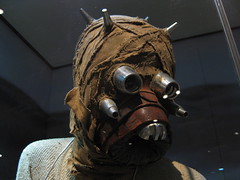
Spent a day of our recent vacation at the Minnesota Museum of Science’s Star Wars exhibit – the largest collection of actual Star Wars props and models ever assembled. Miles was jumping out of his skin with excitement, seeing actual/life-sized land speeders and battle droids, scaled down ship models used by ILM in various episodes, trying to pierce the veil of the Jawas. The exhibit took every opportunity to use the props as learning opps – we got to assemble our own maglev trains, program R2 units to negotiate an obstacle course, build support systems for robots capable of standing both on flat and sloped ground, and C3PO hosted a 15-minute live-action educational robot show… a nice combination of education and learning. Finished up the day by jumping to hyperspace in the cockpit of the Millennium Falcon, very convincing. If the lines between fact and fiction weren’t blurry enough before last week, they are now!
Booglarized
Three weeks ago, Amy came home to find a rear window of our house smashed, our house ransacked. Missing were my GPSr, a couple of digital cameras, a video camera, and two of Amy’s film cameras, including an old two-lens Mamiya and the Nikon FE2 she did her master’s thesis work on. Left behind, strangely, were a couple of Nerdz wrappers and an English class assignment to read two Shakespeare books this summer. We were sure the heist was done by some local high school kids. El Cerrito police dusted for fingerprints, took a report, and that was that. We never expected to get anything back, and started the insurance process.
A few days later, I realized my checkbook had also been stolen. Immediately checked my online banking and found that, sure enough, a check had been cashed, my signature forged. Since Wells Fargo showed a clear scan of the thief’s name and writing, I forwarded it to the police and called the bank to find out where and when it was cashed. The cop was then able to obtain surveillance footage of the actual “guy” from the ATM where it happened. Wow – a break! But then, two weeks of nothing.
Yesterday, got a call from the PD informing us that they had obtained a warrant, searched the perp’s house, and retrieved Amy’s two film cameras. Interesting that analog gear was the only stuff “he” couldn’t fence. And there was an extra twist – the perp was apparently a very large black transsexual in the midst of hormone treatments, now in custody. Life is so weird.
This morning we traipsed down to the department so Amy could I.D. the two cameras and Miles could get his first jail cell tour (pix of him behind bars unfortunately didn’t work out). But I did get a good shot of the inside of a drunk tank (complete with floors you can hose down in the morning). And of Amy walking out of the department, jubilant with her much-loved film cameras.
Just amazed we got anything back at all. Huge props to the El Cerrito PD for following up so thoroughly, and for caring!

ALIPR Captchas
Captchas are so 2007. There are enough good captcha-breaking bots in the wild now that they’re pushing 10-15% success rates at decoding images, and can generate a new attempt every six seconds. Mail systems at Yahoo!, GMail and Hotmail all have been cracked in the past year. And Google’s Blogger service is under seige from spambots creating hundreds of thousands of splogs without human interaction — and they’re doing it through automated captcha cracking.
A new visual authentication system called IMAGINATION, from Penn State’s ALIPR (Automatic Linguistic Indexing of Pictures) program, takes a very different approach. Working with random images rather than characters means the pool of possibilities is not finite (image recognition is far more difficult than character recognition). And the two-part process refines the human requirement further: Find a center, then describe.
But while traditional captchas have had problems with accessibility, ALIPR is going to be completely off-limits to the blind. Oh, and it takes up a whole screen, rather than a few hundred pixels2. That sounds like a deal-breaker right there. Or at least a deal-breaker until we get so fed up with being cracked that interaction designers are willing to give up an entire page to make it stop.
Once you solve the captcha, the site invites you to throw your best bot at it. I’m thinking maybe five years before the bots crack this one.
Twitter Found My Phone
Amazing… just took a break from the all-day Journalism and Databases session we’re running, checked for recent Tweets, and there was one apparently from myself:
Hi.i found this phone.could you tell me how to find the owner..
A few Tweets later, messages from Xian Crumlish, Michael Fitzhugh, and Dylan Tweney, pointing me to the source. A block walk and I had the phone again (which I hadn’t even realized was missing until Twitter told me). Thanks so much Good Samaritan Silje for having the brilliance to check my address book and send an SMS Tweet as me, and to alla y’all for helping to track it down.
Xian’s book title is spot on: The Power of Many.
Update: Whoa! This little dance just got covered on Wired.com’s blog (by Tweney).
Tech Training for Reporters
Another big week of podcasting coming up as we (the Knight Digital Media Center at UC Berkeley) launch a week of training for working journalists in “new media / digital media” internet technologies. This week will be a variant of last month’s workshop – we’ll be working with reporters rather than editors this time around, and tuning the training to suit. As always, the workshop will be peppered with panels and conversations with fascinating experts, and those sessions are open to the public.
Can’t make it to the J-School? Tune in to the podcast series live, or catch archived versions the following week. I’m especially interested in “100 Megabits across the Digital Divide,” with Brewster Kahle of the Internet Archive, but all of the sessions are bound to be worthwhile.
Knight Digital Media Center April 2008 Lecture Series
Cal Day 2008
Miles and I had a great time yesterday at Cal Day, UC Berkeley’s campus-wide open house. Miles got to play with a 15 foot python, had cockroaches and stick bugs walking all over him, went fishing for lizards (I remember when my brother and I used to make lizard fishing poles out of car antennas and fishing line), watched his own voice dance on the screen of an oscilloscope, experimented with the Bernoulli principle (a ball floating on a column of air), experienced his first drinking bird, created a miniature earthquake, built an Indian boli, and almost got conked by the physics experiment below – I turned around to get my camera out of its bag and heard a clunk and some gasps – he had been pulling on the steel balls and the whole thing came off the table and wound up around his neck! Fast reactions – he caught the frame with his hands.
Afterwards, went to a musical performance of The Emperor Has No Clothes at the historic Julia Morgan Theater.
Audio Post from Misty Mountain Hop
Went for a hike, but ended up mountain biking up Schmidt Lane with slick tires.
Don’t Walk Away in Silence
Note: Despite the date, this is not an April Fool’s post. Can’t believe I have to say that.
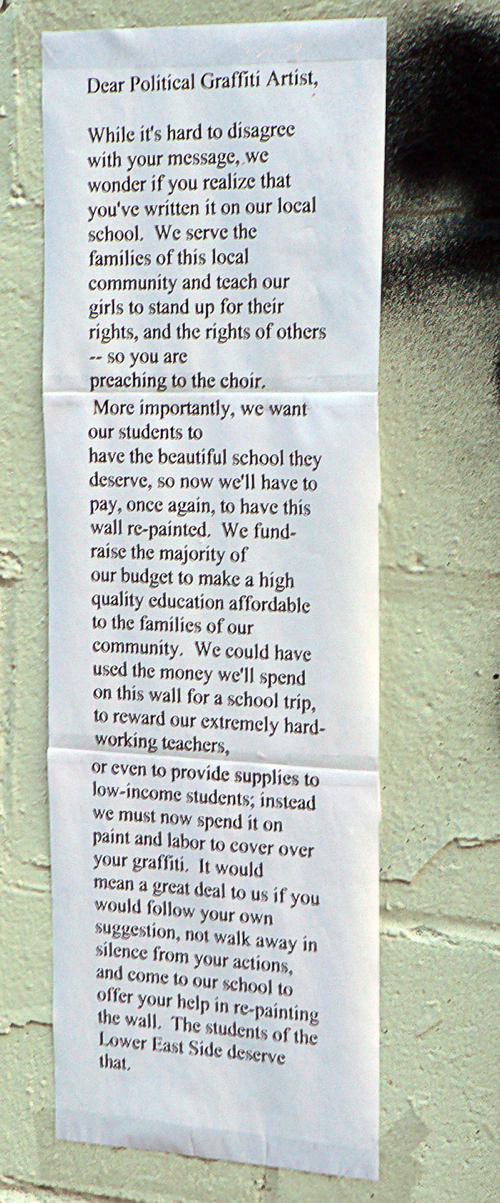
“Don’t walk away in silence,” someone spray spraypainted on the wall of a girls school on the lower east side, New York. The school painted over it, of course, and left this note in its place:

The school turned the episode into a teachable moment. “It really gave us a chance to engage in a dialogue with our students.”
via GammaBlog
The Science of Sleep
60 Minutes, The Science of Sleep — We’re sleeping less than ever:
In 1960, a survey by the American Cancer Society asked one million Americans how much sleep they were getting a night. The median answer was eight hours. Today that number has fallen to 6.7 hours – that’s a decrease of more than 15 percent in less than a lifetime. And from what the scientists 60 Minutes met are finding, we may be putting ourselves in a perilous situation.
.. and we’re paying dearly for it. Test subjects allowed to sleep only four hours per night are able to metabolize sugars at about the same rate as pre-diabetics, and have a voracious appetite. In other words, there may be a connection between cultural sleep deprivation and the obesity epidemic. And of course, memory and mental acuity in general suffer dramatically as well. Not to mention nice-ness (tired people are cranky people).
But what refrain is more commonly heard in the workplace than “I’m exhausted?” We’re compensating for the insane pace of everything by staying up later, perhaps fooling ourselves that we’ll be more productive if we just trim off a few of those hours “wasted” on sleep. But it ain’t natch’l, what we do.
“But you know I find it amazing to see how many people are asleep within five minutes of boarding an airplane at 11 o’clock in the morning. You know, sit down and boom. It shouldn’t happen. A normal adult shouldn’t be falling asleep at 11 o’clock in the morning, minutes after sitting in a small, uncomfortable airplane seat. It just shows that, you know, people are exhausted.”
Ever since Miles was born, I’ve been deep in this pattern, getting by on 5-6 hours/night (7 on a mellow day), day after day, week after week. I used to try and get one full 8-hour night per week, but now even that doesn’t happen regularly. You just get so used to being a zombie, it starts to feel normal. Every now and then you get a full night or something close to it, and the mental clarity is astonishing, this feeling of alertness like you remember from a long-ago life. I swear I’m going to reform, get back on the 8-hour track permanently… but I never do. They say we’d be more productive sleeping more than less – that the increase in sharpness more than compensates for hours lost in sleep. But it’s hard to convince myself of that.
Anyway, it’s well worth the watch (or read).
Tech Training for Journalists
The Knight Digital Media Center has been running workshops providing multimedia skills training to journalists for a while now, but this week marks the start of a program expansion, as we offer our first Tech Training for Editors workshop. Rather than Photoshop, Sound Track Pro, and Flash, we’ll be teaching RSS, podcasting, map mashups, and other essential internet technologies to editors looking to expand the web savvy of struggling newspapers.
I’ve been busy setting up WPMU as a mock CMS for the editors to work on, relying heavily on the PodPress, Twitter Tools, and WP-Flickr plugins. I’ve also got the new Prologue theme installed, to demonstrate how publications can provide Twitter-like services of their own (I’ll be demonstrating it in a mini-session on microblogging).
The mid-day and evening sessions will be webcast as usual, but this time we’re adding a new element to the mix — rather than panning the camera to a screen displaying output from the presenter’s laptop, we’ll be using Vara Software’s Desktop Presenter to mix output from the speaker’s laptop with camera output, directly into our webcast software (knock wood). Tune in!