
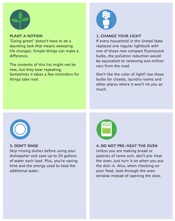
 Excellent summary of (mostly) easy things you can do to reduce your footprint – carbon and otherwise: 50 Ways to Help the Planet. A quick read. Focus is on individual action, and doesn’t ask the impossible. I thought the call to use clotheslines was especially interesting — in the U.S., we obsess about how energy-efficient our dryers are. But when I lived in Australia in 1983, nobody had a dryer – to own one would have appeared wasteful and indulgent. Recently talked with friends just returned from living in Australia, who confirmed that dryers are still uncommon. And talking with others a couple of nights ago, confirmed that this is still the case in many (most?) countries. Dryers v. clotheslines are a great example of the degree to which a culture is willing to be inconvenienced to avoid waste. The U.S. is extremely adverse to inconvenience, and cultural norms are extremely difficult to change (n.b.: We own and use a dryer too).
The counter-argument to this kind of list is that it ignores the big picture (big oil, big industry). But change has to happen at all levels (“Think globally, act locally.”) Every action you take, every decision you make, is a vote for how you want things to be (the Categorical Imperative). If you want a habitable planet, you must act towards it. If you want a habitable planet for your children, you must at least try to set an example, show them that not every action need be wasteful.
Lately I’ve been more wrapped up than I probably should be, obsessing about the fact that – by this point in time – we need to be beyond the point of asking whether we need to be taking drastic steps to stabilize the environment before it’s too late, but how. I’m bothered by two groups: On one hand the apathetic – people who hear all the science going down, but do not act to change their lifestyles. On the other we have the actively oppositional – people who continue to dispute that the mountains of evidence that we are facing dire consequences for our neglect is real, or that all this talk about consequences is just a money-making scheme for Al Gore. Yes, people with this view are real, numerous, and influential. And I personally think they’re dangerous.
I recently confessed to friends how chewed up I was feeling about all of this, and one said something to the effect of “But this is all just your opinion, and you want to force your opinion on others.” Well, I do believe that humans don’t want to be inconvenienced, and that we’re not going to get to where we need to be without lots of enforcement. If we allow the apathetics and the conspiracy nuts who either ignore or deny the critical state we’re in, we have no reason to hope that we can save the human race from what is now pretty much certain destruction at our own hand. So, yes, I do feel like we need to “force” environmental care on everyone. If we don’t, we’re doomed. But … what exactly is an opinion? How overwhelming does the evidence have to be before something crosses over from opinion to actionable fact? Is this really just the “opinion” of the vast majority of scientists?
The world runs on bread, and financial incentives help. When it’s financially beneficial to go green, people and corporations do. The question for me is, how can we get to a point where our motivations are more than just financial? For example, that we agree to reduce the speed limit not because it will save us money, but because it reduces carbon emissions, i.e. because it’s the right thing to do, i.e. because it satisfies the Categorical Imperative? I see people on Twitter talking about the move to reduce the national speed limit as an example of a “nanny state.” Well… if people were motivated by their sense of responsibility to the planet that gives them life rather than just to their wallets, we wouldn’t need a nanny state, would we? But that’s never going to happen.
What’s missing? How can we get everyone on board?

 Several years ago, when
