Seven Television Commercials

Recently at Stuck Between Stations:

radiointro

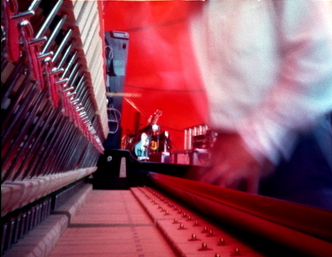
Scot sat down with his better half to watch Radiohead: Seven Television Commercials, a brief collection of Radiohead music videos.

Such impressionistic stuff, we decided to skip any attempt at actual review/synopsis and instead just riff words off the visuals and post whatever came out, do a sort of Kerouac typewriter roll on it. What follows are seven songs, seven paragraphs.

Roger, Discovering Japan

I recently stumbled upon Neojaponisme’s summary of the hundred greatest Japanese rock albums, as compiled by Kawasaki Daisuke two years ago. While I’m generally no fan of numerical rankings for music, I’m struck by his explanation of why such lists have often been uncommon in Japan: he claims that almost entire music industry there “is infected with the idea that they should not rank releases because it would ‘make the record companies angry’.”

Waste Stats

Some really amazing figures on solid waste, via the Clean Air Council, including:

Only about one-tenth of all solid garbage in the United States gets recycled.

In the U.S., 4.39 pounds of trash per day and up to 56 tons of trash per year are created by the average person. [Since this is garbage night and this stat got me curious, I actually weighed our garbage tonight before taking it to the curb – a total of 2.5 lbs for a family of 3 – the rest was recycled or composted.]

Diapers: An average child will use between 8,000 -10,000 disposable diapers ($2,000 worth) before being potty trained. Each year, parents and babysitters dispose of about 18 billion of these items. In the United States alone these single-use items consume nearly 100,000 tons of plastic and 800,000 tons of tree pulp. We will pay an average of $350 million annually to deal with their disposal and, to top it off, these diapers will still be in the landfill 300 years from now. Americans throw away 570 diapers per second. That’s 49 million diapers per day.

Throwing away one aluminum can wastes as much energy as if that can were 1/2 full of gasoline.

Americans receive almost 4 million tons of junk mail every year. Most of it winds up in landfills.

As of 1992, 14 billion pounds of trash were dumped into ocean annually around the world.

Forty-three thousand tons of food is thrown out in the United States each day.

Each American exerts three times as much pressure on the natural environment as the global average.

People who change their own oil improperly dump the equivalent of 16 Exxon Valdez spills into the nation’s sewers and landfills every year.

… more at the site.

Generating RSS Mashups from Django

I recently got to work on an interesting Django side project: the Bay News Network – a directory of Bay Area bloggers and hyperlocal news sites. The goal of the site was three-fold:

  1. To create a many-to-many directory of local sites that matched our editorial criteria
  2. To let site owners log in and edit their own listings
  3. To both consume and produce RSS feeds from the listed sites

The first two were pretty standard Django approaches – develop data models and editing interfaces using Django forms and re-usable apps like django-profiles and django-registration. The third goal turned out to be more interesting. We not only had to gather RSS feeds from more than 100 external sites several times per day, we needed to re-mix them (e.g. provide an integrated feed representing all blogs that cover Food, or all blogs that cover Oakland).

“Consuming” RSS feeds meant we needed to integrate feeds from the external sites into our own site. At the most basic level, this was pretty straightforward using Mark Pilgrim’s excellent Universal Feed Parser, which turns the real-world’s tag soup of disparate, incompatible RSS formats  into a reliable data format you can step through in your code or templates. This worked well enough until I realized that grabbing and parsing external feeds in real-time was just not going to scale, performance-wise. Plus, we still had the RSS mashups to build, and would clearly need to be storing feed entries in our own database in order to sort them by category, etc.

Thus began the hunt for good feed aggregation systems for Django. Most roads pointed to django-planet, planet planet, and FeedJack, which are systems for gathering content from external sites and importing it into a single aggregated site. These were close to what I wanted, but weren’t great on the re-usability side. Since I already had  existing models to define the sites, their owners, and their feeds, I didn’t want to rewrite all my models to work with another system’s conception of how things should be laid out. I also didn’t feel like plowing through their source code to chop out and rewrite just the bits I wanted. Eventually realized that I was looking for a few lines of code to work with my system, not a whole external system.

The surprising solution came from the Community section of the official Django project web site. The Django developers keep the code that drives djangoproject.com in subversion along with the source code to Django itself. And the code that drives that section of the site is really lightweight. So I did a subversion checkout of the Aggregator app, and found that all I really needed from it was its update_feeds.py script, which itself is a wrapper around Universal Feed Parser, tweaked to talk to my own models.

Two gotchas to be aware of:

  1. The app includes a bundled templatetags directory with a file called aggregator.py. But the name of the app itself is “aggregator.” I was getting strange import errors in various places before I discovered on the django-users mailing list that Django doesn’t like it when an app name matches a templatetag name. Easily fixed by renaming the templatetag.
  2. My first runs of update_feeds.py went fine, but later started erroring out with database integrity errors. The GUID field on the FeedItem model is set to unique=True, which prevents your database from storing any one FeedItem more than once. That’s great, but it was dishing up integrity errors for some reason. I fixed this by changing this line in update_feeds.py:
feed.feeditem_set.get(guid=guid)

to:

FeedItem.objects.get(guid=guid)

Once I was able to get the updater to run consistently without error, I needed to get it running via cron. The trick to running a Python script that talks to the Django ORM from a crontab is that you must supply the full Python paths in the environment to cron – it doesn’t pick them up automatically from the environment of the user that runs the cron job. This worked for me:

PYTHONPATH=/home/bnn/projects:/home/bnn/projects/bnn
DJANGO_SETTINGS_MODULE=bnn.settings
20 15 * * * python /home/bnn/projects/bnn/scripts/update_feeds.py 2>&1

Producing Feeds

With the harvesting system up and running, and all content coming into the datbase associated with blogs that were in turn categorized by “beat” and geographical area, outputting aggregated RSS feeds was a simple matter of using Django’s native syndication framework as documented. This went into urls.py:

feeds = {
    'all': AllFeeds,
    'cat': CategoryFeeds,
    'area': BeatFeeds,
}

# Feeds
url(r'^feeds/(?P.*)/$', 'django.contrib.syndication.views.feed', {'feed_dict': feeds}),

… and I created a file feedgenerator.py to contain the three corresponding classes and their querysets, using Holovaty’s sample code from chicagocrime.org as a starting point.

Cognitive Surplus

There’s an expression I hear a bit too often, in reference to other people’s chosen pastimes. It’s usually used in a negative sense, and more often than not, the pastimes being referred to are things like blogging, or Twittering.

“People have too much time on their hands” … or …  “Where do people find the time?”

Clay Shirky had a similar conversation recently, regarding the thousands of people who spend their free time culling, cultivating, editing, and massaging the vast fount of human knowledge that is Wikipedia.

“Where do people find the time?” A fair question, until you look at it in comparison to the amount of time people spend watching television. As it turns out, Wikipedia represents, collectively, about 100 million hours of thought. Meanwhile, watching television consumes around two hundred billion hours, in the U.S. alone, every year.

So how big is that surplus? So if you take Wikipedia as a kind of unit, all of Wikipedia, the whole project–every page, every edit, every talk page, every line of code, in every language that Wikipedia exists in–that represents something like the cumulation of 100 million hours of human thought. I worked this out with Martin Wattenberg at IBM; it’s a back-of-the-envelope calculation, but it’s the right order of magnitude, about 100 million hours of thought. And television watching? Two hundred billion hours, in the U.S. alone, every year. Put another way, now that we have a unit, that’s 2,000 Wikipedia projects a year spent watching television. Or put still another way, in the U.S., we spend 100 million hours every weekend, just watching the ads. This is a pretty big surplus. People asking, “Where do they find the time?” when they’re looking at things like Wikipedia don’t understand how tiny that entire project is.

Shirky is talking about this in terms of “cognitive surplus” — all the brain power that’s sitting idle in a consumptive state, rather than a productive state. That’s not quite fair – we all need to consume information if we’re going to produce information. And oh yeah – we all owe ourselves a bit of “veg time” every day. But before you ask the question “where do people find the time” in regards to any person’s pastime that doesn’t interest you personally, remember that the average American watches 8+ hours of TV per day.

That in itself is a stunning statistic, and I’m not sure how to digest it – if you subtract time for work, school, eating, etc. I can’t see how a person could even watch two hours per day (I’m guessing that a lot of people simply leave the TV on all the time), but still. That’s a whole lot of cognitive surplus.

Miles and Scot Build a Fort

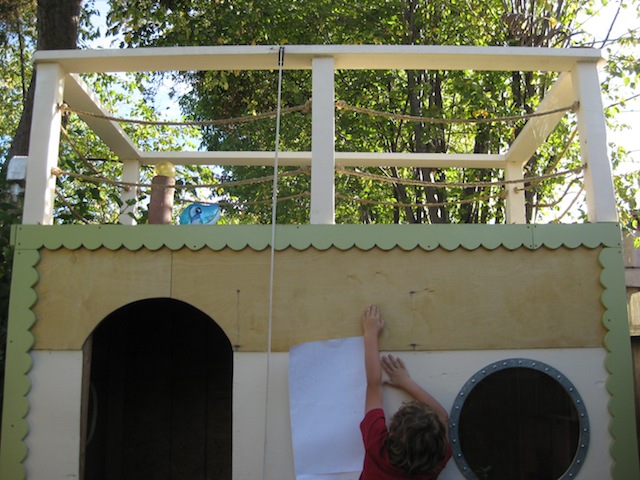
Over the course of  summer 2009, Miles and I spent almost every dry weekend working on a backyard fort project. Awesome father/son bonding experience. He got to learn lots about planning and working with tools, and I really enjoyed having something analog to work on for a change. Took pictures along the way, and finally got around to putting them together in an audio slideshow this week.

final_fort_small

Click for slideshow

Law of the universe: All projects turn out to be more complicated than when first conceived, and this turned out to be true of both the fort build and of making the slideshow. So many fiddly details behind the scenes that are never apparent in the final product.

I actually recorded Miles talking about the build in two takes (with a professional Marantz audio recorder borrowed from the J-School), then edited them down in Garage Band. Did my best to match audio to the visuals, but in order to utilize all the best clips, there are a bunch of areas where you’ll find him talking about something out of order. No matter – it’s just for fun.

Audio slideshow (note: there’s a full-screen option in the slideshow viewer).

Geek Notes

The original plan was to do the slideshow by importing still images into Final Cut, where I could edit durations and audios all together. However, the discrepancy between still image/video aspect ratios and pixel shapes (square pixels for still images, rectangular pixels for video) kept resulting in weird output. Fiddled with it forever but just couldn’t get it right, so decided to do SoundSlides after all.

Neither SoundSlides nor iPhoto provide audio editing functionality, and I still needed a way to sync up the images with the audio where possible, so this is what I ended up doing:

  • Arranged and edited images in iPhoto, exported to a temporary QuickTime slideshow.
  • Also exported the images from iPhoto with filenames set to “sequence.”
  • In Garage Band, imported both the temporary QuickTime and the .WAV files from the Marantz audio recorder. This gives you a timed thumbnail preview in GarageBand you can use to sequence your audio.
  • Since I had two takes of the audio and wanted to select bits and pieces from both, created a third “temp” track I could use as a holding bin for audio scraps I hadn’t decided what to do with. This seven minutes of audio is the result of two full evenings of audio editing!
  • Set the “movie” track to “Hide” in Garage Band so I could export an MP3 of the finished audio.
  • Imported the sequenced still images and the final MP3 into SoundSlides Plus to create the captions and final output.

Article Journal

Birdhouse Hosting is pleased to welcome Article Journal:

Article is an online journal based in the San Francisco Bay area that strives to provide a venue for heartfelt and engaging conversations about art. We believe in talking openly and assuredly about inspiration, imagination, magic, politics, ideologies, atrocities, spirituality and love. These are the elements that define what we make and how we see.

“Dad Rock” Isn’t a Bad Thing

Recently at Stuck Between Stations, Roger Moore has been on a tear.

Wilco: For Dads About to Rock, We Salute You

Wilco will always be too traditional for those who want them to be weird, and too weird for those who want them to be traditional.

Shatner Meets Sarah: Tundra on the Edge of Forever

For a long time after I first saw spoken-word artist Sarah Palin recite for a national audience, part of me doubted her existence. … But Palin is indeed real, and the past month has shown that I clearly misunderestimated her artistic skill. A governor is a lot like a performance artist, but with actual responsibilities.

Jacques Dutronc: 500 Billion Little Martians Can’t Be Wrong

I only remembered it was Bastille Day an hour before it was over this Tuesday, but I knew just what I wanted to hear. Jacques Dutronc is a revered figure in his country’s rock history that remains a total obscurity to many stateside. That’s a shame, because if there’s one person who can demonstrate that “French rock” isn’t an oxymoron, it’s Jacques Dutronc.

Populate Mailman Lists from Django Projects

I spent much of the summer building an intranet in Django for Miles’ school. Since the school is a co-op, we need to keep track a lot of stuff – charges, credits, and obligations, parents, students, teachers, family jobs, committee membership, the board, etc. etc. I’m happy with how the site came out, but unfortunately can’t share it here, since it’s a private site.

One of the goals of the rebuild was to put an end to the laborious manual process of maintaining the school’s multiple overlapping mailing lists. Since all of those relationships, people types, and groups were already stored in the intranet’s database, I figured it should be possible to run various queries and populate Mailman mailing lists from them directly. Due to the messy nature of the real world, the process was a lot trickier than it sounds on paper, but I eventually did get a smoothly working list generation system up and running, talking to our Django system and working with virtually no manual intervention. Members can update their own profiles and find that their mailing list subscription address has changed automatically a few hours later. Administrators can give someone a new family job or board position and that person will find themselves subscribed to the right mailing list for it later that day.

Since there isn’t much published out there on making these two systems (Django and Mailman) play nicely together, I decided to publish the scripts and document the recipe I used to get it all working. Hope someone finds the system useful.

Soon Obsolete

A week ago, I spied this sign, attached to a chain link fence on a construction site near my work. Thought it was strange, maybe a relic from a bygone era, but mostly just loved it as a metaphor for a seven-year-old codebase we’re about to ditch. Still, the words NONCHALANCE VIABILITY SURVEY rang in the back of my brain. This was too odd to be accidental.

Last night, I pulled up the picture again and noticed that it included a toll-free number. Decided to give it a call – why not? What I heard next was… well, you’ll just have to call it yourself and see.

obsolete

So apparently the whole thing is an art project of some kind – subtle and “official-looking” enough to pass for just more bureaucratic signage, so easy to walk past, not notice, be ignored. But just below the surface is something that rings a bit like a Church of the Subgenius 20 years later. Digging deeper, found this SFMOMA article about the project (and related ones), which in turn linked to Elsewhere Public Works, who apparently run the Nonchalance Viability Survey. Dig the arcane command line interface at the Elsewhere site.

I keep thinking about how this sign could have been just a raised eyebrow to me, barely noticed. How much do we miss on a daily basis? In the swirling miasma of culture, there are unnoticed touchstones that lead to paths that goes as deep and as far as we care to follow.