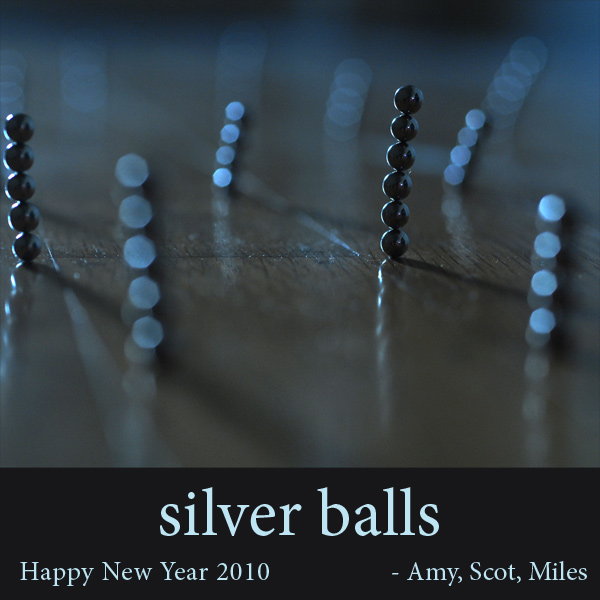
Accidental team effort: A while ago, we ordered a set of super-magnetic BuckyBalls from ThinkGeek. Miles soon discovered he could stick them to the nails in our wooden floor, and stack them up in delicate little towers. Amy, with her amazing eye for detail, saw something beautiful in the scene and started taking pictures – close up, and with a very short depth of field. She accidentally left the camera’s light temperature sensor set to Tungsten, which caused this gorgeous bluish cast.
Remembering that ThinkGeek has a section attached to each product in their catalog for “Customer Action Shots,” I submitted the image alongside their BuckyBalls product entry. Next day, amazed to discover we had won this month’s user submission prize!
I’m totally in love with Amy’s shot — and with Amy. And with Miles.
J-School students have been doing amazing work this semester on a trio of hyperlocal news sites: Mission Loc@l, Richmond Confidential, and Oakland North. I’m particularly moved by their multimedia feature piece, Five Teenagers, which takes a look at “Teens On Target or TNT, an after-school program based at East Oakland’s Castlemont High School. TNT trains students to teach violence prevention in the city’s middle schools.”
The video above is excerpted from the piece, but be sure to visit and check out the whole package, which interviews five teens, breaks down some chilling numbers, and provides an embedded map of regional homicides thanks to Oakland Crimespotting.
I was also impressed by the lack of Flash in this piece – everything is done with JQuery. Multimedia journalism and Flash go hand-in-hand (just surf through the projects listed at Interactive Narratives and count how many are done in Flash vs. standard methods). But slowly, multimedia journalists are beginning to realize that the downsides of Flash that we web standards geeks rant about are real, not just theoretical. At the same time, the quality, reliability, and ease-of-use of Javascript libraries like JQuery really are making it possible for non-programmers to put packages like this together.
Update, April 2016: Since iTunes 12 and Apple Music, I now store my entire collection in the cloud and am able to access/control it from anywhere, easily, and to redirect the output to any AirPlay device. So the notes below are no longer relevant.
Scenario: Music collection on an iMac in the office on one end of the house, pumping music over Airport Express to stereo in the living room on the other. Need to be able to remotely navigate collection and control playback from a laptop in the living room.
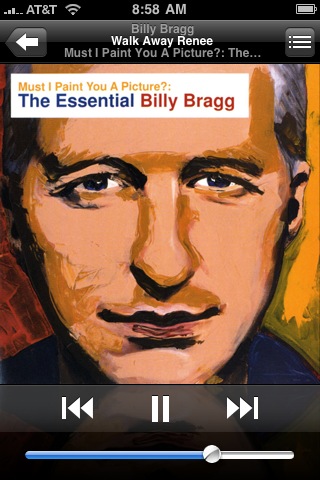
Seemingly perfect solution: iTunes Remote app for iPhone, connecting to the office Mac via wi-fi. Close, but not quite. At first, iTunes Remote app seems like the perfect remote control, complete with album covers. But a real remote you can pick up and operate on a moment’s notice, no strings attached. The iTunes Remote app, on the other hand, takes around 10 seconds to re-connect to the remote library every time you want to use it. You wouldn’t accept that kind of delay from any other remote control, so iTunes Remote gets annoying fast.
Alternative 1: Enable iTunes Sharing on the office Mac, then launch a copy of iTunes on the living room laptop and access the shared library. Configure iTunes to send music from the laptop directly to the AEX. Problem solved? Not quite. I rely heavily on the ability to rate tracks as they roll through. 1 or 2 stars for the tracks I can live without, then periodically cull duds from the collection based on ratings. Tracks with 4 or 5 stars form the basis for my best playlists. Unfortunately, when connecting to a remote library in this way, you have read-only access, and no way to rate tracks on the remote box. Bzzzzzt, deal-breaker.
Alternative 2: Third-party software. There are a few shareware packages available in this niche, but the only one I found that worked reliably was Jonathan Beebe’s open source Remote iTunes. The interface is a stripped down clone of iTunes itself, but its remoting ability includes something iTunes does not – the ability to authenticate as an admin user. Enter the IP of the office Mac, a username and pass, and give it a few seconds to pull across the music library index. Once connected, it stays connected, and you get the ability to rate tunes on the remote system. It’s not perfect, but close enough for jazz.
I’d love for iTunes itself to grow this ability so I’d have access to all iTunes features. Alternatively, I’d kill (not literally) for a desktop version of the iPhone Remote app. But Remote iTunes gets the job done with less pain than anything else I’ve tried.
… on how a new biography and forthcoming film may signal an Ian Dury renaissance.
As the missing link between Benny Hill and Bertrand Russell, Dury had ingenious ways to find the sublime in the ridiculous. His backing band, the Blockheads, stayed tight and funky in an era better known for its sloppy chaos.
From the New York Times blog And the Pursuit of Happiness, Maira Kalman explores the relationship between agrarian societies, fast food culture, and how “the fabric of our lives is bound in the food we eat.”
Back to the Land – Do the affluent have access to the really healthy food while the less affluent do not?
Nothing earth-shattering in what she’s saying – it’s the way she’s assembling her ideas that I love – the unusual, homespun visual presentation supports the spirit of what she’s communicating.
A labor-intensive way to way to blog, but that’s exactly perfect when what you’re writing about is the importance of slowing down the cultural experience, and the significance of real work by real people.
So it finally happened. Wanton destruction on an unprecedented scale. Entire civilizations wiped out with the flick of a wrist. Totally innocent sentient beings running for their lives, with no hope of cover from the firepower of a much more advanced species.
Until tonight, Spore had been a beautiful educational game Miles and I played together some evenings. An exploration of evolution, from cells swimming in primordial soup to inchoate creatures finding their legs and their appetites, to tribes discovering one another through song and charm, through civilization building, the strangeness of religious wars, and finally into the technological sophistication and problem solving of the space stage.
Through it, Miles was discovering how the world as we know it came to be. The importance of adaptation, the consequences of evolving without eyesight, or with a too-small mouth, the importance of keeping factories, homes and entertainment in balance, the trade-offs between having slow-moving crab claws or jet propulsion.
There had been difficult points in the game, when we had been forced into Hobbsian choices between eliminating a few diseased members of a species and letting illness take over an entire world, or between killing and being killed by malevolent species from other continents or distant star systems. But suddenly our 7-year-old was interacting differently. He had evolved into the space stage, piloting a sophisticated craft through the galaxy, trading blue spice for yellow, learning the finer points of terra-forming new worlds. Having discovered a new planet populated by a people still in the tribal stage, hovering above their world in a craft they couldn’t begin to understand, he had opened fire with everything he had, decimating one village after another.
“Why are you killing these people?,” I asked, assuming (hoping) there was a good reason, that he had been asked by the Habafropzipulops to eliminate some new form of growing evil. But the response was simple, and grim:
“They’re only in the tribal stage.”
Of course, our son had been working his own way through the tribal stage just a few weeks earlier. Had he forgotten already that everyone goes through the tribal stage? That ignorance of the future does not make you deservant of death?
We had a long and involved conversation about good and evil, about the difficult trade-offs and judgment calls we’ve sometimes had to make on our way to the current world. But none of it sank in.
“They’re not real. Why does it matter?”
All these months of playing a game I had hoped would help him to understand human history and to sharpen his moral compass had failed, because at seven he was already too good at distinguishing between meatspace and gamespace. On one hand, he had us. People worry that kids will absorb too much from games, will be unable to distinguish between fantasy and reality. But the problem here was that he was too able to make that distinction, and thus able to pick off entire civilizations since they were “only pixels.” How do you answer something like that?
Don’t get me wrong – I’m not worried that he’s unable to distinguish between good and evil. He’s got a heart of gold and is generous and wise beyond compare. But still, it was rattling to see him doing this. We told him that if he was going to play like that, he couldn’t play.
What we were having trouble communicating was that the game was a teaching tool for both his mind and his heart, and that it was important to us that lives were not trivialized.
That was the part that was difficult for him to distinguish. Children can be more wise than you give them credit for, and can also be more literal than you expect. He sees Spore as a game, not a metaphor. And he knows that the game is just a game, that pixels are just pixels. Meanwhile, we want him to see the game as an experiment through which his instincts play out, and that his instincts and morality will guide him away from the wrong courses of action.
At the same time, what young boy doesn’t want to play shoot-em-up, to draw pictures of tanks and aircraft carriers, play with green plastic army men?
In the end, we told him that he would have to play Spore with a good heart or not play at all. The look on his face was intense — one part perplexed, one part fascinated, one part incredulous, one part mad. We don’t want to throw the baby out with the bathwater here. We’ll see what part of the message sticks.
This blog has been chugging along at around 300 visitors per day for the past few months (it was much better back before Twitter nearly keeled my urge to blog at all). But the recent Drupal or Django article went a little viral, and things have been nutty over the past 48 hours:
WP-SuperCache has held up admirably, scarcely a performance blip felt on the Birdhouse VPS.
There’s a large body of technical information out there about content management systems and frameworks, but not much written specifically for decision-makers. Programmers will always have preferences, but it’s the product managers and supervisors of the world who often make the final decision about what platform on which to deploy a sophisticated site. That’s tricky, because web platform decisions are more-or-less final — it’s very, very hard to change out the platform once the wheels are in motion. Meanwhile, the decision will ultimately be based on highly technical factors, while managers are often not highly technical people.
This document aims to lay out what I see as being the pros and cons of two popular web publishing platforms: The PHP-based Drupal content management system (CMS) and the Python-based Django framework. It’s impossible to discuss systems like these in a non-technical way. However, I’ve tried to lay out the main points in straightforward language, with an eye toward helping supervisors make an informed choice.
This document could have covered any of the 600+ systems listed at cmsmatrix.org. We cover only Drupal and Django in this document because those systems are highest on the radar at our organization. It simply would not be possible to cover every system out there. In a sense, this document is as much about making a decision between using a framework or using a content management system as it is between specific platforms. In a sense, the discussion about Drupal and Django below can be seen as a stand-in for that larger discussion.
Disclosure: The author is a Django developer, not a Drupal developer. I’ve tried to provide as even-handed an assessment as possible, though bias may show through. I will update this document with additional information from the Drupal community as it becomes available.
In September 2004, I posted a brief story about a honkin’ pile of mulch that had recently landed in our driveway, along with a couple of quick snapshots.
Five years later (i.e. last week) I was contacted by a nice woman at a film production company who were making a film for Microsoft about a Boy Scout tracking mulch sales with an Excel spreadsheet. They wanted to use my image in the film and were prepared to pay me $250 for the rights to use the photo. While flattered, I have serious ethical issues with both the Boy Scouts (of today) and Microsoft, so my first inclination was to go ahead and take the money. But I have another ethical issue that outweighs those – the idea that I deserve to be paid for a snapshot I took four years ago.
I am not a professional photographer, and I did not take the photo with artistic or resale value in mind. The photo was only taken to support that brief blog entry. Its small amount of value was used up in that post, and I was paid for my small efforts with the equally small amount of attention it received (yes, we live in an attention economy now).
In my work, I benefit tremendously from the efforts of people who give away their work. My career would simply not be possible without the thousands of hours that have gone into Apache, MySQL, Firefox, PHP, Python, Django, etc. Likewise, I am studious about giving away the source code to the projects I put time into. I benefit from blog posts by people who are solving problems, and I try to repay that debt in some small way. In other spheres, all of this would be considered “intellectual property” with a monetary value. In the open source software world, it’s called “the free exchange of ideas,” and it makes the modern world go ’round.
I believe that we all stand on the shoulders of those who have gone before us, and our peers. Our culture is built on quotations – an endless re-use and re-mix of ideas exchanged between people. While I support an artist’s right to earn a living, I have serious problems with the idea that a 3-second snapshot is somehow worth more than dozens hours of time put into code. I believe an artist has a right to be paid for their initial work, but not to be paid again and again in perpetuity for that work. If an artist wants to keep making money, they should have to keep doing new work, like the rest of us laborers do. The idea that a person can put work into something once and then feel entitled to keep making money from it forever feels unfair. It smacks of a world that values money over ideas. That’s a problem I don’t want to be a part of.
I feel that copyright should exist for a very brief period of time — just long enough for the artist to recoup their efforts before moving on to the next thing — not the 70+ years Disney has pushed it out to. How long should that period be? I don’t know – I suppose just long enough so that consumers don’t say “I’m not going to buy that record – I’ll just wait until it enters the public domain.” So… five years? Maybe. Why are we still battling over the hugely valuable Beatles catalog? The band isn’t even together anymore – that music should have entered the public domain decades ago.
To accept money for this snapshot would have felt hypocritical. A couple of friends worked on me last night, trying to convince me that the marketplace, not the creator, should set the value for the work. Their arguments almost worked. And of course the money would be nice. But in the end, I decided to stick to my guns and publish the piece on Flickr with the attached Creative Commons Attribution license, which requires nothing but credit to the artist, even for commercial use.
I’m sorry to learn that the photo is being used by Microsoft and the Boy Scouts, but confident in my decision that to accept money for it would make me part of the larger copyright over-extension problem. If I believe that ideas should be free, and that a photograph is an idea, then I need to back up that belief by NOT accepting money I don’t deserve for for an old snapshot that took close to zero time, effort, or inspiration to create.
At bottom, I don’t feel that Microsoft or the Boy Scouts should have to ask for my permission to use the photo to begin with. They should be able to proceed on a cultural understanding that that photo is nothing but a speck of dust in our cultural landscape, and know that they can use it as freely as we use the English language in our daily speech. The fact that they “have” to ask permission is exactly what’s meant by the term chilling effects.
So, Julie, please use the image in your film however you like. A line of credit is all that’s required. As it should be.

 Update, April 2016: Since iTunes 12 and Apple Music, I now store my entire collection in the cloud and am able to access/control it from anywhere, easily, and to redirect the output to any AirPlay device. So the notes below are no longer relevant.
 Alternative 2: Third-party software. There are a few shareware packages available in this niche, but the only one I found that worked reliably was Jonathan Beebe’s open source


 There’s a large body of technical information out there about content management systems and frameworks, but not much written specifically for decision-makers. Programmers will always have preferences, but it’s the product managers and supervisors of the world who often make the final decision about what platform on which to deploy a sophisticated site. That’s tricky, because web platform decisions are more-or-less final — it’s very, very hard to change out the platform once the wheels are in motion. Meanwhile, the decision will ultimately be based on highly technical factors, while managers are often not highly technical people.
  This document aims to lay out what I see as being the pros and cons of two popular web publishing platforms: The PHP-based
 To accept money for this snapshot would have felt hypocritical. A couple of friends worked on me last night, trying to convince me that the marketplace, not the creator, should set the value for the work. Their arguments almost worked. And of course the money would be nice. But in the end, I decided to stick to my guns and publish the piece on Flickr with the attached