Birdhouse Hosting is proud to announce the launch of its brand-new, completely redesigned hosting site, along with all-new pricing and features for hosting customers. All Birdhouse users will be automatically upgraded to the new hosting packages as their accounts are migrated to the new server. We’ve also added a new business-level “Plan D” super package for gonzo users. All accounts now come with full-featured cPanel account management access, plus a big bump in the number of email addresses, lists, databases, etc. per plan. It’s like Christmas in April.
Imitation Giraffe
Long after Miles is supposed to be asleep last night, hear him making noises in his room. Walk in to find him with one foot up on either rail of his crib, hands on the headboard, head held high on an outstretched neck. He’s making weird smacking noises, opening his jaw wide and moshing it shut. He stops to look at me and says “This is how a giraffe eats, Daddy.” Great. While he’s supposed to be asleep, he’s in there doing giraffe impressions for an audience of one.
——
Amy takes Miles to Petco to look at hamsters and frogs. In an aquarium, one of the fish is dead, lying on the gravel. On the way home, Amy asks if he would like to have a pet. “I want a fish!” “What kind of fish?,” she asks.
“I want a died fish!”
RAW Image Encryption
Back in March, I ranted (and learned a lot about) the proprietary nature of the RAW image format stored in digital cameras, and the headaches caused by this non-opennness for people who simply want to shoot RAW and be able to get those images into their photo cataloguing software of choice.
Now it turns out that not only are RAW formats proprietary, they’re also sometimes encrypted, which means they can’t be read by any software other than that provided by the camera manufacturer. Photoshop is often considered the most capable software available when it comes to reading RAW images, but Adobe was so afraid of being sued under the DMCA if they reverse-engineered the formats that they decided not to support them at all.
Does a camera vendor have a legal right to tie their hardware’s output to a particular piece of software? I suppose they do, technically speaking. But they do so at the expense of the consumer, roping users into a counterproductive closed loop. There is no technical reason why white balance information should be encrypted; the reasons are all economic/political. My hope is that this move will backfire on Nikon and that consumers will revolt (hackers have already broken the encryption, by the way). What bothers me is that the camera industry is apparently taking cues from the DVD industry, which has convinced most consumers that it’s OK to build encryption standards directly into hardware. Not a healthy trend.
World Wide Panorama
A few days ago I was standing in the courtyard at work when a guy walked in and started to set up a tripod. This reminded me that I had been meaning to shoot a panorama of the courtyard stitch it together into a QTVR movie. Started talking about this with my boss, and the tripod guy piped up. Turns out it was Don Bain, one of the world’s premiere QTVR experts, and that he was there to do just that. “It’s a strange and beautiful world.”
Spent a couple of hours this morning with Bain in his labs at the Geography dept, where he is director of the Geography Computing Facility. Could not have asked for a more thorough or careful introduction to the technology than one-on-one with the man himself. He’s been doing these for many years, and had mountains of QTVRs to show (full-screen on an immense Apple monitor, no less). Also got a very detailed introduction to QTVR Authoring Studio, which, strangely enough, Apple has never ported to OS X (but which works fine in Classic). The difference between watching a master at work and an ordinary Joe is that Joe will pump something like this out in 15 minutes, while the master will spend days doing and re-doing until it’s exactly right.
Bain is also the progenitor of the World Wide Panorama, in which participants from around the world all shoot a similar object (like a local bridge) in their region on the same day, and upload finished QTVRs to the site. You can waste hours surfing the panoramas at the site, for which he won a “Best Find” award from Yahoo UK last year.
Heh – just clicking around his Virtual Guidebooks site and was surprised to see a panorama of Morro Bay on the Help page. I spent many hours paddling across, diving under, rowing over, and daydreaming in that bay. Funny to have it pop out of nowhere at me like this.
Make 001
O’Reilly was kind enough to send me a copy of the premiere issue of Make — a magazine more about atoms than bits (though there’s software stuff there too), written by and for extreme makers — people compelled to hack anything and everything they can get their hands on.
First issue: Great article on Kite Aerial Photography (which I’ve posted about here before), building a miniature linear accelerator in your basement, fabbing a functional video camera stabilizer on the cheap from galvanized pipe and barbell weights (crude, but effective – apparently performs almost as well as rigs costing thousands)… tons of fascinating stuff. A version of Popular Mechanics not destined for the barber shop, but for the workshop benches and nightstands of modern geeks. And almost no ads (though I’m sure that won’t be true by the second issue).
Includes a wonderful piece by Tim Anderson on Heirloom Technology — how inventors and researchers can work smarter and faster by spending more time in the library researching historical and organic solutions than in the lab reinventing the wheel. Beautifully written. Back when I lived in Boston, used to go to Tim’s MIT inventor/storyteller parties, and never left without jaw on floor. It was in Tim’s lab that I saw my first 3-D photocopier in action.
O’Reilly has hit one out of the park with this one. Will also check out the Make podcast tomorrow.
Getting the Podcast Bug
For the most part, I’ve taken a pretty laissez-faire attitude toward all the recent podcasting fervor. Spewing opinions over the internet is nothing new, and neither is the concept of an internet radio station. But as has been the case with weblogs compared to traditional web sites, half of what makes podcasting a powerful meme is the fact that publishing and distribution mechanisms are simplified and streamlined, standardized into easily consumable information streams.
If 99% of everything is crap, the same is true of weblogs and podcasts. Unfortunately, because you can’t time-condense podcasts the way you can skim an online publication via RSS, podcasting presents more of a temporal demand than does blog skimming, not to mention the technical hurdle of teaching non-geeks to subscribe to them, sync to audio players, etc. Still, if you can find a bit of time to listen, and are able to sift out the good feeds…
I don’t see the radio industry shaking in their boots exactly, but this is day one for the technology, after all. The newspaper industry didn’t think much of blogging at first, either. I’ll be working with J-School radio classes next semester to set up their first podcast distribution system.
After Jamie Wilkinson pointed out that NetNewsWire 2.0 has really slick RSS/MP3 enclosure handling abilities (it’ll even transfer downloads right into an iTunes playlist of your choice, ready for sync’ing), I decided to try listening to Slashdot Review and IT Conversations on my run today, rather than to The Slits and Plastic Bertrand. Made me feel old and dusty at first — continued erosion of my dwindling opportunites to rock out, but really enjoyed it and finished the run feeling like I had gained something.
Podcast Alley is teeming with options. Help me winnow the field here — any personal fave casts you’d like to recommend?
Update: Check out Darren Barefoot’s Why I’m Not Smoking the Podcasting Dope.
Comic Art Effect
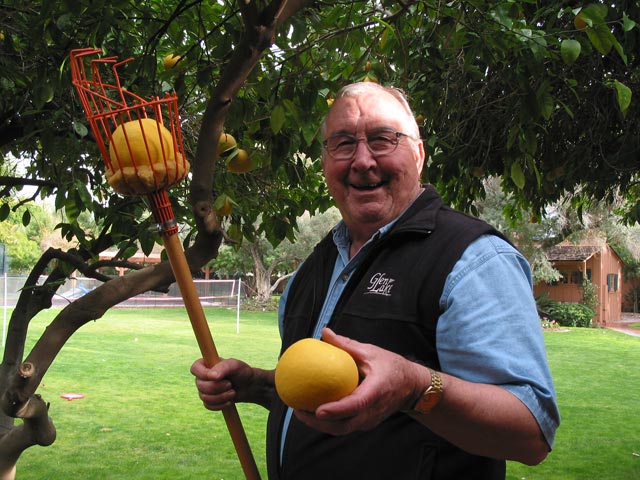
Experimented a bit last night with this Photoshop tutorial — how to turn photographs into comic book art panels (click for larger versions). Fairly involved – nine pages and nine layers, but took less than 15 minutes. Could probably trim that to five minutes with a bit of practice. Actually, some of the built-in posterization options in later versions of Photoshop get you fairly close to this effect, but without the halftone screen and cross-cut hatching that “sell” it as comic art. Pictured (before and after): My father-in-law Ben picking grapefruit in Palm Springs last winter.
Post-Consumer Industrial Beauty
Chris Jordan photographs the overflow of consumer culture as panoramic portraits of steel drums, piles of crushed cars, sawdust, mountains of cell phone chargers, shipping containers, gas cylinders… production and its waste are not without beauty.
QTSS on XServe
We’ve received the first replacement server in our coming move to an all-Mac campus: The QuickTime Streaming Server we use to webcast events and event archives is no longer running on Windows, but on Panther Server from a dual 2.5 GHz XServe with 2GB of memory. Any future bottlenecks will be at the NIC or switch, not due to I/O. The machine is dreamy, and the XServes really do look great in a stack. :)
Was looking forward to using the QTSS Publisher utility you get with OS X Server for batch/automated hinting of files, generation of .qtl files, etc., but was sorely disappointed — Publisher is really geared for environments that don’t already have a workflow system in place. Assumes too much, and isn’t very configurable. But soon discovered I now have access to the qtmedia and qtref command-line tools (not available for Linux or Windows), so spent most of the day writing a shell script to batch re-write metadata, generate .qtl reference files, add hint tracks (our broadcast software doesn’t hint the files at run-time), and relocate movies to a final resting place on the streamer. In with Flynn.
The script is available for download here.
Diego and Susy
Family portraits, taken in a similar orientation once per year since 1976, presented as photo essay. A family floating through time, children evolving to become echoes of the parents and yet not. A beautiful record.
On June 17th, every year, the family goes through a private ritual: we photograph ourselves to stop a fleeting moment, the arrow of time passing by.
Try keeping your eye on a single column, then scrolling the page vertically – like a filmstrip animation of a person’s biological life.
Thanks Susanna