 Just before leaving for Austin last week I caught an article that brazenly wondered “Has SXSWi gone mainstream?,” citing the choice of Mark Zuckerberg for one of the keynotes. What happened to the cutting edge? It’s true nothing really ground-breaking came out of this year’s show, but that had absolutely nothing to do with the conference’s usefulness… or fun quotient.
As usual, I took (and posted) loose notes on most of the sessions I attended. And as usual, there are often two or three sessions you want to see all happening at once. If you realize you’ve stumbled into a clinker, it’s a crapshoot whether it’s going to be worth it to stumble out, walk halfway across the convention center and try for seating in another — but you do your best. The Twitter back-channel helped tremendously… getting bits and pieces of other panels whispered in helped alleviate the feeling that you were missing something big.
 Yeah, I fell for the Twitter thing big-time this year (I’m “waxwing,” if you care); remains to be seen whether it will be as fun or as useful outside the context of the show. Twitter was everywhere – at times it seemed like you couldn’t glance at a laptop (must have been 85% Mac, for cripes sake) without seeing someone plotting their tweets. I’m not big into SMS, but between trying to hook up with people and following Twitter feeds, I’ve never done so much texting in my life
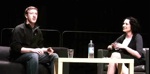 Had the inverse privilege of being present at the Mark Zuckerberg train wreck interview … not to be forgotten. Gossip and armchair analysis of the interview dominated conversations for the next 24 hours until we were all just sick of hearing about it.
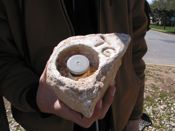 Got four hours of good geocaching in with mandric on the first day, before badge pick-up. Austin is in love with virtual (no physical box) caches for some reason – I think they just love their history. As a way to discover parts of a new city through serendipity, caching can’t be beat (and I think Milan caught the bug too!) Some pretty creative hides. Thanks Austin!
As for panels… where to begin? The Expression Engine 2.0 demo blew our doors off (coming version fully integrates ORM-based framework CodeIgniter). Jason Fried’s 10 Things We’ve Learned at 37 Signals totally inspiring for the 2nd year in a row. Henry Jenkins keynote an intellectual rollercoaster — tough competition with Kathy Sierra’s Tools for Enchantment (walked out of that one reeling). So many incredible data visualization techniques unwrapped in Data as Art (big implications and challenges for journalists). Went to two scaling sessions: Scalability Boot Camp and Scaling Web Ventures – of the two, the 2nd had more real-world tips, both both full of useful goodies. Interesting web pre-history in The Web That Wasn’t. Still feeling ho-hum about Adobe Air. Building Portable Social Networks attempted to address the coming tower of Babel between SNs, but left us with “We’re in for a world of pain.” Speaking of pain, I felt for the Microsoft guy defending MS Sharepoint against Drupal at the CMS Roundup. More here.
 Getting too old for the relentless party scene that is SXSW, now more interested in finding quiet places to talk with old co-workers and friends, but managed to squeak in a couple of good parties. Really enjoyed myself at Opera‘s party at Stubbs, where I spent 20 minutes in the bathroom talking with an Opera engineer who was the spitting image of Neil from The Young Ones. Think Opera is dead/irrelevant? Factoid: Opera currently employs more than 500 people – the mobile browser market is huge, and Opera owns it. Also a great party at the Mexican American Cultural Center (gorgeous architecture, and music by Gruppa Phantasma = Santana + War + 2008; break dancing like you never seen. Managed to get by on 5-6 hours of sleep per night, but couldn’t keep up that pace for much longer (despite official advice to NOT try and pace yourself (the “liver hacks” portion of that session were especially interesting).
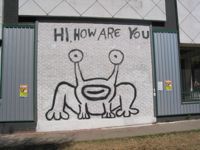
Finally made my pilgrimage to the Daniel Johnson “Hi, How Are You?” mural at the top of Guadalupe, en route to lunch at Ruby’s – some of the most amazing brisket and ribs I’ve ever eaten, served up by the pound on butcher paper in a ramshackle wood and corrugated tin building that hasn’t been renovated in 70 years (or something like that). Even beat The Salt Lick (but not by much).
Didn’t take as many photos as in years past, but managed to get a Flickr set up. Once again, it takes something like SXSW to lift us out of the .edu miasma and into the new world. Always worthwhile.
Update: Wow – Check out these SXSW Interactive 2008 Sketchnotes. Gorgeous.
 Loose notes from