Gutting a Display

Sdisplay-Repair5 Amy uses a 17″ Studio Display attached to a Mac Mini. Recently she found the top half of her screen going dim (pretty much unusable for photography work), and the power light flashing in a two-short, one-long pattern. Goog took me to a page on the Studio Display Backlight Problem. Looks we had a dying power inverter, right from the textbook. Ordered a replacement from MoniServ, which arrived a few days later.

After dinner tonight, Miles and I dove into the repair (he got to work the allan wrenches and screwdriver, and to unplug/re-plug the connectors). “This could go one of two ways: Either it’ll work perfectly and Mommy will consider us both heroes, or will fail miserably and we’ll get an earful about how nothing in this world has lasting value anymore.” Took our time with it, and the whole process turned out to be very easy – done in half an hour.

Monitor’s like new again. We’re heroes!

Music: Brian Eno :: Sky Saw

Miles Davis Is Dead

In The Bone Room with Miles today, Christmas shopping. He’s fascinated by everything there, of course, but flips when he sees the full-size human skeletons. Arms outstretched, revelation in his bright eyes, he points to one and calls out loudly:

“Oh my Goss, Daddy, look! That must be Miles Davis!”

I laugh. “It could be, but why do you think it has to be Miles Davis?”

Arms stretched wide, look on his face like I’m a compleat idiot: “Well, Miles Davis is dead, isn’t he?”

Music: Canned Heat :: On The Road Again

Statistics and Suffering

Not sure what to make of this Der Spiegel piece on how statistics of death and deformity are consistently overrated after nuclear accidents. Upshot: real rates of destruction are generally far lower than popularly reported.

To answer these questions, the Japanese and the Americans launched a giant epidemiological study after the war. The study included all residents of Hiroshima and Nagasaki who had survived the atomic explosion within a 10-kilometer (6.2-mile) radius. Investigators questioned the residents to obtain their precise locations when the bomb exploded, and used this information to calculate a personal radiation dose for each resident. Data was collected for 86,572 people. Today, 60 years later, the study’s results are clear. More than 700 people eventually died as a result of radiation received from the atomic attack:

  • 87 died of leukemia;
  • 440 died of tumors;
  • and 250 died of radiation-induced heart attacks.
  • In addition, 30 fetuses developed mental disabilities after they were born.

Even sites like Nature News say Chernobyl’s ecosystems are “remarkably healthy” and that “biodiversity is actually higher than before the disaster.”

My initial reaction is that this is an incredibly skewed, twisted perspective – some flavor of (possibly unintentional) historical revisionism. Or that data simply conflict, and different reporters pick and choose their angles. Yet the piece is very even-handed, doesn’t seem to be written with any kind of pro-nuke agenda, more a commentary on how exaggeration commonly follows on the heels of tragedy. But I’d like to see a rebuttal or response to this article written by other science journalists.

And then… stop. Just. Stop. It’s madness to talk this way.

Chernobyl

Watch Paul Fusco’s photo essay on victims of Chernobyl, and their children. And remember that everything beyond these messed up human lives is just statistics. And that death rates are very different from suffering rates. And that statistics are just damn lies anyway. And that people are real. Suffering is real, and cannot be reduced like this.

Thanks Jim Strickland

What Happened?

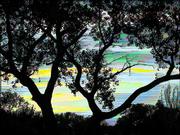
Mcoldtreeandsunsetatkin  T180 When CCDs go bad, accidental digital beauty. This reminded me of a series I stumbled across on LJWorld several years ago — the gorgeous results of having dropped a camera into a pond. Wonder how often people have this kind of accident and find themselves suddenly blessed with a “magic camera.” The only time something similar happened to me was when I was trying to shoot raindrops hitting the surface of the ocean in the middle of a tropical storm in Jamaica. Enough ambient moisture entered the camera body that everything it shot for the next few hours was distorted and smeary – not quite accidental beauty, just bad. And it cleared up by the next morning after leaving it open to dry overnight. Hmmm… I can find a few on Flickr, not nearly as many as I’d expect. Now I want to find a cheap/used digicam just to drown it.

Music: Tom Waits :: Murder In The Red Barn

Publishing Frontier

Birdhouse Hosting welcomes two great new media blogs:

pubfrontier.com: A raucous public discussion of the publishing revolution with an all-star list of contributors. “The goal of our site is to conduct provocative public discussion of the revolution that is happening in publishing and how it effects readers, society, economics, and fundamental values such as privacy.”

aliceinradioland.org: The blog portfolio of Pauline Bartolone — multimedia storyteller, radio producer and investigative reporter.

Oobox

David Pogue, in the NY Times:

These are all actual Web sites that have hit the Web in the last year or so: Doostang. Wufoo. Bliin. Thoof. Bebo. Meebo. Meemo. Kudit. Raketu. Etelos. Iyogi. Oyogi. Qoop. Fark. Kijiji. Zixxo. Zoogmo.

And these are names coughed up the Domain and Company Name Ideas Generator:

Cojigo. Roombee. Kwiboo. Trundu. Oobox. Ceelox. Myndo. Ababoo. Vible. Yambo. Eizu. Twimba. Yanoodle.

So… are startups today really using a randomizing algorithm to poot forth their brand identities? Or are humans sitting around board room tables coming up with names that only end up sounding randomly generated? Either way, these name forms are only memorable when they’re alone in the field, like Google. When there are dozens of them, all recognizability is lost.

Music: William Parker :: In Case of Accident [Live]

You Got Beacon’d

Felt like I needed to do something different last Saturday. Didn’t want to work on the house, didn’t want to work on the computer, too cold for hiking… decided to make a double batch of beef stew. Decided to save it to my “recipe box,” which required setting up an Epicurious account. Little did I know that a few minutes later, half the people I know would know that I was a new Epicurious user, via Facebook.

Beacon

Been hearing a lot about Facebook’s Beacon functionality over the past week, but it felt utterly yicky to get Beacon’d myself. Not that my chosen beef stew recipe was any great secret, but didn’t expect that a simple account signup was world news.

If I had known that Epicurious was one of Facebook’s 44 Beacon partners, I probably wouldn’t have done it. If there was an interface cue warning me about it, I probably looked past it. We’re so used to whipping quickly through such mundane tasks that we don’t exactly read our EULAs or every word on every page we visit. And Beacon is apparently even more insidious than it appears on the surface:

According to the researcher, Facebook’s Beacon tracked the activities of users even if they had logged off from Facebook and had declined the option of having their activities on other sites broadcast back to their friends.

Controversy over Beacon is swelling by the minute, but apparently Facebook isn’t alone in the practice. There may be a silver lining to the mess:

The controversy raised by the social networking site’s use of the Beacon technology has helped drag into the open the widespread but hitherto largely hidden problem of online consumer-tracking and information-sharing, according to privacy advocates. “This Facebook debacle is in one way very good, because it shows people just what is happening,” said Pam Dixon executive director of the World Privacy Forum. “There are other sites and other places where very similar data arrangements exist, but it is all happening under the radar and people simply don’t realize it.”

I feel gross all over. But the beef stew came out great.

Update: Facebook caves, will allow users to turn off Beacon.

Music: William Parker :: Long Hidden, Pt. 3

Want a Danish?

This week at Stuck Between Stations:

– Me, on Van Morrison’s 1967 contractual obligation, in which he “mails it in” like no one has ever mailed it in before:

I can see by the look on your face
that you’ve got ringworm.
I’m very sorry to have to tell you, but you’ve got ringworm.
It’s a very common disease.
You’re very lucky to have … ringworm
because you may have had … something else.

Audio at the site.

– Roger, on the unlikely roots of Jamaican reggae and soul in Canada.

Canadian reggae and soul, eh? If you expect that combination to go down as easily as curried goat with a side of Canadian bacon, you may be surprised.

Fava Beans and a Nice Chianti

Wine150 Talking with friends the other day about the amazing ways in which states of mind affect our perceptions. We spend a lifetime believing that our senses don’t lie, while our senses are themselves undergoing constant, tortuous manipulation by expectations and previous experience. If a hunter sees a leaf blowing across the road, he might raise his rifle, thinking it’s a rabbit, while his non-hunting companion sees only a leaf blowing across a road. What we experience is “real” to us, even though that experience could be dramatically altered by an empty stomach, a bad hair day, or a month on Xanax. Sounds cliche’, but what is “real,” anyway?

Caught a great segment on NPR the other day (via podcast) about a vintner doing studies on the impact various kinds of music has on tasters’ perceptions of wines.

Cabernet Sauvignon, for example, is best when paired with “music of darkness” — thanks to the ability of rage-filled songs to smooth out similarly aggressive tannins, Smith’s theory holds. An idyllic Mozart composition, on the other hand, works in reverse, potentially ruining a good Cab.

His results are apparently readily reproducible. Does this mean that wine tastings should be conducted in absolute silence for objectivity’s sake, or that the right music should be played for each wine tasted? And why do people talk about what foods wines go with, but never what music? After listening to this, music seems like a pretty important factor in the chemistry of perception.

Then happened on an equally fascinating write-up on some tweaked wine tastings. In one:

Brochet invited 57 wine experts and asked them to give their impressions of what looked like two glasses of red and white wine. The wines were actually the same white wine, one of which had been tinted red with food coloring. But that didn’t stop the experts from describing the “red” wine in language typically used to describe red wines. One expert praised its “jamminess,” while another enjoyed its “crushed red fruit.” Not a single one noticed it was actually a white wine.

On the surface, the results would seem to throw all pretense of objectivity in wine tasting out the window. “The second test Brochet conducted was even more damning:”

He took a middling Bordeaux and served it in two different bottles. One bottle was a fancy grand-cru. The other bottle was an ordinary vin du table. Despite the fact that they were actually being served the exact same wine, the experts gave the differently labeled bottles nearly opposite ratings. The grand cru was “agreeable, woody, complex, balanced and rounded,” while the vin du table was “weak, short, light, flat and faulty”. Forty experts said the wine with the fancy label was worth drinking, while only 12 said the cheap wine was.

So in these cases, perception was being altered not by audio inputs, but by messing with expectations. Lots of interesting comments on that story, illuminating the problem in a myriad of ways. To me, the take-away is not that one must discard all pretense to objectivity, or the idea of a “science” of wine, but that vinophiles can use the practice to explore the melding of senses and conditions, play with them, mash them up. As long as one is aware that the tongue and nose don’t tell the whole story, and that the rest of one’s mind, body, and prior experience factor in, then the sense of play is retained. But take yourself too seriously, lay claim to objectivity on a slippery slope, and the house of cards falls down.

See also: Similar piece on coffee and the retail experience.

Music: Lee Ranaldo & Stephen Malkmus :: What Kind of Friend Is This

Outer Space

Miles-Barnacle 30 minutes before bedtime, Miles (pictured cross-eyed, balancing large barnacle on head) announces to me that, no, we aren’t going to start listening to Cinnamon Bear as planned. He’d just remembered that he’d made plans with four of his kindergarten pals to travel to outer space on Monday, and that he needed to get ready. Thus began a flurry of preparations, including:

– One scuba diving flipper (made from an empty Kleenex box) [check]

– One piece of maritime artwork featuring a glued-on wooden sign reading “The Brain,” accompanied by a hastily scrawled diagram of a human brain [check]

– One pair of binoculars made from two toilet paper tubes lashed together with blue masking tape [check]

– One small flashlight [check]

– One space helmet, made by widening the opening of the aforementioned flipper [check]

– One compass (real) [check]

Should be quite an adventure.

Update: This morning Miles added a pointy stick “for poking out alien’s eyes.” We suggested that it might be smarter to bring aliens back for scientific study, and he agreed. Ditched the pointy stick. Once he arrived at school with his bags of gear, his teacher got curious and wanted to know what time he was departing. “I’ll probably blast off at snack time and get back to earth at lunchtime.”

Music: Marcus Carl Franklin :: When the Ship Comes In