Bottlemania

Bottled Salon has an interesting interview with author Elizabeth Royle about her new book Bottlemania, which dissects the bottled water industry from top to bottom. For Royle, it’s not as simple as “Bottled war evil, tap water good.” She recognizes that not all regions can get good drinking water from the tap (but most do), and she recognizes that most bottled water is not in fact “just filtered tap water,” as is commonly claimed (well, it is, but the filters used by Coke and Pepsi are more sophisticated than the home filters that consumers have access to). That said, Royle has seen the bottled water from the inside out, and sees a corporate manipulation of the culture on the road to making bottled water seem almost normal and OK. The idea that water from public fountains is “filthy” or not to be trusted, the idea that you risk ingesting pharmaceuticals or other toxins if you drink tap water, the idea that Fiji water (actually imported from Fiji!) can offset the huge carbon footprint of shipping water across the water by buying carbon credits… she sees through it all. Sounds like a good summer read.

Music: The Sea And Cake :: Lamonts Lament

Rise Above Plastics

Plasticjellies I don’t know what it is about the Great Pacific Garbage Patch that makes me feel so profoundly sad. Actually, I do. Just a century plus change since the industrial revolution, and the oceans, which have existed in perfect, bounteous balance for billions of years, have become a garbage dump – and not the kind we can build a baseball field on top of.

100 million tons of plastic now swirl in the vortex — so much plastic that samples show plastic particles outnumbering zooplankton by a ratio of six to one.

This plastic ends up in the stomachs of marine birds and animals. In fact, one million seabirds and 100,000 marine mammals die globally each year due to ingestion of or entanglement in plastics.

I like the way care2 is running this petition. Rather than yet another unanswerable call to law-makers, it’s a pledge to become conscious. To notice the plastic you’re consuming that might be avoidable… and to avoid where you can.

  • Using reusable bottles for my water and other drinks. By using just one reusable bottle, I will keep 167 single-use plastic bottles from entering the environment.
  • Using cloth bags for groceries and other purchases. For each reusable bag I use, I will save approximately 400 plastics from being used.
  • Recycling the plastic bags and bottles I already have. For every thirteen plastic bags I don’t use, I will save enough petroleum to drive a car one mile.

Remember: In the Reduce, Reuse, Recycle hierarchy, Reduce comes first.

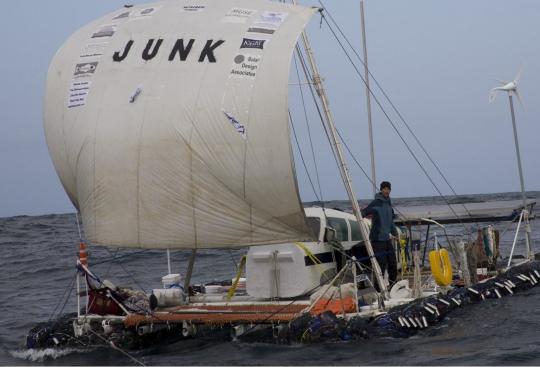
Update: Definitely check out this cnet piece on a pair of sailors traveling from CA to Hawaii in a junk made of junk. Also some staggering facts in that piece, which pegs the plastic/plankton ratio at 48/1.

Junkjunk

Music: Billy Bragg :: All You Fascists Bound To Lose (Blokes Version)

Human Exoskeleton

Imagine traipsing down the trail with 200 lbs. of extra weight… and not feeling it. Better: Imagine being paralyzed, and suddenly able to walk. Human exoskeletons are a reality.

Berkeley Bionics has spent the last several years developing and working to perfect their exoskeletons, which augment both a person’s lifting strength and endurance. With the HULC device, a person can carry up to 200 pounds without seriously impeding their mobility while using up to 15 percent less oxygen to bear the weight, increasing the length of time a person would be able to haul such a load.

Notes on Twitter

Twitterrific Icon Twitter (microblogging in general) is changing the way I communicate and consume. With ever-shrinking windows of available free time, the self-imposed expectations/pressure to blog something every night, or even a few times a week, melts away. Instead, I drop quick thoughts and notes into the ether as they occur. The 140-character length limit means there’s never any expectation that thoughts be fully formed. Maybe that’s yet another sign of cultural acceleration and the cheapniss of snack-sized media, but it works for me.

Twitter has also become a partial cure for my ongoing failure to actually read anything. Hundreds of feeds in the RSS reader, thousands of bookmarks, and I rarely look at anything that doesn’t find its way into my inbox. But for some reason, I actually take time out to consume what’s going down in the Twitter stream — it’s become a partial cure for bad media consumption habits. Twitter has become a 2nd inbox, perhaps more playful than the first, but essential nonetheless. Twitter has clicked for me in a way no other social network has.

In the few months I’ve been on the service, Twitter has found my phone, I’ve been able to follow one of our J-School students as he was jailed (and then freed) in Egypt for covering riots, I’ve gotten music and software recommendations, watched as journalists experimented with new ways to reach their drifting audiences, gotten to listen in on conferences there would be no way I’d have time to attend…

At times it almost feels like Twitter should have its own internet protocol, like it’s something new altogether. Not quite IRC, not quite IM, not quite blogging, not quite RSS. It’s all of those things synergized, yet still http-based.

Twitter-holics deal constantly with Twitter’s outages, which have become a near-daily occurrence. Talk about a killer app — what other service’s userbase would remain so loyal with such consistently bad uptime?

Twitter is built on Ruby on Rails, which has taken a lot of heat in recent months as a result – much buzz about how Rails doesn’t scale. But remember: “Languages don’t scale, architectures do.” And that’s the rub – Twitter was built quickly, with all the wrong assumptions, without foresight into the complexities that would be brought on by massive popularity 18 months later.

The issue is that group messaging is very difficult to achieve at a grand scale.

Excellent article at Hueniverse on Twitter’s scalability challenges. Summary: Rails is a framework used primarily for building content management systems. But Twitter isn’t a CMS at all – it’s a messaging system and an API. While most web apps read from the database hundreds of times more frequently than they write, Twitter is writing constantly, which creates a whole different kind of strain. And while most web apps depend heavily on caching to maintain performance, Twitter is cache-resistant, since every single user has a unique view, and each user’s view needs to be refreshed constantly. Caching need not apply. And since the API is both public and powerful, multiply the strain x dozens or hundreds of external desktop clients and filtering sites and services.

Twitter is currently being rebuilt piece-by-piece, and things are slowly getting better. There are rumors that the rebuilt components are all written in PHP, though the company denies the rumors.

Tip: To make Twitter work for you, you need a desktop client. I use Twitterific. And don’t be afraid to follow strangers. Check out who you’re following are following.


Music: Minutemen :: No Parade

Web 2.0 is Sharecropping

So tempting to let everything live in the cloud, to hand over storage and bandwidth requirements to YouTube and Flickr, to use an external wiki service rather than host your own, let Google run your email… but think hard before handing it all over. Before you know it, you’re an indentured servant.

From the recent ignite conference:

Music: Orchestra Baobab :: Jiin Ma Jiin Ma

Brain Great-iator

File under Truth Is Stranger: A couple of months ago Miles’ viking helmet got busted — right around the time we had to replace the video inverter in Amy’s monitor. Naturally, the broke inverter ended up attached to the broke helmet, along with a few lights and some pipe cleaner. Miles called it “The Brain Great-iator,” because it allegedly makes your brain greater (unconfirmed).

Greatiator    Carell

Separated at birth? Miles and Steve Carrell

Then last month’s Wired mag hit the stands, with cover story 12 Hacks That Will Amp Up Your Brainpower, featuring Steve Carrell sporting a grown-up version of Miles’ own invention.

Michael Scott is going to get so sued.

Music: Pink Floyd :: Dramatic Theme

Religion a Product of Evolution?

New Scientist: Evolutionary anthropologist James Dow has written a program – called Evogod – that simulates the evolution of religion, attempting to determine whether the impulse to pass on unverifiable information might have evolutionary benefits. When run, the software concludes that, yes, the impulse does sustain itself, but only if non-believers help believers out.

Other attempts to explain the origins of religion contend either that A) Religion is an artefact of other brain functions (cf Julian Jaynes’ The Origin of Consciousness in the Breakdown of the Bicameral Mind), or that B) Religion is an adaptation in its own right (my take on #B: when non-believers are persecuted, of course belief becomes a survival benefit).

The article explains the idea that religion only flourishes if non-believers help out believers by suggesting that belief could be an impressive trait to non-believers. I think it could also correlate with the history of non-believers being forced to help build pyramids/cathedrals, or to otherwise participate in believer culture. Religion generally has an imperialistic (evangelistic) trajectory, a tendency to overcome non-believers in the local culture, so that non-believers come under control of believers (even today non-belief carries stigma, which is itself a cultural force that confers evolutionary advantage to believers).

Not addressed in the article is any kind of scrutiny of Evogod’s actual code or algorithms. If the principles in the source code aren’t sound, neither is the theory.

Music: Johnny Cash :: The Man Who Couldn’t Cry

Ruby on Rails at Birdhouse

Rails Birdhouse Hosting is proud to announce support for Ruby on Rails! All users will now find a new Ruby on Rails icon in their cPanel interface, and we’ve written a new Rails FAQ explaining how to get a RoR application scaffold off the ground.

We can’t support actual Ruby programming questions – users will have to turn to the Ruby on Rails community for that – but we will help you get an initial RoR installation going. We’re looking forward to seeing what you create.

Music: The Bennie Maupin Quartet :: Ours Again