Another Day on Earth

It’s been 15 years since Brian Eno released a vocal album. All of the ambient stuff in the years between has been interesting and even gorgeous at times, but not sustaining in the way records like Another Green World have been (Green World still has the power to take me far, far away). Out of the blue (or into it), the just-released Another Day on Earth revives some of that spirit — ethereal synth washes, complexly layered vocals, Fripp-like guitar, melodies that simply float without sounding anemic… It’s not Green World, but it’s great to have the old Eno back again.

emusic has it, iTunes doesn’t. Amazon review. There’s also an Eno interview available for download (billed as a podcast, though I think content should have to be serialized to be billed as a “podcast”).

Music: Brian Eno :: Under

Amplified Bicycle

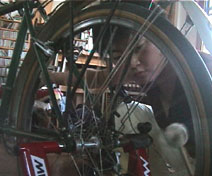
Mallet On the second night of the recent Matthew Sperry Memorial Festival, cellist Theresa Wong played an amplified bicycle, in a performance that brought many in the house to tears. Wong, who studies performance at Mills College, had been playing the amplified bicycle prior to having known of Matthew or his death. I had been storing the bicycle from which Matthew was struck in our garage for quite some time.

After the performance, I offered Matthew’s bicycle to Theresa to use as her instrument; she accepted. I spent Saturday afternoon getting the wheels rolling again, chain disentangled, brake pads unstuck, and cleaning up the road grit. Rested my hands on the grips – the last things Matthew ever touched – and took the bike for a spin, meditating on his life. Sunday I delivered the bike to Theresa’s Oakland loft.

Theresa found the bike resonant, full of surprising sounds. After a few minutes of orientation, she improvised a piece for Matthew. A wild dove had been hanging out in the loft for a few days, and we imagined it to be Matthew’s visiting spirit.

Orchesperry

Today marks the 2nd anniversary of Matthew‘s death, and the 2nd night of a four-day memorial concert series to benefit his family. Tonight went to see Orchesperry — a large ensemble of Bay Area musicians formed in his honor, in the spirit of a page his wife found in one of his notebooks outlining his dream of a well-contained ensemble that would defy expectations of what “energy music” or “free music” is or can be. “Loud passages should be the exception and not the rule.” I’m breathing. I’m floating. I’m smelling. I’m thinking:

I smell fresh paint.
I smell resin dust floating from a cello bow.
I smell fish on somebody’s breath.
Matthew, I smell your chicken soup.
I miss the way you played blocks of foam and garden tools
And anything you could find that made a sound.
The drummer is gently bowing a Bundt pan.
You would have loved that.
You signed your letters XXOO.
Tonight they played a piece with that title.
I watched your wife’s shoulders heaving with grief.
I felt you in the room, we all did.
Wish you were here. XOXO.

At one point, one of the musicians got up from her chair and started pedaling an amplified bicycle, a gush and whir of the chain in sprockets resonating through the frame, tweaking effects pedals, memorializing Matthew’s last ride, making incredible sounds. Later I approached the musician to tell her I still had Matthew’s partly wrecked bike in my garage. I told her I wanted her to have it, to make it her instrument. She agreed. Next week I’ll get the wheels spinning again, take it to her. A heavy but wonderful evening.

Venus de Moto

Ezra Demoto    Ezra Ambassador

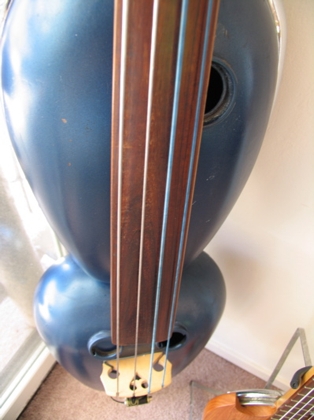
Traveled with some of our visiting journalists yesterday to the hideout of Ezra Daly, who makes instruments (mostly basses) out of junkyard parts and found objects. Pictured: Venus de Moto and Frankenbass — the latter crafted from an old Moto Guzzi Ambassador gas tank, resting in an old Yamaha chassis re-deployed as a bass stand. The instruments are gorgeous in person. Long in the making, one-of-a-kind, and completely functional. Total commitment and patience in these. Daly plays mostly psychobilly and cow-punk, but has very eclectic tastes. I was sort of a hanger-on, mostly went along to see the instruments, and to help with tech stuff as needed. Amazing to see these instruments in person, and to hear them played. With fire.

Update: One of the journalists put an image of me from the same visit up on his Flickr account. Not particularly flattering, but love the lighting.

Music: Ozric Tentacles :: Ayurvedsim

The Life Aquatic and Seu Jorge

Wes Anderson’s The Life Aquatic gives me hope for the future of filmmaking – I haven’t seen a movie this gorgeously cinematic, this surprising, this full of dry humor and great music and perfect frames one after another for… how long? A masterpiece.

Punctuated throughout by Seu Jorge playing David Bowie songs on acoustic guitar, solo, in Portuguese. “Ziggy Stardust” from the crow’s nest, “Rock and Roll Suicide” from a shack on the beach… poetic and weird and beautiful in a way I never expected. Need to find more Seu…

Music: Wilco :: Theologians

Orchestra Baobab

Palace of Fine Arts today with friends and kids to a matinee performance by Senegal’s inimitable Orchestra Baobab. The SF Jazz Festival this year is hosting a few daytime performances on the side to give families/children a chance to absorb high-frequency good vibrations — a brilliant idea, and Baobab was a perfect fit. Deeply grooving, musically accessible, culturally significant, and totally jamming. Amelia bum-rushed the stage with a hundred other tots and was clapping and dancing. Wonderful afternoon.

Senegal is a country with a rich musical heritage and one of the most vibrant pop music scenes on the african continent. Its music today is dominated by one main sound – the breathtaking rhythms of Mbalax, the music of the Wolof people in the north of the country. But it was not always so. In the 1970s the style that filled Senegal’s airwaves was a fusion of Afro-Cuban elements with various local sounds drawn from Senegal’s diverse cultural traditions. And the undisputed masters of this fusion were the legendary Orchestra Baobab.

Other noteworthy music stuff:

Tom Waits’ most cherished albums of all time. Waits on John Lurie:

Get the first record, The Lounge Lizards. You know, John’s one of those people, if you walk into a field with him, he’ll pick up an old pipe and start to play it, and get a really good sound out of it. He’s very musical, works with the best musicians, but never go fishing with him.

And run, don’t walk, to try and digest Unknown Hinson — the craziest side-burned, snaggletoothed s.o.b. ever to wield a country rock guitar and shoot a pistol at the same time. The videos left me breathless.

“Don’t bite the lips … that kiss you
I don’t want … to say it … again.”

Thanks Mal and Mike

Music: The Dells :: Give Your Baby A Standing Ovation
Wreck-n-Roll

An El Cerrito neighbor builds basses and guitars from junkyard parts. “Cycle Pole” and “Venus de Moto” employ motorcycle gas tanks as bodies. “Flying VW” uses hubcaps as resonators, and incorporates the artist’s wisdom teeth as control knobs. “Frankenbass” incorporates a tailpipe as part of its design. Inspiring. Need to check these guys out one of these nights.

Intelligent MIDI Sequencing with Hamster Control

If you want your kid to go to Cornell and create a hamster-controlled MIDI device, the trick, apparently, is in making sure he has access to both a Habitrail and a Heathkit AO-1 Audio Oscillator construction set.

Guided by inputs based on hamster movements, Markov chains were used to perform such beat and note computations. In culmination, 3 simultaneous voices were produced spanning 3 octaves and 3 rhythmic tiers. Each voice was controlled by two hamsters: one that was responsible for adjusting the rhythmic qualities of the melody and another that modified the note sequence. With all of these elements in combination, an output was produced with very musical qualities. All of this was implemented using an Atmel Mega32 microcontroller, distance sensors, a HamsterMIDI Controller, and 6 hamsters.

I don’t pretend to understand all of this, but the output is lovely – some fusion of Philip Glass and Twink.

Thanks baald

Music: Half Man Half Biscuit :: Irk The Purists

The Art of the Segue

I’ve posted before about how the file-based sterility of MP3 listening habits blot out much of the romance of musical discovery, and how the concept of an album as an indivisible artistic totality has all but been erased (I’m not so sure that’s a bad thing – there’s a whole lot of crap on a whole lot of good records, and I scuttle dud tracks without a shred of guilt).

Adding to the discussion, Dave Mandi wonders what shuffle mode is doing to the art of the segue — the ease (and the thrill) of letting a computer or an iPod choose tracks from a collection at random is diminishing the art of the well-selected transition. In Praise of the Segue:

With MP3s becoming the de facto currency of music listening and trading, and with shuffle mode becoming a more and more common way of programming an hour of music—Apple’s recent introduction of the iPod Shuffle is pretty clear evidence of that—the art of the set and the segue is in imminent danger of dying. … We have the opportunity to create greater meta-masterpieces than ever, tailored to people’s moods, or the time of day, or the weather. Why destroy all that by getting lazy and pushing the “shuffle” button?

It’s all true, but… I love shuffle mode, not afraid to admit it. Creating thoughtful transitions is something I make time for when burning the Christmas CDs. For daily listening, accidental random musical collisions charge me up.

Music: Dandy Warhols, The :: Be In

Cowbell, Vibraslap: The Unforgotten Staples

In SNL’s famous “Behind the Music” Cowbell skit [transcript], Christopher Walken is the producer during a Blue Oyster Cult recording session. Will Farrell is hard-driving on the cowbell through “Dont Fear the Reaper” — a little too hard-driving, his bandmates think. But Walken insists: “More cowbell. I got to have more cowbell.” The piece has cult status for a reason — we all know deep inside that the cowbell has been woefully under-appreciated in music history.

NPR makes amends with their tribute piece: There’s Just Something About That Cowbell, while The Cowbell Project archives every song readers can think of that centers on that luscious, penetrating sound. The site even calls Christopher Walken “The Patron Saint of the Cowbell.” You can also get Cowbell T-shirts to proclaim your adoration.

It’s the cymbal’s evil third cousin. It’s the dark ring that pounds in the back of your brain and lets you know, it’s time to rock. The cowbell is an instrument that can’t be overused. It should never be underused.

I’m glad for the cowbell that it’s finally being recognized for its place in rock history, I really am, but also feeling sympathy for the even less-lauded Vibraslap. If the cowbell is underutilized in modern rock/pop, the vibraslap is all but forgotten. Once upon a time, the vibraslap was a staple of both big orchestral rock and high school bands; now it’s less than a footnote. (MP3 excerpt from ELO’s “Jungle”):

Granted it’s kind of buried in the mix there — someone point me to a more prominent sample please — I got to hear more vibraslap.

Music: Brian Eno :: M386