Mose Allison / Patricia Barber

Went last night to see Mose Allison and Patricia Barber as part of this year’s San Francisco Jazz Festival (scored tickets through Barber’s sound guy, an old housemate).

Barber looks like a librarian, but plays like Geri Allen meets Cecil Taylor (well, the Cecil reference is a bit extreme), with a voice that is somehow both soaring and subdued, on the dry side, very personal. Barber’s band was tight, but somehow I kept feeling like I wanted them to unleash a bit more power/freedom. Something slightly academic in their vibe prevented me from really being floored. Nevertheless, there were some incredible sounds, and their fascinating deconstruction of Norwegian Wood was like no version of that song you’ve ever heard.

Mose Allison looked like he hadn’t changed a bit in 30 years (maybe because he looked 70 even in his 40s). baald described his blues/stride style as “comfortable, like old sneakers” — which is accurate. But you don’t listen to Mose for musical innovation so much as for his whimsical philosophical/political/scientific meanderings. Kind of a Tom Waits/Randy Newman for the previous generation.

Check his Your Molecular Structure (iTMS link).

Music: Air :: Clouds Up

Duckmandu Does DK

It’s the 25th anniversary of the Dead Kennnedys’ seminal album “Fresh Fruit for Rotting Vegetables.” What better way to pay tribute than to cover every track on the original album on the accordion? Aaron Seeman is the virtuosic Duckmandu on “Fresh Duck for Rotting Accordionists.”

In a sense this project was a science experiment which posed the question, “Would it be possible to play this very difficult music, note for note, on the accordion?” There were certainly moments when success seemed unlikely.

DK bassist Klaus Flouride actually sings backup on five of the tracks. And if covering the entire Fresh Fruit album wasn’t enough, Duckmandu throws in a few Minutemen and Black Flag pieces to seal the deal. Samples at site (“Jesus and Tequila,” sadly, is not one of the downloadable tracks).

Music: Unknown Instructors :: Punch Out *The Layoff* Gratuity

One Nation Under a Groove

I knew there was a reason we’ve been Tivo-ing Independent Lens — jumped out of my chair tonight when it turned out we had caught a new documentary on Parliament-Funkadelic, Yvonne Smith’s One Nation Under a Groove. Solid hour of interviews and archival footage, from barbershop days to the descent of the mothership. Concert clips much too short, can only imagine the torture of the filmmaker trying to decide how to balance the mix of interview and archival material. Mind-bending stuff, took me back to a former, funkier life. Nice discography on the site, too.

Flattered to find a link to my old P-Funk article from PBS.org! (in the “Learn More” section).

Music: Funkadelic :: Can You Get To That

No Direction Home

Last night finished watching Martin Scorsese’s two-part documentary on the early part of Bob Dylan’s career, No Direction Home — fascinating and beautiful. The film spent a lot of energy not just on concert footage and interviews, but on context — the musical and social environment from which he shot like a weed into mesmerizing strangeness.

Scorsese put a lot of weight on Dylan’s slippery nature, his refusal to be pinned down or labeled. The establishment media was absolutely fixated on making him “The spokesman of a generation,” “The father of protest music,” though relatively little of his output was actually political or topical except in the most obtuse way, and he consistently confounded reporters’ attempts to get him to make political statements, or to actually speak for his generation. Priceless footage of a Swedish photojournalist asking him to “Suck on the arm of his glasses” — wanted to stage Dylan looking thoughtful or something. Dylan walked up to the photog and held his specs up to the guy’s mouth. “You suck on them.” A student journalist looking ridiculous as he demands to know the symbolism of the barely visible motorcycle on Dylan’s t-shirt on the cover of “Highway 61 Revisited,” Dylan looking incredulous that people were so desperate to find hidden meaning in his every move. “Umm, I was just wearing that shirt that day, I really don’t remember.”

Much of the footage is chilling in its beauty, Dylan so in the moment, so completely absorbed by the muse. Allen Ginsberg: “He had become identical with his breath.” Lots of interview footage with Joan Baez on their difficult relationship, and her frustration that Dylan wouldn’t throw his weight behind the protest movement, as she had assumed they would do together. “He was the most complex person I’ve ever met.”

Pointed threats, they bluff with scorn
Suicide remarks are torn
From the fool’s gold mouthpiece
The hollow horn plays wasted words
Proves to warn
That he not busy being born
Is busy dying.
– It’s Alright Ma (I’m Only Bleeding)

Focus on Dylan’s transition from folk to rock, and how his freewheeling mixture of the genres frustrated folk purists. Crowds booing, hollering “Traitor!” Pete Seeger admits wanting to take an axe to the power cords at one electric performance, Dylan today talking about how painful it was to learn that one of his own heroes was rejecting that music so completely. But truthfully, some of the electric performances are painful to watch in contrast with the solo work, even as they’re tremendous in their own right.

The doc stops abruptly in 1966 with Dylan’s motorcycle accident, and you’re left hungry for another four (or more!) hours covering the years that have gone between.

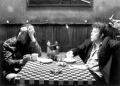
Jack Shows Meg His Tesla Coil

Coffeeandcigarettes Got partway through Jim Jarmusch’s Coffee and Cigarettes tonight. Brief vignettes of people sitting around drinking coffee and smoking cigarettes, talking, being awkward, uncomfortable, going nowhere, living. Tom Waits and Iggy Pop (priceless meeting – who knew Iggy could be so sweet?), Steven Wright, Bill Murray, Steve Buscemi… everybody fits. In one scene, Jack White of the White Stripes is sitting in a cafe’ with ex-wife Meg (who is commonly thought of as his sister), homemade Tesla Coil sitting in a little red wagon beside him. Meg wants to know more. Won’t give away the rest. Cinematography is gorgeous, dialog typically Jarmusch. Boring and enthralling and totally beautiful.

Music: Buzzcocks :: Choices

Supatamp

Playing “Switched-Off Bach” a while ago (interesting history on the releases of Switched-On and -Off in 1968) when a melancholy passage comes in. Miles looks at me and says, “Daddy, this music makes me sad.” Walked into his room and pulled the blankets over his head. Later pegged a less-than-upbeat Toots and the Maytals track as also being “sad.” Can now identify four or five genres. When asked, usually says his favorite kind of music is “weggae.” This evening, driving home listening to Breakfast in America, M pipes up from the back seat. “Daddy, this music isn’t sad like that weggae song, this music is happy!” Typically unable to help myself from supplying info he isn’t ready to process, I pounce on the opportunity to tell him all about Supertramp. “Now I know a lot of kinds of music. Cwassico, Chazz, Blues Clues, Weggae, and Supatamp!” Decided not to go into the messy terrain of subgenres like Ork. Maybe when he turns three.

Music: Pete Brown & his Battered Ornaments :: Then I must go

We Jam Econo

Went to watch a documentary about The Minutemen, We Jam Econo, with Roger tonight. Archived gig footage interleaved with interviews — Watt driving his old white van around San Pedro plus dozens of conversations with musicians from in and around the early 80s SoCal punk scene.

The movie reminds you how awkward it is to use the word “punk” to describe The Minutemen — they get lumped in due to their energy and their label and their place in time, but really shared very little with typical punk bands — no mohawks, no punk uniform (check D. Boon’s ridiculous shoes for proof), little in the way of punk attitude. The Minutemen were never crass. They were more complex than that – political without being blunt, musically complex without making “music for musicians” (not that I think art music is bad, just saying The Minutemen weren’t about that). Artful without being arty. Humble, totally honest, real people making music that sounded like nothing that’s come before or since.

The interviews are great – a virtual who’s who of the SST scene, “including John Doe, Thurston Moore, Colin Newman, Ian MacKaye, Jello Biafra, Richards Hell and Meltzer, and a big chunk of Black Flag’s large revolving cast: Greg Ginn, Henry Rollins, Keith Morris, Kira Roessler, and Dez Cadena” (from Pathetic Caverns).

Not enough time spent on Double Nickels, easily the greatest album ever made in the history of humanity (don’t challenge me on that, even though I mean it). But compensated for it with some jaw-dropping acoustic footage (who knew?) — including Hurley on bongos.

Run, don’t walk.

Interview with filmmaker at the Seattlest
New Yorker review

Music: The Yardbirds :: Happenings Ten Years Time Ago

Etymology of Baba O’Riley

Recently discovered that the title of The Who’s “Baba O’Riley” (the swirling keyboard intro of which I used as the soundtrack to a speech given by a talking moose to Amy at our wedding five years ago) is derived from the names of composer Terry Riley, who gave Pete Townsend the idea for the synthesizer part, and spiritual teacher Meher Baba, who was Townshend’s spiritual guru at the time. The things you learn.

Music: Raymond Scott :: Peter Tambourine

Screwdriver Mode

Listening to Brian Eno talk about the creation of Another Day on Earth over the past few days. He spends some time meditating on the temptations that technology presents, and the balance he has to strike between using the technology compositionally vs. the danger of becoming seduced by it. Talks about how artists used recording studios in the 50s, before there was so much huge money in the industry and each hour of recording time was money out of musicians’ pockets (still true for independents today, though the equipment has changed). “First take best take” (Trungpa –> Kerouac) was much more common. Now we produce the hell out of everything. Overproduction a side effect of too much technology presenting too many choices.

The central problem of a musical piece may be the lyrics. But that problem is hard, and no one can solve it on the spot. So instead we start tweaking knobs, applying 177 effects to 19 guitar parts across 128 tracks, sidestepping the core weakness of the piece and distracting the listener’s attention from the song.

Comparison made to getting stuck on a piece of writing and starting to tweak the fonts, page layout, etc. rather than the piece. He calls this process “screwdriver mode.” The seductive garden paths of technological possibility.

I watched this happen with myself and the old birdhouse — originally using web technologies to create web art, then slowly finding myself spending more and more time exploring technologies without actually applying them.

We see the same tendency with digital photos and music collections – becoming obsessed with cataloguing, databasing, finding new ways to sift and sort, all taking attention from taking excellent photographs or really listening.

Distractions. Screwdriver mode. All of us susceptible to it, some more than others.

Music: The Fugs :: Nameless Voices Crying for Kindness