
The Power of Many

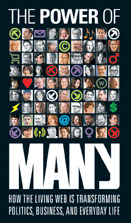
the power  of manyA couple of months ago, Christian Crumlish gave me a copy of his just-published book The Power of Many (How the Living Web Is Transforming Politics, Business, and Everyday Life). I’ve known Christian for a lot of years — back when Birdhouse was primarily an arts collective publishing “new media” works by artists discovering the web for the first time, he invited me to join antiweb (ironically no site currently online) — a loose collective of web developers scattered around the world, trying to find the capabilities and limits of the new medium. Christian, a writer of dozens of computer books, also ran Enterzone, an online literary e-zine.

Christian’s latest book is not only his first to appear in hard-cover, but also his first that’s not a technical/how-to; rather, it’s an exploration — at turns straightforwardly journalistic, nearly stream-of-consciousness, and scholarly — on the transformative power of online communities. Crumlish goes behind the scenes not technically, but anthropologically, examining how weblogs and wikis, social networking sites, web services, SMS, discussion groups, flash mobs, etc. have transformed the way people gather and organize, both online and in meatspace. And he chronicles his involvement in the web-savvy Dean campaign, his deep roots in the Grateful Dead scene (whose online existence in many ways mirrors the ethos of the Dead culture), wanders through topics ranging from spontaneously self-organizing micro-communities to well-funded corporate and political action groups.

On first discovering online journals, most people find them puzzling, a paradox. Who would put their private diary online? … Omigod, my mother read my blog! Indeed, there are countless stories of people who misjudged the effects of putting their thoughts and ideas into the public domain and who lived to regret the confidences broken, the parties offended by their snarky comments, their exposed secrets. In time, though, anyone who continues the exhilarating tightrope walk of online self-examination will manage to cultivate that gray area between public and private that seems just personal and revealing enough to draw in readers and invite scrutiny but that still holds back what truly belongs out of public view entirely.

Christian has always kept a finger in each of a dozen pies — I can never keep up with all the simultaneous online ventures he manages to keep afloat. His Radio Free Blogistan is another great read. And I still love his early hypertext fiction piece No Bird But an Invisible Thing.

Music: Steve Hillage :: Lunar Musik Suite

Fribilty Jones

In the newsgroup alt.os.linux.redhat lives a current thread titled “OsX compared to Linux and BeOS” (gratuitously x-posted to a handful of other OS groups) — a fairly typical bottomless OS war, er, reasoned discussion, either fascinating or tedious depending on your disposition.

First of all, I’m floored that anyone in the universe is asking whether BeOS is a viable alternative four years after the company bit the dust. That’s funny bit #1. But this excerpt had me rolling:

>>> is there anyone who knows OS X and Linux well who can
>>> make an honest and reasoned comparison of the two?

>> Scot Hacker?

> Fribilty Jones.

So that’s what it’s come to. Get a job, have a baby, fade from the OS scene, and before you know it, you may as well be Fribilty Jones. Less than zero. Dang, it rolls off the tongue nicely though. Fribilty Jones. Fribilty Jones. Fribilty Jones. Must … create … pseudonym …

Thanks mneptok.

Music: Lee Scratch Perry :: In This Iwa

Kissing the Dead

Just finished the final exam in my Unix Security class — three classes down, a fistful to go to complete my cert. Once again, learned a ton but feel like I just scratched the surface — security is a bottomless topic. In addition to the nuts and bolts stuff, great tangential discussions. One day, discussing the behavior of viruses and the significance of “laying low,” an analogy to the ebola virus:

The disease is often transmitted during funeral preparations in Congo which traditionally require relatives and friends to wash and kiss the dead body.

… and so entire villages are wiped out quickly — the local culture inadvertenly helps the virus to more efficiently kill its own host. If AIDS killed its host immediately, it would virtually be over — its long dormancy is what enables it to spread. Which helps explain why so few computer viruses are immediately destructive — if a virus formatted your hard drive the minute you contracted it, it wouldn’t have the chance to propagate. It wouldn’t become a “popular” virus.

Powerful: A theoretical virus that sits around on a corporate LAN and changes one digit in one randomly selected cell in one randomly selected Excel document per month. And nothing else. How long could such a virus evade detection? How much hair pulling would this cause? How soon before people stopped trusting Excel?

Music: Tom Waits :: Low Side Of The Road

Out of the Ditch

Hell froze over, and my boss decided to switch from Windows to Mac, got himself a shiny new PowerBook. After one week: “It’s like I’ve been stuck in a lousy marriage for 20 years and finally met a decent woman.”

He wishes to make clear that he is not, in fact, stuck in a lousy marriage (in case his wife should ever read this).

And now, after the umpteenth drive into the ditch with Windows-based hacks and system failures, and interminable battles with spyware and virii followed by lengthy and tedious reconstructions, our sysadmin has announced plans to ditch all Windows servers and workstations on the J-School campus and going all OS X — a massive purchase and conversion planned for this summer. Should be an interesting challenge, but enough is enough. We all have limits.

Music: The White Stripes :: Ashtray Head

Virtual Slaves

Not into computer games, but this story is fascinating. We’ve all heard about how people gather virtual goods (swords, cash, immunity) in online games and then sell them on eBay — apparently this is now a $4.3 million eBay market. So this dude reverse engineers protocols and violates the terms of service of Ultima Online — he figures out how to script the game, sets up a little server farm in his closet, and creates a bunch of players. He sets these virtual players to work mining virtual gold in the virtual world, then sets up a business selling the gold on eBay for real cash. Gets rich doing it. His biggest danger is getting caught. What if someone walks up to one of his electronic slaves and tries to talk to it? To solve this, he routes incoming messages to an IM service, which is piped to his cell phone. Now his slaves can converse with other players wandering by no matter where the guy is at the time. He was never caught, but finally decided to throw in the towel and confess all. I find all of this mind-blowing.

Music: Can :: Butterfly

Virtual Private Servers

Working with a potential client who intends to run a highly dynamic site that they expect to grow to pretty quickly over the next six months, and trying to find the right server for them. Standard shared hosting is not in the cards for them – they need a higher level of data separation as well as a performance guarantee. But their budget is a strong consideration, so we’re looking at Virtual Private Servers, which are a stepping stone between shared hosting and dedicated servers.
Continue reading “Virtual Private Servers”

Hallelujah, the Mac Is Back

A good read at Salon about less-obvious aspects of the Mac Mini strategy, or more accurately, why the whole Switch campaign didn’t work. About the differences between Mac people and PC people:

Mac people love their computers on a personal, emotional level. Windows people, on the other hand, prefer to think of their machines as office tools, gadgets no more special than the stapler. Windows users don’t expect much in the way of quality, beauty or elegance from their machines; if they did, they’d be Mac people.

and:

You do your taxes on your PC. You pay homage to John Coltrane on your iPod.

Continue reading “Hallelujah, the Mac Is Back”

Girl Friday for Target Disk

Target disk mode is the greatest thing since sliced bread — connect two Macs with a FireWire cable, reboot one while holding the T key, and its hard drive appears on the desktop of the other, ready for data transfer. When I got the iMac a couple of weeks ago, decided to do my usual Carbon Copy Cloner stuff and blast a fully loaded OS and set of apps onto it (not sourced from my old Mac), then use target disk mode to load all of my user data on top of that. The process worked, but took a while and involved some pain (not worth going into).

Turns out, I’m lame.

Because I cloned it without ever booting it to “factory defaults” first, I never saw the new Setup Assistant Apple has apparently started shipping with all new Macs. Could have saved myself a few hours. When Amy’s Mini arrived yesterday, the Assistant appeared before the Desktop loaded — “Have an old Mac? Want to copy all your apps, user data and settings over? Plug in a FW cable, restart the old Mac with the T key down, and go have a smoke.” Well, it didn’t say that exactly, but something like it. Setup Assistant is basically a user-friendly intelligent wrapper around target disk mode. A Girl Friday for Mac migrations.

An hour later, the Mini was a nearly exact clone of her old machine – new OS and system apps, old user data, previously installed apps, and settings. Everything works flawlessly.

The Mini is even better IRL than pictured. Silent, small, fast, cheap, and beautifully designed. Apple hit one out of the park. It’s hard to get Amy excited about technology (she was talking about the plants in our yard while I was opening the carton), but after a morning using it, she’s totally in love with this box. And we have finally achieved a minor goal we set several months ago – a silent home office (it’s incredible how much noise two older PowerMacs can generate, and how that drone can get on your nerves in a subtle, background-y sort of way over time). The difference is night and day.

Music: His Name Is Alive :: Smooth