Miles (age 4), at the zoo. We bump into an old friend, who tells M that bats look a lot like flying foxes.
Miles: “But if you want to see a flying fox, you have to use Firefox.”
Uh-oh.
Music: Israel Kamakawiwo’ole :: La ‘Elima

Tilting at windmills for a better tomorrow.
Miles (age 4), at the zoo. We bump into an old friend, who tells M that bats look a lot like flying foxes.
Miles: “But if you want to see a flying fox, you have to use Firefox.”
Uh-oh.
Am I crazy, or has Mail.app gotten slower with time? Nope, not crazy. Mail.app uses SQLite, and its database can stand a good vacuuming from time to time. Simple instructions on optimizing your Mail.app indices to re-optimize internal data structures. No metrics on this, but there’s no question my larger mailboxes are snappier after running this.
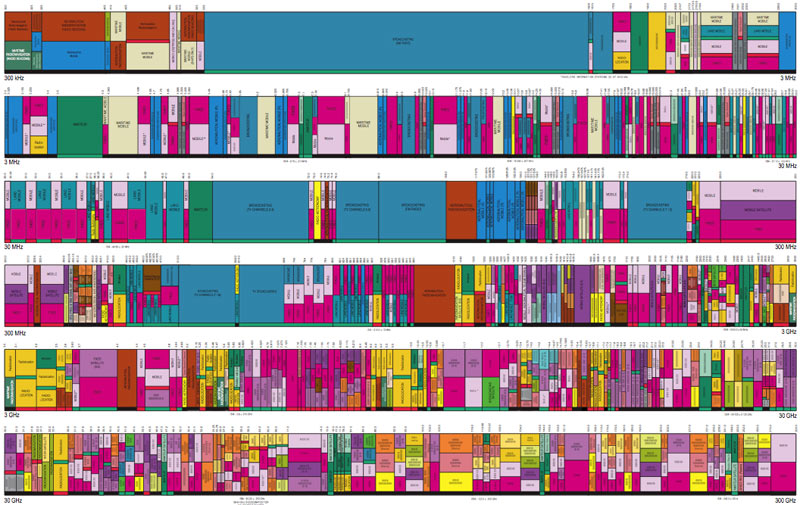

The US radio frequency allocation chart and a visual inventory of your hard drive.
Bruce Eckel (author of Thinking in Java) on his personal transition from Java to Flash/Flex for RIAs (rich internet applications). He chronicles his disillusionment with client-side Java on the web/desktop, from the early, optimistic days of “Write once, run anywhere,” to the current state of affairs, where Java applets on the web are virtually non-existent, and Ajax / Flash have become what Java always wanted to be. And Ajax, he argues, has already pushed JavaScript just about as far as it’s going to go, leaving Flash/Flex as the only real contender for quality RIAs. Only he says it much better than I can.
It’s not impossible to build GUI applications with Java, but it’s been 10 years and there are still installation hiccups with applets, Java WebStart, and regular applications. After 10 years, people don’t trust it anymore. If it’s not there after 10 years, then I’m going to go out on a limb and say that someone doesn’t consider this problem important enough to fix. And even if they did, there have been so many bad experiences among consumers that it would take years to get the trust back.
Last month I expended what were probably too many words in a discussion on a mailing list, making the point that Apple inherently values DRM-crippled music. How else to explain the fact the iTunes store attaches DRM to music even when the artists don’t want it there? Buy 100 songs from iTMS, I argued, and you’ve invested $100 in music that can’t be played anywhere but in iTunes or on the iPod. If Sony comes out with an iPod killer next month, you’d be reluctant to switch because you wouldn’t be able to take your purchased music with you. DRM is valuable to Apple, Sony, and Microsoft (who all exercise the same kind of data lock-in) even when there’s no direct profit in it, consumer convenience be damned.
Steve Jobs’ recent open letter to the music industry knocks a neat hole in my argument, making the point that, based on their data, 97% of music on all iPods is not protected, and that 3% is hardly sufficient incentive to prevent users from switching. Hmmm… Good point, but then why is some music available at eMusic (my favorite online music store by far) without DRM while the exact same music is sold as cripple-ware at iTMS?
Not sure what to think, but I appreciate that Steve is calling for an end to DRM. His letter is extremely cogent (one wonders how many lawyers’ hands the letter passed through before publication), and provides a great primer on the opposing forces with which Apple and other music providers find themselves wrestling. Of course, the fact that much of Europe is threatening to follow in Norway‘s footsteps in making the iPod (or rather the breakdown of consumer choice its DRM represents) illegal is likely a contributing factor.
Digital camera consumers tend to think of megapixels as simplistically as some car shoppers view horsepower: More must be better, right? Shoppers are blinded by increasing megapixel values, at the expense of better image sensors, higher quality lenses, image stabilization, etc. Result: Many people are wasting more storage and ending up with noisier images, rather than getting higher quality images, as they often think they are. c|net, calling the megapixel arms race on the carpet.
As the digital-camera market matures, consumers are becoming aware that lens quality, processor quality and image stabilization technologies are at least as important as pixel counts when determining image quality.” … “We went past the point where more megapixels made a difference years ago,” MacAskill said. “In the last 3 million prints we’ve made for very discriminating eyes, none were returned for lack of pixels.”
Andrew Leonard reviews Salon co-founder Scott Rosenberg’s new book, “Dreaming in Code: Two Dozen Programmers, Three Years, 4,732 Bugs, and One Quest for Transcendent Software. For several years, Rosenberg followed the (now largely stalled) development process of the open source PIM Chandler, and was also dragged through the development process for Salon.com’s custom content management system (a process I myself went through last summer). On why Vista and other large development projects are almost predictably over-budget and very late:
… the incredible difficulty of estimating the time it takes to do this stuff, whether you are building a little content management system for a relatively modest-size Web company or whether you are building the operating system that will be used by three-fourths of the known universe. The difficulty in saying, A) How long will it take to do what you want to do? And B) When are you done doing what you want to do?
The answer, it turns out, is incredibly elusive, and very few people are capable of estimating these things with anything approaching precision. On build vs. buy:
And the programmer who says “it will be faster for me to write it, rather than to learn it,” is usually correct. Except that what he will write, most likely, is something that will work but will not have its rough edges worked out.
Touche’. I’m becoming convinced that the ideal middle-ground on the build vs. buy spectrum is to use a development framework like Rails or Django. Then you aren’t building all of the plumbing yourself, and you still get to lean on the hard work of others, but you also aren’t constrained by the models and methods of fully-baked systems (like pre-rolled content management systems). The downside to frameworks is that, to be productive, you need more up-front training than you would when building from scratch, or when using an existing product. To that end, I’ll be doing another week of pure research/training next week – this time on Python/Django (after I get some molars removed, that is). Whether a week will be enough to start feeling productive with it is something I’ll soon find out.
Voice recognition has come a long way in recent years, but what about melody recognition? Just spent 10 minutes at Midomi, a new search engine that lets you sing, whistle, or hum a few bars into a Flash-based recording widget, runs a whole bunch of voodoo analysis on your input, and spits back results based on what song it thinks you must have intended. Potentially great for those times when you remember how a song goes but not what it’s called, or any of the lyrics. The goal is to sell you downloadable versions of the search results, but based on the miserable output it generated for me, it’s back to whistling for friends and co-workers – Midomi batted nearly zero.
Started with PiL’s “Track 8” – Midomi thought I was singing “The Rainbow Connection.” Whether that’s a limitation of the technology, or a matter of the song being too obscure, or that my rendition would have been unrecognizable even to humans, I don’t know. But when I couldn’t get it to recognize “Sittin’ on the Dock of the Bay,” my confidence in the technology’s ability to recognize common songs plummeted. My attempt to render Herb Alpert’s “Spanish Flea” fell flat as well (Midomi thought I was humming “A Spoonful of Sugar” — yipes. Tried whistling the same song rather than humming, but no dice — Midomi interpreted that attempt as “My Sharona.” Captain Beefheart’s “Orange Claw Hammer,” according to Midomi, must be a drunken version of “Edelweiss.”
Amy’s a better singer than me, so turned her loose. When Midomi guessed that her version of “Fly Me to the Moon” must have been one of “Like a Virgin,” “Rhiannon,” or “Ebony and Ivory,” she lost interest. Finally hit paydirt with “Happy Birthday,” but sheesh.
Why is Avid / Digidesign suddenly pushing Garage Band rather than Pro Tools? Is there an implicit acknowledgment here that PT is too complicated / expensive for a huge swath of users? Maybe this doesn’t seem weird to others — of course Avid can still sell you the hardware, even if you don’t go for their integrated M-Box/Pro Tools package. Maybe it strikes me as odd because of the endless battles we’ve gone through at work over the question of whether PT is overkill for our users (we’re now teaching Soundtrack Pro to multimedia journalism students rather than Pro Tools, so I guess we landed somewhere in between).
Apple profiles ukulele master Lyle Ritz, who recorded his latest album No Frills entirely in Garage Band (at age 75 no less). And it does sound gorgeous.
There’s a lot of competition in the web-based calendaring / personal time & resource management space, but there’s something special about Scrybe, now in extended beta. “Focus on details without losing the surrounding context.” The demo video is impressive. Cross-platform, syncs between multiple computers, off-line mode, smooth interface, some nice innovations. A little Backpack, a little Exchange Server, a little Ajax… nothing earthshaking overall, but seems really well put-together, and solves real-world problems. The “Thoughtstream” feature seems innovative. Haven’t joined the beta (which is currently in waitlist mode), but will keep an eye on this.
Thanks Rob