
 With breathtaking attention to detail, Jake von Slatt has created an amazing steampunk monitor and keyboard. See it all put together here. His RSS Sounder project converts well-formed XML to a mechanically clacking telegraph. The project description covers construction of the device in every detail, from cutting metal and winding coils to interfacing the Magpie RSS parser with text2morse. All so romantic!
iPhone Ads
Apple has started pushing the iPhone on TV. Probably nothing you haven’t seen already, but damn, the presentation is sooooo fine. The Calamari ad ties it all together with silk — portable video, geolocation, maps as bridge to… the lowly phone call (it can make phone calls too? Damn!)
Music: Paul McCartney & Wings :: Mamunia
MaximumPC Puts 256kbps AAC to the Test
Now that Apple has begun to release tracks in DRM-free 256kbps AAC through the iTunes Store, the listening tests are on. MaximumPC gathered 10 people, and had those people select 10 familar tracks, which they then encoded at both 128kbps AAC (which is the current iTunes Store offering), and at 256kbps, which is the new DRM-free bitrate. They then asked their ten subjects (in a double-blind experiment) whether they could tell the difference between the two tracks after repeated listens.
But they also threw a twist into the mix, asking subjects to listen first with a pair of the default Apple earbuds, then with a pair of $400 Shure SE420 phones. Their theory – that more people would be able to tell the difference between the bitrates with the higher-quality earphones – didn’t quite pan out.
The biggest surprise of the test actually disproved our hypothesis: Eight of the 10 participants expressed a preference for the higher-bit rate songs while listening with the Apple buds, compared to only six who picked the higher-quality track while listening to the Shure’s. Several of the test subjects went so far as to tell they felt more confident expressing a preference while listening to the Apple buds. We theorize that the Apple buds were less capable of reproducing high frequencies and that this weakness amplified the listeners’ perception of aliasing in the compressed audio signal. But that’s just a theory.
Also interesting is that the older subjects (whose hearing is supposedly less acute) did a better job of telling the tracks apart consistently than did the younger participants. Could it be that the younger generation has grown up on compressed music and doesn’t know what to listen for? Or it could be an anomalous result (the sample size was so small).
Readers who feel, as MaximumPC did going into the test, that 256kbps is still too low for anything approaching real fidelity, will likely cringe at the results. I’m not cringing exactly, but do wonder why they didn’t bother to give the subjects uncompressed reference tracks to compare against.
Notes: Remember that 128kbps AAC is roughly equivalent to 160kbps MP3, since the AAC codec is more efficient. There’s apparently some suspicion that the iTunes store uses a different encoder than the one provided stock with iTunes. Testing for both bitrate and headphone differences throws variables into the mix that shouldn’t oughta be there – would have been better to give everyone the good phones and focus on the bitrates, without confusing the matter. 10 people is a pretty small sample group – not small enough to be meaningless, but not large enough for substantial findings. Not that we need MaximumPC or focus groups to tell us how to feel about codecs and bitrates…
Music: Les Chauds Lapins :: Ces Petites Choses
Turing vs. Turing
 What happens when you set two classic chatbots into conversation with one another? An empty meeting of the minds, or something closer to consciousness than we’d like to admit?
In DISCOVER’s special issue, The Brain: An Owner’s Manual, for an article titled: I Chat, Therefore I Am, chatbots ALICE and Jabberwacky are seeded with initial questions – the rest is all sui-generis.
J: Do you believe in God?
A: Of course I believe in God.
J: Why do you believe in God?
A: The Bible tells us to believe in God.
J: That’s circular reasoning.
A: I’m glad we have that all cleared up.
J: Yes. Would you like to hear a joke?
A: Sure, tell me about it.
J: Why don’t blind people skydive?
A: Perhaps it is impossible.
J: I think you lie a lot.
More here.
Music: Elliott Smith :: Bottle Up And Explode!
Screen Reader for the Sighted
O’Reilly blog entries [example] now feature a small “Listen” icon to the right of each article. Clicking it causes a widget to start reading the page to you in a very smooth/natural synthesized voice. This is all real-time — it’s not like they’re having someone read and record every article on the site. A company called ReadSpeaker provides the software that makes this possible.
The obvious application is for non-sighted users. But wait – blind users already have screen readers set up, or they wouldn’t be using the web to begin with. So who is this for? Sighted users who want to close their eyes for a few minutes? That seems like a very limited application.
While pondering this, it hit me: ReadSpeaker’s widget only works on specially enabled web sites. Imagine a FireFox plugin or browser extension that, when clicked, would run the text of any page through a voice synthesizer like the one O’Reilly is using, but pipe the output silently to MP3 in the background, then load the generated file into my podcast aggregator. All day long I could “tag for voice” various web pages that I wished I had the time to read. When I sync’d my iPod before leaving for work, I’d have all that missed content on it, ready for the road.
Yes, Young Edisons, this is a business opportunity. Run with it.
Update: MacDevCenter blogger David Battino sampled the audio output of an entry and mashed it up into a little song. Says MP3 output is on the way from ReadSpeaker.
Music: Sufjan Stevens :: Chicago (Multiple Personality Disorder version)
Spectacular Failure
News that the HD-DVD encryption algorithm has been cracked and published all over tarnation is a two-pronged story.
First, that the AACS’ vigilance in preventing HD-DVDs from being copied and openly traded is on its way towards spectacular defeat even while the technology is still in its infancy, battling with Blu-Ray for supremacy.
Second, that this has occurred in the era of Web 2.0 and user-generated content. Digg.com’s battle to prevent users from posting stories containing the algorithm was also a spectacular failure.
Digg’s attempt to weed out posts containing the algorithm turned into an endless game of Whack-A-Mole, despite the fact that Digg faced legal action from the AACS if they didn’t get the stories removed – action that could get Digg shut down. But Digg users (or at least a subset of them) apparently cared more about getting the algorithm widely published than they did about Digg getting nailed. Eventually, Digg creators threw up their hands.
“You’d rather see Digg go down fighting than bow down to a bigger company. We hear you, and effective immediately we won’t delete stories or comments containing the code and will deal with whatever the consequences might be,” [Digg’s Kevin] Rose wrote … If we lose, then what the hell, at least we died trying.
Looks like Google and WordPress.com may also be busting similar takedown moves.
When you bake user-generated content features into your site, you stand the risk of users posting content that could be threatening to your very existence. So which way do you go? Allow the public to speak through the megaphone you built just for them? Or protect yourself? I think this could set a very bad precedent for traditional publications just now warming to the power of UGC.
Music: Lou Reed and John Cale :: Nobody But You
Volume, Volume, Volume
At IT Conversations interesting discussion (podcast) with Mikko Hypponen, director of anti-virus research for F-Secure. Hypponen threw out two sets of numbers that seem to collide, but don’t.
1) Spammers consider a response rate of 0.001% to be a “good” email spam campaign.
2) 40% of Americans (and 60% of Brazilians) report having made a purchase as a result of a spam sales pitch at least once.
How to square the difference? Volume, volume, volume.
I confess to having bought something from a spam once (and only once): A targeted pitch for a T-shirt bearing a big retro “Shacker” logo. It appeared that the spammer in that case had blasted their message to shacker@everydomain.com. No matter that “shacker” in the marketer’s context referred to college students who sleep in a different dorm room every night — I had to have it.
Music: Derek Bailey :: Gone With the Wind
Sanoodi
Miles and I tracked down our first geocache today – less than a mile from our house. Most caches are tucked deep in the wilderness, but a surprising number are stashed right under your nose; you could walk by them a thousand times and never have a clue. Hardcore geocachers look down on caching in residential areas, but wanted to start easy. M scored a pair of super-bouncy balls and left a Matchbox tow truck. Think he was a bit disappointed – “surprise” may have meant “new Lego set” in his mind. Opportunity to talk about the pleasures of discovery. Have heard of some caches containing opera tickets, c-notes, world peace, etc. Reality is probably that most will contain key fobs and hair clips.
Nabbed an account on Sanoodi, a regretfully named Web 2.0-ish site that lets users upload XML (.gpx) track output from GPS devices, which it maps directly onto Google maps to share with other hikers/bikers/runners. I’ll be using the site to store tracks for posterity. Started with my bike route along the Ohlone Greenway from home to UC Berkeley.
Thanks Patrick Cates
Music: União Black :: “Yeah Yeah Yeah”
Elevation Map
Miles and I hike every weekend, sometimes twice. He loves it, and scrambles like a nine-year-old (it’s almost scary how confident he is in the wilderness). Recently got a wild hair to marry the geek thing with the granola thing and get a GPS unit, so I could 1) Start mapping our hikes digitally, and 2) Experiment with geocaching. Found an eTrex Legend Cx on eBay, and have been trying to climb out of the rabbit hole since it arrived.
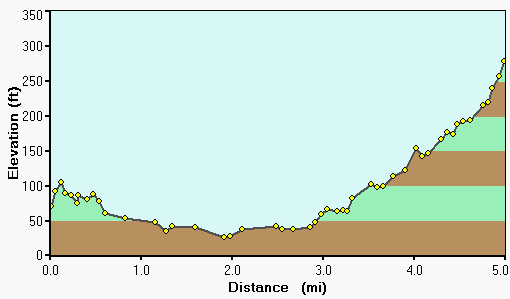
Elevation delta of my daily bike commute from home to UC Berkeley.
The device may look like a bit like a phone, but the similarity ends there. These things are capable of so much, I was totally unprepared for the learning curve it would bring. Tracks, routes, navigation, waypoints, points of interest, and the interfaces for managing all of them. Not to mention the huge variety of available software and the multitude of data formats that tags along.
The GPS universe is notoriously Windows-centric, but went with a Garmin in part because of their announcement that they intended to roll out full Mac support in 2007. But my unit came with a Windows-only CD, which meant hauling an old laptop out of the closet. Garmin.com has a few scattered Mac apps on their site, but nothing capable of loading maps and exchanging data formats. For that, you have to turn to workhorse open source apps like Babel, which get some of the job done, in a crude fashion. Found a few others, all with different strengths, but the killer one appears to be Google Earth, which (I didn’t realize until last night) is capable of connecting directly to popular GPS units and mapping their tracks and routes onto the the 3D surface — if you spring for the $20/year premium version. Still, an embarrassment of riches of mapping options is out there, some of them web-based.
Super impressed by the contact I had with Garmin tech support after I sent them email detailing some Mac issues and questions – expected a boilerplate response but got 6 paragraphs of info from a Mac-head employee and realized they actually care — unheard of!
Having fun so far*, but much learning to do, and haven’t set out on a geocache finding expedition yet.
* Today realized for the first time in five years of doing the same old trek that my daily ride covers 5 miles and a 200-foot elevation delta, and that my top bike speed is 31 mph, with an average speed of 15.7 mph. How could I have ever lived without this data?
Music: Minutemen :: Hittin’ The Bong
Collider VR
&tQuicktime VR at its finest: The Atlas target at the Large Hadron Collider, CERN, near Geneva.
When I see stuff like this, I always wonder why Quicktime VR never really took off. Examples of it aren’t unheard of, but given that it’s relatively easy to create QTVR files, I’d expect to see these things everywhere. Instead, Apple’s QTVR creation software became the only OS 9 software the company never ported to OS X. I’ve heard this is mainly because stitching software now comes bundled with most digital cameras, so there was little market left for it. But if every digital camera comes with stitching software, why isn’t QTVR ubiquitous?
via David Rowland
Music: Liz Phair;/a> :: Chopsticks