Whale Watchers

Whale watchers in Norway got more than they bargained for recently:

While the tourists were admiring one of the great mammals of the sea, a Norwegian whaling boat approached and shot the whale in front of their eyes.

There’s a sort of cultural schizophrenia here, a country profiting both from selling the right to watch whales in all their native grace and also to kill them for profit. Not that much different from our own bizarre contradictions (we eat cows but not horses, chickens but not cats… why?) But weird when two sides of the public mind collide so viscerally.

via Weblogsky

Bikes Inherently Dangerous?

San Francisco is home to the world’s most aggressive bicycle activists. It’s also home to one of the world’s most aggressive anti-bike activists. Dishwasher and blogger Rob Anderson has succeeded in convincing a judge to put a temporary halt to construction of any new bicycle lanes in the city, on environmental grounds (the lanes allegedly have “not received the level of environmental review required by the California Environmental Quality Act”).

Anderson’s premise is that bicycles are inherently dangerous and will therefore never become a realistic mass transit option. Apparently it’s never occurred to him that bikes are inherently dangerous primarily because of the extreme proliferation of cars?

Only thing worse than an irrational person is a mean irrational person. With power.

Chernobyl Legacy

Past threads about Pro-Nuke Greens have gotten me thinking hard about my life-long opposition to nuclear power. The arguments are strong. But I just spent some time immersed in Paul Fusco’s multimedia photo essay Chernobyl Legacy, and it’s very hard not to come away thinking, “It’s not worth it. We can’t take this risk.” Incredibly intense, moving, gruesome. Fusco narrates about how “they” assure us: “Yes, we made a mistake, but we’ve got it all figured out now. It won’t happen again.” But things that humans make can — and do — wear out, break. Maybe I’m just having an emotional reaction. But we weren’t there. We didn’t / aren’t living through the aftermath of Chernobyl. I somehow don’t think you could come up with any argument in the world to convince these people that humans should ever play with nuclear power again.

via antiweb

Lab Meat Redux

Wired covers the Test Tube Meat story. Short version: hamburger in two years, steak in 10 (steak requires better alignment of muscle fibers and the ability to recreate blood vessels running through). Stuff being grown without scaffolds in 1mm sheets, which can then be stacked to create thicker cuts.

The “yuck” factor: “But it’s not natural!” And how natural is it to stuff 10,000 chickens into a metal shed, snip off their beaks and pump them full of antibiotics and hormones? How natural is it for cows to eat corn? (which is pretty much all factory farmed cows eat, much to the detriment of their livers).

This research strikes me as a great leap forward in human consciousness. I hope that one day we’ll view factory farming as a barbarism of the past.

Previously: Lab Meat. See also Meat-Growing Robots (WTF?)

Technorati Tags: , ,

Doomsday Vault

In the Svalbard islands, floating halfway between Greenland and Norway in the Arctic ocean, researchers have begun construction of a vault designed to house seeds of all known varieties of the world’s crops, in the event of global catastrophe — a Noah’s Ark for the plant world.

The vault’s purpose is to ensure survival of crop diversity in the event of plant epidemics, nuclear war, natural disasters or climate change; and to offer the world a chance to restart growth of food crops that may have been wiped out. At temperatures of minus 18C (minus 0.4F), the seeds could last hundreds, even thousands, of years. Even if all cooling systems failed … the temperature in the frozen mountain would never rise above freezing …

The vault is eventually expected to house some three million seeds. And in case any smart-alec seed thieves get bright ideas, the place is crawling with polar bears.

Question: If nobody knows where the Svalbard islands are now, how the heck do we expect the few Mad Max humans who survive to figure out where they are, or how to get there? Oh, wait – Svalbardians will probably be the only survivors anyway, so they’ll be all set.

via antiweb

Music: Francois Bayne :: Rosace 3 from Vibrations Composees

Technorati Tags: ,

Lab Meat

In The Conscience of a Carnivore (“It’s time to stop killing meat and start growing it”), William Saletan makes an eloquent moral case for our coming ability to grow meat in giant petri dishes, rather than raising it the old-fashioned way:

Growing meat like this will be good for us in lots of ways. We’ll be able to make beef with no fat, or with good fat transplanted from fish. We’ll avoid bird flu, mad-cow disease, and salmonella. We’ll scale back the land consumption and pollution involved in cattle farming. But 300 years from now, when our descendants look back at slaughterhouses the way we look back at slavery, they won’t remember the benefits to us, any more than they’ll remember our dried-up tears for a horse. They’ll want to know whether we saw the moral calling of our age.

Apparently they’ve already succeeded in growing fish flesh in a dish, which looked and smelled good enough to eat (though FDA rules didn’t allow them to taste it). Pork isn’t far behind.

To me, lab meat seems like the ultimate extension of what we already do with factory farming and slaughtering, in terms of its sterility and the way it removes us from the natural life/death cycle. But lab meat has the added moral advantage of not involving sentient life, which should place a large swath of vegetarians and Buddhists in an interesting position.

The piece is also available as a podcast (Slate has become my favorite podcast subscription). See also: Why meat may not be murder.

Music: Stereolab :: Visionary Road Maps

Play Pump

Historically, villagers in water-starved areas have worked hard to manually pump contaminated water up from shallow water tables for drinking – water they then have to carry in buckets back to their homes. People spending their time as beasts of burden.

Inventor Trevor Field is bringing clean, fresh drinking water from deep underground to villagers across Africa with the Play Pump, which harnesses the limitless energy of kids. In place of the traditional hand-cranked pump, Field’s team installs a merry-go-round connected to a deep well pump on school playgrounds. The kids, who often have virtually no access to playground equipment, love it.

The Play Pump can be installed in a few hours for just $7,000, and can bring drinking water to more than 2,500 people — water that’s cleaner than what came from the hand pumps it replaces, since it comes from deeper underground.

Field then sells ad space on the pump’s reservoir to finance pump maintenance — and reserves one ad panel for AIDS awareness campaigns: “We’ve got to get the message through to them before they become sexually active,” he says. “It seems to be working.”

According to comments on the Frontline story, other companies are using similar solutions to generate electricity.
Music: Robert Wyatt :: Tubab

Flowers From a Dung Heap

Hot on the heels of Hercules’ recent victory over Wal-Mart, Mark Morford on the intended greening of “this most voracious and powerful of low-end, trashy retailers.”

Wal-Mart has already committed to selling 100-percent sustainable fish in its food markets. They are already experimenting with green roofs, corn-based plastics and green energy (which is now used to power four Canadian stores, for a total of 39,000 megawatts, amounting to what some estimate is the single biggest purchase of renewable energy in Canadian history). Is this remarkable? Groundbreaking? Utterly confounding? Well, yes and no.

The motive may ultimately be profit rather than a genuine interest in eco-health, and their move to sell organic food may undermine the critical “small and local” ethos, and there may still be a dozen other reasons to avoid shopping at Wal-Mart, but you gotta admit there’s something very wonderful in this, “like flowers from a dung heap, like vodka from old potatoes.”

Music: spot :: ray’s new sunglasses

Yeti Crab Walks the Earth

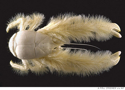
Ga Hairy Lobster More than a mile down, hanging out near thermal vents off the coast of Easter Island, scientists have discovered a creature “so distinct from other species that they’ve created a new taxonomic family for it.” The “furry lobster,” which has pincer arms twice as long as its body and which has only vestigial membranes for eyes, may use its fur to trap bacteria, which it then consumes. Or maybe not. This kind of thing fills me with awe.

Mark Morford of the SF Chronicle:

Just look. Kiwa hirsuta is just a little bit mesmerizing, strange, stirs up something deep and potent. An eyeless, albino, crablike animal, sublime and magical and perfect in its alien weirdness … like something straight out of a medieval bestiary, a Sendak book, a Castaneda shaman’s peyote dream. It’s not a lobster. It’s not a crab. It’s not anything anyone really understands — and why is it covered in silky blond hair? They don’t know that, either. It just is. Just one of those things. Like why the whales sing. Like why some parrots can tell you who’s calling before you pick up the phone. Like the existence of dark matter. We just don’t know. And what’s more, the sheer volume, the breathtaking amount of information we don’t know is so mind-boggling and perspective-humping that you take one look at the Kiwa and only say, Hi again, wicked gorgeous unimaginable vastness of the universe.

Music: The Congos :: Fisherman

Whale Falls and Mouthless Worms

Frankpressiworm Fascinating audio presentation by Marcia McNutt of the Monterey Bay Aquarium, comparing the challenges of undersea and outer space exploration. Making her point about how much incredibly surreal life still awaits discovery here on earth, McNutt described the (relatively) recent discovery of the Frankpressi worm, which has no mouth and no stomach. Found two miles undersea, the worm appears only during “whale falls” – when a whale corpse sinks to the bottom of the sea, delivering a 70-ton feast to the ocean floor. The worm attaches itself to the hull of the whale and grows “roots” which descend into the whale’s bone marrow, where they begin digesting food osmotically.

What really puzzled researchers was the fact that all of the worms appeared to be female — where were the males? Turns out the males live only inside the females. The males are tiny, yolk-like creatures that develop only to the point where they can produce sperm, at which point their growth is permanently stunted. Sounds familiar.

Music: Steve Hillage :: Fish Rising