Willful Infringement

New Media Musings’ J.D. Lasica reviews the documentary Willful Infringement for Mindjack. After having been crucified by Disney for creating trailers that included Mouse snippets, the director traipsed the country talking to people whose work had been stifled by overzealous copyright enforcement.

“He … interviews … a pair of party clowns in Anaheim, California, who were warned not to create balloon animals for kids that looked too much like Tigger, Barney, or the Aladdin genie.”

Question: If the same kind of “chilling effects” enforcement currently being leveled against any use of music or moving images had historically been imposed on quotations of text, how would our culture be different today?

“My mother was a children’s librarian, and she imbued me with a world view that culture is a conversation, that you don’t own stories, you share them,” he tells me. “What has happened over the past few decades is that culture has become privatized to the point where we’re now facing a crisis. We need to remember we can still quote and sample, we still have fair use. As a free culture, we’re still allowed to do things without permission.”

Music: Cocteau Twins :: Eggs and their Shells

Why Cell Phone Conversations Are Annoying

Why is it annoying to be in the presence of someone else’s cell phone conversation, especially on a train or other confined area? If pressed, most of us would probably say that “people talk too loud” on cell phones, which makes the calls more annoying than being in the proximity of a two-person conversation.

But the affect is actually more subtle than that. Andrew Monk and colleagues from the University of York did a pretty careful study, rating the impressions of standers-by after they had been surreptitiously exposed to cell phone and normal conversations at both normal and loud volumes.

Turns out it’s not so much the volume of cell phone conversations (though that’s certainly a factor) but the fact that a person is standing there talking apparently to no one. Psychologically, we just can’t filter this into the background as easily as we can a two-person conversation, which we (I’m surmising here) have evolved for millions of years to be in the proximity of. This of course raises the question of how many millions of years it will take for us to regard nearby cell conversations as perfectly normal.

Clearly, mobile phones score far worse than face-to-face conversations, confirming much anecdotal evidence. As we might expect, loud conversations score worse than quieter conversations. It’s striking, however, that mobile-phone conversations are judged more negatively than loud conversations. Participants even said that the volume of the mobile-phone conversations was more annoying than those that occurred face-to-face, even though the volume was the same, and was controlled by objective measures.

Music: David Byrne :: Wheezing

Greendale

Have been listening to Neil Young’s sonic novella “Greendale” for months – a somewhat disjointed portrait of three generations living in a small town, ultimately focused on granddaughter Sun Green, who awakens to her enviro self, takes over the lobby of Powerco, welds herself to the beak of a bronze eagle and becomes a media spectacle through the oracle of her megaphone (“Hey Mr. Clean, you’re dirty now too”).

Later realized that Young had made a movie out of Greendale — the whole thing shot on a Super 8 underwater camera (“That Super 8 grain looks like my music sounds“); the footage is grainy, never quite in focus, and seems to oscillate between 12 and 20 frames per second. The music is huge, deeply rocking. The stories are completely honest and uncomplicated — no symbolism at all. If a song mentions a rooster, Neil shows you a rooster. The characters speak every word of the songs. In anyone else’s hands, this kind of literalism would be corny, but Greendale is totally truthful, like almost everything Neil Young has ever made.

Music: Cosmic Jokers :: Interplay of Forces

China’s Chopstick Crisis

Usually when one hears about rates of global deforestation, you get stats such as “Amazonian rain forests are being decimated at a rate of 2.4 acres per second.” But recently I’m hearing more about the amount of forest being razed to create disposable / one-time-use chopsticks throughout Asia:

China now produces and discards more than 45 billion pairs of disposable chopsticks every year, cutting down as many as 25 million trees in the process, according to government statistics. Another 15 billion pairs are exported to Japan, South Korea and other countries. At the current rate of timber use, environmentalists warn, China will consume its remaining forests in about a decade.

And despite China’s great land mass, they’re importing 60 million cubic meters of timber yearly to meet demand. To make matters worse, the Chinese government actively encouraged disposable chopstick use for years to inhibit communicable disease. There is a nascent environmental movement in China which encourages people to carry their own non-disposable chopsticks, but I’ve heard from Chinese environmentalists that environmentalism in China gets even more strange looks than it does in the U.S.

So… what happens in a decade, when all of China’s forests are gone?

Music: Minutemen :: Beacon Sighted Through Fog

Triplets, Destino

belleville Watched The Triplets of Belleville with Amy tonight (see trailer). Refreshing to see animation that impresses not because of technical sophistication or by breaking any particular ground, but because of pure inventiveness — even though most of the film feels like it could have been drawn in the early 60s, the animators make choices that are impossible to justify even within the film’s own universe — such as the gorgeous and eerie, Giaocametti-tall ocean liners Mrs. Souza and her dog chase across the sea in a paddle boat. Likewise, the simple plot is peppered with such bizarre scenarios — picture three musical biddies who subsist on a diet of dynamited frogs navigating a steel ship of bicycles and a projector through a vision of paris where buildings have giant wine bottles built in, and you’ll start to get a picture of the imagination factor here. Unlike anything I’ve ever seen, but not just “weird” — it’s charming and truly beautiful.

Had read months ago about Destino – the 1946 collaboration between Salvadore Dali and Walt Disney, but never imagined I’d get to see it on the big screen. But we were lucky – Destino screened just before Triplets; perfect pairing. Much of it was exactly what you would expect from these two forces — the best parts were greater than the sum.

Image above snapped with phonecam during Triplets — this is why the Rolling Stones are cracking down on cell phone use at concerts – copyright grey area is simple and instantaneous.

Music: The Polyphonic Spree :: La La

tinywords

To lead a fulfilling life, one needs haiku beamed to one’s cell phone daily. Birdhouse is proud to host tinywords.com, home of a mailing list that takes advantage of the limited text capabilities of cell phones’ SMS-email gateway capabilities — haiku are perfectly suited for the size constraint. Of course you don’t need an SMS phone to sign up – any email address will work.

tinywords is the brainchild of writer and Mobile PC Magazine executive editor Dylan Tweney, whose weblog is also hosted here.

Music: Altai Hangai :: Mandukhai Khatan

Urban Freeflow

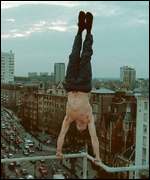
traceurFascinated by a new urban sport (perhaps sport is too controlled a word?) called Le Parkour, aka Park-Core, aka free running, aka Urban Freeflow. The idea is simply to move the human body through the environment as quickly and as fluidly as possible. There are good videos all over the net, although I’ve never seen so many 404s, slow servers and broken footage – must be something about the laissez faire atmosphere of the activity. Most of what you see is like skateboarders without the boards – 20-something men bouncing off walls, slithering under obstacles, doing hand plants from tall rails. I’m looking forward to seeing the art form mature, for Jackie Chan-like style and grace to become part of the improvisation. For someone to take it to a more Zen-like level, as opposed to the hardcore headspace of the skate crowd.

Update: See also House Gymnastics

Music: Koop :: Soul For Sahib

Thoughts on The Grey Album

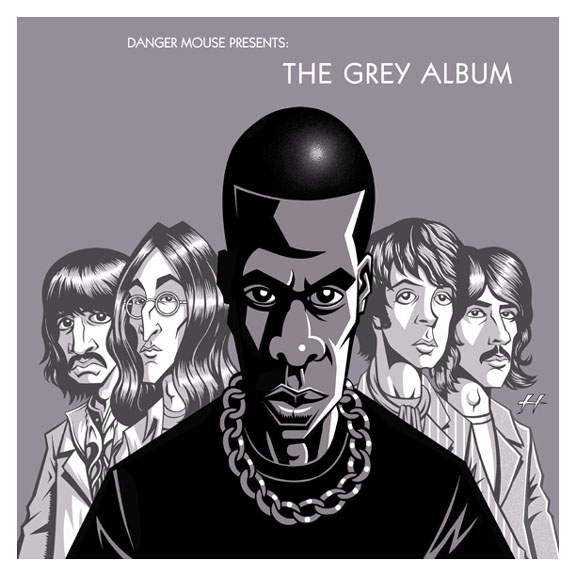
GreyAlbum DJ Danger Mouse’s The Grey Album has been on my iPod for a week now, and I’m still feeling conflicted by it. In case you’ve missed the story, executive summary: DJ Danger Mouse has taken Jay-Z’s “The Black Album” and remixed it with samples from the Beatles “White Album.” The results are brilliant, frustrating, obnoxious, beautiful, and an insult to the legacy of the Beatles (though ironically, probably intended as a tribute). If you haven’t heard it, download mirrors are all over the place. And EMI is dispensing cease-and-desist letters like Pez.

Looking at The Grey Album from three angles:

1) As a concept and a piece of technical wizardry
2) As a challenge to copyright law
3) As a piece of artwork

1) Technically, the Grey Album is a remixological wonder. Danger Mouse is a whiz. It’s a trip to hear such familiar strains hashed and rehashed and whipped up and layered back down with this kind of slick wrist expertise. It’s like there was an explosion at the LP factory and somehow all these disparate parts came back down to earth magically hanging together — all wrong, but still somehow totally in sync. While there are long-ish excerpts from The White Album, most of the Beatles you get here are new beats created by twisting and tangling and untangling snippets from familiar songs. Listening to this stuff, half my attention is busy marvelling at Danger Mouse’s skills.

2) It’s funny how this case overlaps with the Ken Light Kerry/Fonda case that’s been front and center for me at work lately – both involve two works by different creators being remixed by a 3rd party. In Light’s case, lawyers are trying to determine whether newspapers can run the composite/collaged image copyright-free or whether royalties are due. Striking parallels to the Danger Mouse project.

Last Tuesday, thousands of web sites mirrored copies of The Gray Album in an all-day protest called Grey Tuesday, the idea being that if enough people participated in the protest, they’d all get away with it. The Electronic Frontier Foundation has posted comments on the legal position of Grey Tuesday participants.

Napsterization wonders what your rights are “if you own the two albums outright already, and simply want the blended version, remixed?” Great question.

At Corante, Ernie Miller wonders whether some kind of remix formula or recipe could be created to allow consumers to recreate the Dangermouse mix from the two original sources, thus sidestepping copyright issues. I respond that the suggestion is similar to the technique used to distribute the lame MP3 encoder, thus bypassing Fraunhofer’s patent. But music is not a computer program, and I am highly doubtful that sufficient notation could be devised, or that anyone could enter in the data in sufficient detail to recreate the artwork.

3) No matter how marvelous the mix or how interesting the copyright questions, you’re still left with a work of art that somehow has to stand on its own, despite leaning so completely on the work of others. Bottom line: Is it a good record? Well, I’ve been listening to it for days, so it must not be a total abomination. But for the most part, I keep listening because I’m fascinated, not because I think it’s a particularly good record. I’m not much of a rap fan to begin with, and Jay-Z’s style doesn’t do much of anything to goose my predilections. As rappers go, his delivery is bland and his lyrics mediocre. It’s not all gangsta, but there’s way too much of this kind of crap (from various tracks):

All my wimmin get tennis bracelets…
Used to deal snowflake by the O.Z….
I like big-body Benzes…
Stay away from ho’s…
I got 99 problems but the bitch ain’t one…

So you get this amazing mix experiment, all these great old Beatles riffs chopped up tossed up chunked up in cruel and unusual (and very cool) ways, all colliding bizarrely with this semi-gangsta crap. The result is as depressing as it is amazing.

Yes, many of the lyrics are better than the ones I quoted, but bottom line is that Jay-Z’s rap is not worthy of The Beatles backing music (even remixed). In fact, it creates the opposite effect: You get the feeling that one of the greatest records of all time by one of the greatest groups of all time has just had mud ladled all over it. You hear these old Beatles samples, and those lyrics start running through your head. Then Jay-Z starts up with his juvenile patter and you just feel kind of robbed. Listening, I go back and forth between digging this whole crazy messed-up adventure on one hand, and feeling like a great chapter in human creativity has been totally desecrated on the other.

My favorite lyric on the album:

“And if you can’t respect that
your whole perspective is whack,
maybe you’ll love me
when I fade to black.”

Well, maybe. I like what Danger Mouse is trying to do from an experimental POV, I like the way he’s challenging copyright, I dig the beats, I enjoy hearing the Beatles in a totally new vein, but the rap pretty much cancels out any positive net effect. Not entirely, but pretty much. All told, I guess I just feel kind of grey about it.

Music: Jay-Z + DJ Danger Mouse :: Moment of Clarity

1958 Miscegenation Poll

Via Fabiani, via Atrios:

“In 1958, nine years before the Court ruled in Loving v. Virginia that miscegenation laws were unconstitutional, Gallup polled people about interracial marriages.

_____% of whites opposed them?

no cheating.

…and the winner is… 94%!”

So as appalling as it is that half of our society still has a problem with gay marriage, the big picture offers some comfort. 50 years ago, support for gay marriage would not be anywhere close to where it is today. We may not win this round, but the dialog has been advanced tremendously, and society as a whole is slowly waking up to the parallels between homophobia and racism.

We’ll get there. Someday.

Update: Top twelve reasons homosexual marriage should not be legal

Music: Momus :: Team Clermont

Dying Languages

By the time the 21st century runs out, half of all human languages will be extinct, victims of cultural and political forces, the spread of technology, and assimilation in general.

“What is lost when a language is lost is another world,” says Stephen Anderson, of Yale University.

I think there are multiple parallels to globalism and media consolidation here (e.g. the number of owners of TV outlets has decreased by 40% since 1995). Nature teaches us that biodiversity is necessary and good. Whether you’re talking about insect populations, languages, media outlets, or operating systems, there is greater systemic health when there is more diversity. And yet I can’t imagine a way to reduce the rate of language death — it’s simply an aspect of human history I think we will have to accept. And then one day we’ll all wake up speaking fluent TimeWarnerComcast-ese with a Microsoft accent. But at least we’ll all be speaking the same language.

Music: George Handy :: The Bloos