Best commentary yet on Christo’s Gates: The Somerville Gates. See About the Gates for a breakdown of differences in construction/installation expense, public attendance, etc.
Thanks Helen

Tilting at windmills for a better tomorrow.
Best commentary yet on Christo’s Gates: The Somerville Gates. See About the Gates for a breakdown of differences in construction/installation expense, public attendance, etc.
Thanks Helen
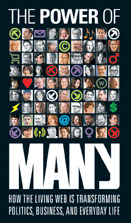
A couple of months ago, Christian Crumlish gave me a copy of his just-published book The Power of Many (How the Living Web Is Transforming Politics, Business, and Everyday Life). I’ve known Christian for a lot of years — back when Birdhouse was primarily an arts collective publishing “new media” works by artists discovering the web for the first time, he invited me to join antiweb (ironically no site currently online) — a loose collective of web developers scattered around the world, trying to find the capabilities and limits of the new medium. Christian, a writer of dozens of computer books, also ran Enterzone, an online literary e-zine.
Christian’s latest book is not only his first to appear in hard-cover, but also his first that’s not a technical/how-to; rather, it’s an exploration — at turns straightforwardly journalistic, nearly stream-of-consciousness, and scholarly — on the transformative power of online communities. Crumlish goes behind the scenes not technically, but anthropologically, examining how weblogs and wikis, social networking sites, web services, SMS, discussion groups, flash mobs, etc. have transformed the way people gather and organize, both online and in meatspace. And he chronicles his involvement in the web-savvy Dean campaign, his deep roots in the Grateful Dead scene (whose online existence in many ways mirrors the ethos of the Dead culture), wanders through topics ranging from spontaneously self-organizing micro-communities to well-funded corporate and political action groups.
On first discovering online journals, most people find them puzzling, a paradox. Who would put their private diary online? … Omigod, my mother read my blog! Indeed, there are countless stories of people who misjudged the effects of putting their thoughts and ideas into the public domain and who lived to regret the confidences broken, the parties offended by their snarky comments, their exposed secrets. In time, though, anyone who continues the exhilarating tightrope walk of online self-examination will manage to cultivate that gray area between public and private that seems just personal and revealing enough to draw in readers and invite scrutiny but that still holds back what truly belongs out of public view entirely.
Christian has always kept a finger in each of a dozen pies — I can never keep up with all the simultaneous online ventures he manages to keep afloat. His Radio Free Blogistan is another great read. And I still love his early hypertext fiction piece No Bird But an Invisible Thing.

Saw a frightening 60 Minutes special a few months ago on the “art” of Thomas Kinkade:
Who is the artist who has sold more canvases than any other painter in history? More than Picasso, Rembrandt, Gaughin, Monet, Manet, Renoir and Van Gogh combined? If you didn’t say Thomas Kinkade, then you’ve been shopping in the wrong places. He is the most collected living artist in the U.S. and worldwide. He produces paintings by the container load. And he is to art what Henry Ford was to automobiles.
At Strata Lucida, Chris draws out connections between uncritical Kinkade fans (not that it’s wrong to want to be soothed every now and then, but some of these folks are adamant that art which challenges is pointless) and uncritical rock fans (those who can’t brook any challenge to their fave band’s greatness, or who suffer from the “[my pet band] can do no wrong, all Zep moments are equally good” syndrome).
I do tend to agree with most of Zeppelin fans in the Trickster thread than not (I don’t think big hair or Tolkein quotes are marks against Zeppelin — dude, that’s what they’re about!) But we have been hearing more backlash against “fine art” lately.
Full circle to 60 Minutes: Andy Rooney launched a tirade against the majority of publicly funded art installations the other night. Rooney’s piece smacked of “I just want to be soothed by public art — where are the good old statues?” But yes, I know there’s a hell of a lot of bad public art out there.
Overheard during the holidays:
“Have you noticed that the tsunami only affected non-Christian countries? God has ways of making his point.”
Since I am resolved to be less judgmental this year, the comment will have to speak for itself. Suffice to say I couldn’t decide whether to roll my eyes or be infuriated.
In 1948, Yugoslavia was on the brink of war with the Soviet Union, tanks lined up at the border. Suddenly:
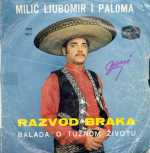
Yugoslav authorities had to look somewhere else for film entertainment. They found a suitable country in Mexico: it was far away, the chances of Mexican tanks appearing on Yugoslav borders were slight and, best of all, in Mexican films they always talked about revolution in the highest terms. How could an average moviegoer know that it was not the Yugoslav revolution?
With the newfound popularity of Mexican culture, Yugoslavians started donning sombreros, pulling ponchos over their heads, and making faux-Mexican records. “The Mexican influence spread to all of the popular culture: fake Mexican bands were forming and their records still can be found at the flea markets nowadays.”
Great album covers and thrilling lo-fi MP3s.
via Boing-Boing.
AP: Nearly half of all Americans believe the U.S. government should restrict the civil liberties of Muslim Americans.
The survey conducted by Cornell University also found that Republicans and people who described themselves as highly religious were more apt to support curtailing Muslims’ civil liberties than Democrats or people who are less religious.
The researchers also found a high correlation between people who consider themselves highly religious, people who believe in curtailing rights of Muslim-Americans, and the amount of TV news consumed.
While researchers said they were not surprised by the overall level of support for curtailing civil liberties, they were startled by the correlation with religion and exposure to television news. “We need to explore why these two very important channels of discourse may nurture fear rather than understanding,” Shanahan said.
Saddened by the news that Martin Luther King’s daughter Bernice King led a march to her father’s grave which, among other things, promoted a constitutional amendment stating that marriage be defined as man/woman. Bernice King is leveraging her father’s legacy not to promote civil rights, but to work against them.
King’s widow Corretta Scott King has stated that “King would be a champion of gay rights if he were alive.” In fact, she has specifically called gay marriage a civil rights issue, and has denounced proposed amendments to ban it. SF Chronicle:
The Rev. Bernice King and march organizers deliberately chose King’s resting place in Atlanta to imply that he would have stood with them. But Martin Luther King’s uncompromising battle against discrimination during his life — and his persistent refusal to distance himself from a well-known gay civil rights leader — show that King never would have endorsed an anti-gay campaign.
To me, this looks like a triple slap in the face: A black woman fighting against civil rights, indirectly speaking for her father when he can’t speak for himself, and waging her war of hatred at her father’s grave site.
A friend recently made the point that the fight for black/civil rights is not a good analogy to the fight for gay rights because race is truly a fact of birth, while the question of whether homosexuality is a fact of birth or choice is open for debate. I’d counter by saying that only non-gays believe this question is up for debate — I’ve certainly never met a gay person who felt they chose the path without feeling an inner/natural draw. If there are gays who don’t think they were more or less “born gay,” they’re very rare.
But whether protestors of Bernice King’s march are right or wrong in drawing the comparison between civil and gay rights does not change the fact that she is almost certainly misrepresenting her father, and has acted disingenuously by hanging a personal agenda on her father’s grave.
Heading down into the BART tonight, a few minutes to spare before my train arrived, reached for a handful of misc newspaper fragments in the recycle bin next to the turnstile, as usual. A man was standing on the other side of the bin with a dirty sweatshirt, long reddish ZZ Top beard, sparkling blue eyes. Possibly homeless. I passed over a few uninteresting bits (sports section, this morning’s headlines), and picked up the business section, just to see what’s shakin’. The man suddenly looked up, gazed sincerely and peacefully into my eyes, and spoke:
“Dylan said, ‘Money doesn’t talk, it swears.'”
Something about him seemed so gentle and kind and understanding, I didn’t feel any response was necessary. Strange but comforting to hold a stranger’s gaze longer than the socially normalized timeslice. He knew I understood what he meant. Wished that life was made of more of these moments.
Had the privilege last night of viewing an almost-completed documentary by J-School student Jigar Mehta on the problem of endemic slavery in Mauritania, where light-skinned Moors have for centuries been enslaving sub-Saharan blacks. Although the government of Mauritania has decreed slavery illegal three times in the past twenty years, it turn a systemic blind eye, chases out journalists, and has even abolished the word “slave” from the vocabulary.
The problem is made more complex by the fact that Mauritania is so poverty-stricken that many slaves feel they’re economically better off being owned than being on their own — freed slaves have been known to return voluntarily to their masters (some masters are abusive, others relatively “civilized,” apparently). And it’s culturally and religiously embedded: Children born into slavery are taught that their enslavement is part of their duty to God.
Another interesting twist: Although the country was until recently a vocal critic of the United States, the discovery of oil and the recent installation of drilling rigs off the Mauritanian coast (expected to double the country’s GNP) has coincided with them suddenly turning against Saddam Hussein, switching their official state position to pro-Israel, etc.
A Mauritanian slavery watch group, working underground to document details on tens of thousands of slaves (and in some cases freeing them), has produced a report which was recently accepted by the U.N.’s human rights watch group.
Mehta’s documentary, which is exceptionally well-produced, is not yet available for public viewing. Will post again when it is. Here’s a 2001 NPR story on the subject.
SF Chronicle: Paleo-con parents out of control. A Texas school had a yearly day set aside when boys could dress in girl’s clothes and vice versa. Some parents (apparently under the influence of the anti-gay mania sweeping the country ever since Kerry promised to force all gays to marry) decided that the “cross-dressing day” promoted homosexuality. The tradition has been swapped out for “Camo Day,” wherein students get to wear black army boots and camouflage to school. Now that’s emotional health!