Interface of a Cheeseburger

Information Architects Japan: The Interface of a Cheeseburger, on how Interface = Brand. On how you can have a bad, ugly product and still be successful if you have a great UI. On why the iPod’s logo is on the back of the device, not the front.

The cheeseburger has the easiest food interface one could think of. No forks, no knives, no spoons, no plates, no chopsticks. Like a sandwich, but softer and sweeter and above all: Standardized. No alarms and no surprises when eating a cheeseburger. Almost as simple as “the only intuitive interface” – the nipple. Sandwiches can be complicated at times.

Music: Tom Waits :: Altar Boy

Kayak Adventure

Kayak Berkeley Miles and I lucked out today and discovered that the Cal Outdoor Club at the Berkeley Marina had public kayak rentals for the last day of the season. Absolutely perfect weather. Thought he’d get bored, but he was way into it. Spent an hour paddling around the Marina and ventured into SF Bay, then went under a long pier where we got to watch a 3-ft. leopard shark get pulled out of the water right in front of us by a fisherman up on the pier above. Wonderful vantage point to witness nature struggling with man.

After an hour, I asked, “Miles, should we go back to the dock or should I keep paddling?” Miles answered “I’m going to lay down on my back [and he did, gazing up at the sky]. Everything I see in the whole world is blue! You keep paddling, daddy.”

Miles Boathead Afterwards we went to the Adventure Playground, across the street – a park that the kids themselves get to build and paint – all scrap wood and old pianos and boats and bicycle parts, etc. If you’ve never seen a two year old wielding a hacksaw, you ain’t lived. More on adventure playgrounds.

Miles Skronkpiano Check Miles throwing down some way out skronk jazz, doing the Cecil Taylor thing on an abandoned piano. The sign reads “Do not hammer, stand, or paint on the piano!” (other pianos there are hammerable and paintable). Forgot to set the white balance on the camera so these came out all blue. Did my best to correct them, but they’re a bit noisy now. At home he was gazing out the living room window as the sun went down. “Already? I don’t want this day to end!”

Music: Kid Koala :: Nerdball

Botnets on the Rampage

“There has been a 67 percent increase in overall spam volume and a 500 percent increase in image spam since Aug. 2006.”
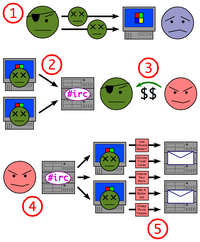
Botnet Illuminating (but seriously depressing) series of articles at eWEEK on botnets — arrays of 0wnz0r3d Windows computers assembled under the control of sophisticated “bot herders,” silently pumping every orifice of the interweb full of spam in all its forms. The virus that makes a machine part of a botnet does not cause harm to its host – like all successful viruses, it wants to assure its own survival. Amazingly, the latest generation of botnet software even installs antivirus software (a pirated copy of Kaspersky Anti-Virus, to be specific) to eradicate competing malware, so it can have the full resources of the infected host to itself.

For a while, it looked like botnet activity was shrinking, but lately it’s seen a huge uptick. vnunet reports that a million-bot botnet is quietly being assembled around the world, and that we’ll soon see an even more massive onslaught of phishing and spam attacks.

The sophistication of these systems is amazing — the botnets even come with their own self-contained DNS system. “This allows a bot herder to dynamically change IP addresses without changing a DNS record or the hosting—and constant moving around—of phishing Web sites on bot computers.”

So can’t botnet hunters just focus on nailing the central command and control machines? Nope – that’s the “beauty” of using a peer-to-peer model:

Control is still maintained by a central server, but in case the control server is shut down, the spammer can update the rest of the peers with the location of a new control server, as long as he/she controls at least one peer.

One of the many factors that makes fighting back so hard is that infected bots expect incoming commands to be digitally signed. Commands from the bot herders to members of the botnet are securely encrypted, and virtually impossible to decipher or reverse-engineer.

The sophistication of modern spammers is impressive on so many levels. Image spam (e.g. Viagra ads that appear as graphics rather than text) has been especially vexing lately, as it seems to elude all filters. Since almost all anti-spam mechanisms — even collaborative ones like Akismet — rely to some extent on the ability to deduce unique “signatures” from a message, every single image sent by machines on a botnet has slightly different dimensions and characteristics, making it nearly impossible to nail down. I’ve even noticed random graphical noise splattered in the background of image spam lately – which prevents any two images from producing identical signatures.

I think I was wrong when I said recently that my IP firewalling script was becoming less effective because spammers had learned to spoof IPs. I believe now that the problem is that the botnets are so widely distributed that the same IPs don’t come up with enough repetition to be useful. Rather than spam spewing from a volcano somewhere in the Ukraine for a few days, it’s now more like a steady mist that suffuses the atmosphere – an endless acid rain emanating from everywhere at once.

What amazes me is that articles like this never seem to point out the obvious: The botnets are comprised entirely of Windows machines. There are currently approximately 5.7 million infected Windows computers out there, ready and able to join a botnet at any time. If I were the sysadmin of a Windows network, this would be significant information to me. It’s not that OS X or Linux are theoretically incapable of this kind of takeover, but the plain reality is that it doesn’t happen. And yet, articles like this never make a recommendation that admins consider a platform shift. Why?

Sadly, experts are starting to feel hopeless about their prospects of staying in front of the game.

We’ve known about [the threat from] botnets for a few years, but we’re only now figuring out how they really work, and I’m afraid we might be two to three years behind in terms of response mechanisms,” said Marcus Sachs, a deputy director in the Computer Science Laboratory of SRI International, in Arlington, Va.

Amazon is having serious issues with spam, as is del.icio.us. Of course one would expect large services to be constantly hammered with spam, but if the largest and best-funded commercial entities on the web can’t keep spam off their public doorsteps, you know things are getting serious out there.

It’s becoming increasingly popular for admins to block entire nations, either at the apache or at the firewall level. I’ve been tempted to do the same myself, but haven’t. Yet.

All of this applies to the interactive aspect of the web as much as it does to email. I deal with it on wikis, discussion boards, blogs, and apache logs (referrer spam). In recent months, I’ve seen them stuffing personal contact forms, and even the public jobs database at the j-school (which is absurd, since no job ever gets published without human review, but that doesn’t stop them from trying). Amidst all the Web 2.0 talk of participatory journalism, the wisdom of crowds, the read/write web, and two-way communication, it’s those very features that are being exploited by spammers and the massive botnets.

I worry that the openness that made the internet possible will ultimately become the sword upon which it impales itself. I see a future where everything is so locked down that all of the fun participatory stuff becomes impossibly difficult. I worry that someday email will only be feasible with whitelisting, that registration with identity verification will be required for all participatory web features, and that the concept of anonymity will ultimately become untenable.

Compare the atmosphere of the internet to the ecology of the earth. It took us millions of years to get to industrial civilization, then just a few decades to pollute our environment to the brink of sustainability. I worry that the internet is following a similar course – 30 years to become mainstream and five years to become so polluted it’s unusable.

Thanks Mal

Technorati Tags: ,

Web OS

The process of getting images out of your camera and onto Flickr is completely different from the process of getting your videos onto YouTube. How do you decide what to store at MySpace or Friendster and what to store on the personal web space provided by your ISP? For many users, these are difficult decisions and even harder tasks – huge barriers to entry for big chunks of the population. David Kushner for Spectrum: “The mess of the Web, in other words, leaves you trapped in one big tangle of actions, service providers, and applications.”

IEEE Spectrum profiles Firefox creator Blake Ross, and describes his latest project, an open source, web-based, personal and/or shared desktop called Parakey, which aims to provide a unified desktop on the web — one that other people can visit, and one that lets you decide what content to share and what to keep private. Parakey will communicate with your home computer, keeping all the right stuff in sync. One step closer to that holy grail of an entire Web-based OS.

Right now, the Parakey front door is devoid of content or clues. But if Parakey take-up turns out to be anything like Firefox adoption (“People are switching to Firefox at the rate of 7 million per month”) things are going to get interesting.

Music: Culture :: Two Sevens Clash

Knight Project

Attilla Came home to one of Miles’ excellent “projects” tonight. His description:

“The ghost took the princess’ hat and then she waked up in the morning and she was going to feed her cat but she had no cat because the ghost took it and he took it to a blue mountain and then all the knights hurried to the mountain and then they climbed up it and this knight stabbed the ghost and then one of the ghosts put the kitty in his hat and the kitty had arrived in his hat to the princess’ home and then they all had a celebration for saving her cat.”

Flickr set

Music: The Pastels :: Attic Plan

iPod Owners: Just Thieves

Flash back to the cassette tax of the 80s, when labels assumed that the vast majority of blank cassettes would be purchased to pirate music, and were able to push legislation forcing cassette manufacturers to share proceeds with the labels. Now flash forward to the present:

Universal Music Group refused to license its music to the Zune unless it could receive a percentage of each device sold, in addition to standard music licensing fees for downloads and subscriptions. “These devices are just repositories for stolen music, and they all know it,” UMG chairman/CEO Doug Morris says. “So it’s time to get paid for it.”

In practical or percentage terms, UMG is not entirely wrong – of course most iPods carry pirated content. It’s the presumption of guilt that galls me. In addition to pirated content, iPods/Zunes etc. also carry a huge honkin’ ton of A) Music ripped from people’s own CD collections, B) Music purchased from services like eMusic, iTMS, Rhapsody, etc., C) Podcasts, D) Music provided for free download by bands on MySpace etc. In fact, I’d wager that a much higher percentage of content on the average iPod is legitimate than was on the average cassette tape.

Taken as a whole, that’s a helluva lot of legitimate content, and a whole lot of people being tarred/taxed unfairly with the “pirate” flag.

Music: Brian Eno And John Cale :: Crime In The Desert

Warhol Used an Amiga

The night the Amiga was introduced to the world, Andy Warhol used one to paint a portrait of Debbie Harry, like only Warhol could. In the months that followed, Warhol acquired a bunch of Amigas, and used them to create what is/was probably the first digital art film. Never released, You Are The One had been, until recently, only rumored to exist. Artdaily:

Long believed lost, this short masterpiece (20 painted frames) was reconstructed by Arnie Friedhoff and his team at ITN on a retro-fitted Mac G5 and reunited with what is believed to be its original soundtrack (also discovered on another floppy disk marked in Warhol’s familiar scrawl “soundtracks for imaginary movies, i.e., you are the one”. Now, after five years of painstaking archival reconstruction, YOU ARE THE ONE is being debuted for the first time anywhere at the Museum of New Art (MONA).

“However, due to threatened legal action tied to estate disputes and to its pending seizure, the museum will only be allowed a one day screening of the film.”

Thanks Mal

Music: Daniel Johnston :: Laurie

The Devil and Daniel Johnston

Yipjump Just finished watching the 2005 documentary The Devil and Daniel Johnston, which has left me feeling both limp and elated. Johnson is a manic depressive singer/songwriter with delusions of grandeur, who has grappled with downward spirals and dangerous encounters throughout his life. His songs are simple and raw, but emotionally complex, sometimes naive, sometimes overflowing with religious fervor, the purest of love (mostly for a girl he was obsessed with 20 years ago). Every song in his catalog of 20+ cassettes is absolutely raw. His drawings and cartoons are as strange and amazing as his music.
In the mid-80s, Johnston became a favorite of the alt-rock scene, and he worked (loosely) with Sonic Youth, Half Japanese’s Jad Fair, Yo La Tengo, Mike Watt, and others. His involvement with the Butthole Surfers ended strangely after the already tottering Johnston ingested LSD at a Surfers show and met the devil head-on. It’s implied that the trip sparked his religious obsessiveness, and that he never quite recovered (Gibby Haynes is interviewed for the film while having his teeth drilled by a dentist). Later in the film, Johnston refuses a bountiful recording contract with Atlantic Records because Metallica is also on the label, and Johnston is convinced the band will beat him up.

In an interview with his parents, Johnston’s father describes how his reading of a Casper the Friendly Ghost comic book led to him taking over their self-piloted airplane and crashing them into the woods. They barely escaped with their lives, but in Daniel’s mind, they became heroes in the Lord’s service. It’s all so fragile and frightening and weird.

Johnston has filmed and taped obsessively since he was very young, and the documentary milks the resulting library of self-recorded material in such a way that you feel incredibly close to his life – and his life’s work.

All of Johnston’s self-released cassettes are available on eMusic.

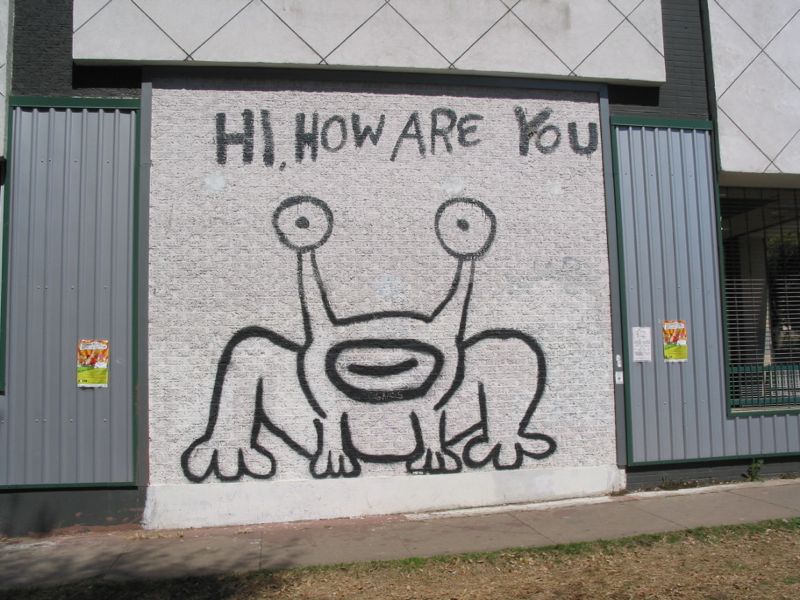
Hi How Are You
The Daniel Johnson mural on Guadalupe in Austin, TX. Click for larger version.

Music: Daniel Johnston :: Never Relaxed

Like

I wannabe like Paris Hilton! No, wait – I wannabe like Tom Cruise. No, wait… I wannabe a wannabe. A new site called like.com (not linking because I don’t feel like lending them the Google juice) features pictures of celebrities with their shoes, watches, handbags, etc. highlighted. Click the highlighted region and the site instantly shows you where to buy the items your heroes are wearing. So you can be like them. Because that’s all it takes, right? If only I had the right watch, I’d be more like Diddy.

This whole thing just reeks to me. As if the whole culture of celebrity isn’t odious enough all by itself, now we need help from sophisticated image recognition technology to sell it back to us a second time. Ewww.

Music: Moondog :: Nero’s Expedition