J-School Web Dev, Tech Training Positions

Want to work with me? We have openings at the UC Berkeley Graduate School of Journalism for a technology training instructor and a pair of web developers. The technology training instructor runs workshops for mid-career journalists on new technologies reporters and editors should be using, as part of our growing Knight Digital Media Center (more on that another day). The two web developers work on the various web sites run by the school and its affiliated programs. Job links:

Technology Training Instructor

Web Developers

Music: Louis Quatorze :: (I Feel Like) Cleopatra

FileTypes for OS X

The fact that OS X still has no central FileTypes preferences panel for controlling associations between file types and the applications they launch in, defining new file types, seeing and editing metadata associated with filetypes, etc. is, IMO, a glaring omission from OS X. BeOS, of course, had File Types nailed. OS X has inherited and expanded on a lot of great ideas from BeOS over the past few years, but for some reason still keeps this kind of control out of the user’s hands (you can set the application associated with a file, or with all files “of this type” from Info property panels, but seriously – this kind of functionality should be baked into the system preferences panel.

The excellent RCDefaultApp gives you the control you’re looking for. Let’s just hope something similar is in Leopard.

Death by Numbers

OK, you already know this, but still fascinating to see the numbers spelled out. Your chances of dying in a plane crash are approximately 1 in 20,000; chances of dying in an auto accident roughly 1 in 100. And yet the thought of going down in a burning plane perpetually occupies a special fear-spot in the public imagination.

As our media wrings its hands relentlessly over the 11 victims of Minnesota’s Interstate 35 bridge collapse and the nine missing Utah coal miners, 42,000 people will die of cancer this month. “Meanwhile, 3,000 people, mostly sub-Saharan African children, will die today of malaria with nary an Associated Press story to spread the news.”

We care, but the diseases and the car wrecks that kill thousands of us every day are so common that they’re the opposite of news. They’re also usually too frightening to contemplate. Freak accidents, in contrast, are freakishly comforting.

Plastic Bags Are Killing Us

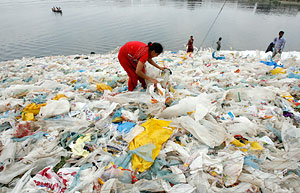
Plastic BagsOnce upon a time, the “Paper or plastic?” question seemed like it could go either way. Choose plastic and you’re choosing something that may be stuck in landfills for hundreds of years. Choose paper and you’re sacrificing trees (“it takes 14 million trees to produce the 10 billion paper grocery bags used every year by Americans”). But it’s way more complicated than that. From an excellent article at Salon:

Every year, Americans throw away some 100 billion plastic bags after they’ve been used to transport a prescription home from the drugstore or a quart of milk from the grocery store. It’s equivalent to dumping nearly 12 million barrels of oil. … Only 1 percent of plastic bags are recycled worldwide.

The bags look like jellyfish to a lot of marine life. The bags that don’t get “eaten” become part of the flotsam that now clogs every square inch of the world’s now fully plastinated oceans (some sections of ocean now carry 6x more plastic than biomass).

more than a million birds and 100,000 marine mammals and sea turtles die every year from eating or getting entangled in plastic. The conservation group estimates that 50 percent of all marine litter is some form of plastic. There are 46,000 pieces of plastic litter floating in every square mile of ocean, according to the United Nations Environment Programme.

Despite the hopeful-looking recycling symbol on the side of most plastic bags, recycling centers can’t handle them – they bring most recycling equipment to a screeching halt. You’re better off bringing them back to the store where you got them.

“The only salient answer to paper or plastic is neither. Bring a reusable canvas bag, says Darby Hoover, a senior resource specialist for the Natural Resources Defense Council.”

Sadly, environmental incentives to get people to bring their own canvas bags shopping have never worked. But economic incentives might. IKEA now charges customers five cents per plastic bag, and donates the proceeds to an environmental working group. Fashion might work too:

Bringing your own bag — or BYOB as Whole Foods dubs it — is the latest eco-chic statement. When designer Anya Hindmarch’s “I am not a plastic bag” bag hit stores in Taiwan, there was so much demand for the limited-edition bag that the riot police had to be called in to control a stampede, which sent 30 people to the hospital.

Earthresource.org is running the Campaign Against The Plastic Plague.

Karma Credits

As the neocon backlash continues to swell, the “I told you so” temptation grows. Liberals: Right about the environment, right about the war. On a similar tack, the always astute (though often overly wordy) Mark Morford, for the SF Chronicle:

The hippies had it right all along.

All this hot enthusiasm for healing the planet and eating whole foods and avoiding chemicals and working with nature and developing the self? Came from the hippies. Alternative health? Hippies. Green cotton? Hippies. Reclaimed wood? Recycling? Humane treatment of animals? Medical pot? Alternative energy? Natural childbirth? Non-GMA seeds? It came from the granola types (who, of course, absorbed much of it from ancient cultures), from the alternative worldviews, from the underground and the sidelines and from far off the grid and it’s about time the media, the politicians, the culture as a whole sent out a big, hemp-covered apology.

Here’s a suggestion, from one of my more astute ex-hippie readers: Instead of issuing carbon credits so industrial polluters can clear their collective corporate conscience, maybe, to help offset all the damage they’ve done to the soul of the planet all these years, these commercial cretins should instead buy some karma credits from the former hippies themselves. You know, from those who’ve been working for the health of the planet, quite thanklessly, for 50 years and who have, as a result, built up quite a storehouse of good karma. You think?

via Tim Bishop

For Want of a Washer

Tiny drip in the supply hose from a valve under our sink to our dishwasher yesterday. Unscrewed the connector, re-taped it with Teflon, and … the leak continued. Ah – must be the washer in the braided hose! Removed it again and dug at it with a razor blade until the old compressed one finally pulled free (in shreds). Off to Ace for a replacement. Dozens of types of plumbing washers in cute little bins, but — uh oh — none in the size I needed (3/8″). They had 1/2″ versions, but nothing a smidge smaller. Talked to the employees, who said they didn’t sell them, never had. One employee said that in six years of working in hardware, she’d had a ton of requests, but that they had never sold them – didn’t even think they were available. Though she wasn’t sure why.

So here’s where the day gets complicated. Rather than a 10-minute job and a .25-cent washer, it was starting to look like replacing the entire braided cable ($16). And that meant pulling the entire dishwasher… which meant pulling the baseboards out from under the kitchen cabinets. And that’s how simple jobs turn into all-day affairs.

Got it done before dinner, but the whole job took three hours (including trips to the hardware store), some bruised knuckles, a good dose of swearing, and a ton of disbelief. Why in the world would they not sell 3/8″ conical washers? Some arcane historical reason? A good (but opaque) reason? No profit in it (come on, the rubber washer industry is no profit center for anyone). Or did I just get totally bogus information? But our Ace has everything, and super-knowledgeable employees. I don’t get it.

Music: Funkadelic :: Promentalshitbackwashpsychosis Enema Squad

CableCard

David Pogue:

What if I told you about a new product that could improve your TV picture, eliminate one of your remote controls, simplify your home-theater setup and save you money every month? And then what if I told you that your local distributor wished, in its heart of hearts, that nobody even knew about it?

On July 1, the FCC passed a ruling requiring cable companies to supply set-top boxes that come with a removable CableCard. Even better, many new televisions include a CableCard slot that lets you eliminate the set-top box altogether. With a CC-enabled TV, your cable goes straight into the TV, letting you declutter the space, ditch a remote, free up a wall receptacle, and eliminate an analog-to-digital conversion step. Oh, and it’s cheaper (usually around $1.50/month to rent from your cable company, compared to around $6 for a set-top box). Finally, it will soon be possible to slip your CableCard into other devices (like laptops, hand-held units, etc.)

So why don’t the cable companies want you to know about the card? Simple: CableCard communication is one-way, meaning you can’t order movies on-demand through them, and they can’t send stats on your viewing habits upstream to the mothership. No wonder you’re not seeing your local distributor pushing these in the Sunday paper.

The FCC made the right call on this one. Now all I need is a bit of time to watch TV.

Music: Grateful Dead :: Infared Roses

God, Sex, and Family

Posted a while ago about the Moral Compass produced by some of our recently graduated students as part of the News 21 Initiative on the Future of Journalism (News21 is a collaborative effort between four J-Schools). This year’s theme is “Faces of Faith in America,” and the Berkeley piece of that is called “God, Sex, and Family.” Most of the content from all four schools is in now, and the project has shaped up as an extremely well-rounded snapshot of the myriad ways religion plays out in American life.

So much at the site I’m not sure what to point to (and I haven’t begun to read it all). The tent city multi-religion conference inside Second Life was incredibly ambitious (catch a full video snapshot of the event here), and the Data Road Trip provides some fascinating perspectives into everything from Bronx abortions to Arkansas divorce rates. I appreciated this brief interview with atheist Sam Harris, who (to my surprise) says he prefers not to be called an atheist: “atheism is not a good term because it requires defining oneself in opposition to an arbitrary group.” I really appreciated that he made the point that atheism does not imply not having a spiritual life.

Anyway, there’s tons there – dig in. And leave comments if you got ’em – the fellows would love to hear your feedback.

Music: Black Heat :: Wanaoh