
The People That Live in the Walls

Miles’ first close school friend moved away about six months ago. Though they seldom communicate, he’s constructed an elaborate long-distance relationship in his mind. Details change daily, but he consistently refers to “Master Patrick” and to being a member of “Master Patrick’s Army” (which is funny because Patrick is the most peaceful, charming little boy you ever could meet). This morning, Miles gave me a full run-down on how they keep in touch.

I communicate with Master Patrick by electric toilet paper. How does it work? Your voice gets stored in the walls. Patrick has to sit in a electric costume box at his house and the sound comes out of the box. The people in the walls help move the information from the electric toilet paper to Patrick’s costume box.

On the other end it goes into the tube which stores information and when I turn the light on, press inside of it and turn it off, and when I throw up they take out their swords and cut up the germs.

The people who live in the walls are basically … the grownups are from your desk up to here (points to height of an iphone). The children are from your desk up to here (points to the height of a glue stick).

At Christmas they get presents too, from Santa. They like rocks, wood chips, and leaves. There’s a hole in the chimney and some of the presents miss going down the chimney all the way. They go into the hole instead and that’s how the little people get them.

Wherever I go, they go. They jump inside the suitcases when we take a plane.

I’m moving all my Master Patrick stuff from my bedroom to my Clubhouse #1 which only kids can go inside.
Moon Gate

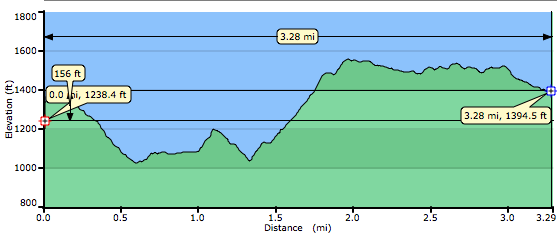
Despite yesterday’s post on difficulty of getting the sapling out of the house for family hikes, had the opposite experience today. Last day of long weekend, yet another unexpectedly gorgeous mid-winter day, the three of us headed for Redwood Regional for a strenuous but truly awesome three-miler. Started at Moon Gate staging area, then descended deep into a valley of giant redwoods, down with the dinosaur ferns and cool streams. Ironic – sunny day, but spent the afternoon in deep shade, beyond where rays could penetrate. The squirt was great and scampered down trails and across logs fallen over creeks just like old times. Hardly a complaint. Fantastic day.

Finally got around to figuring out how to edit GPS tracks with Garmin Bobcat (stupidly renamed Garmin RoadTrip), and upload to TrailGuru:

(press Replay for trail animation). Elevation map screenshot from RoadTrip:

Elevation plot:

Not That Kind of Guy

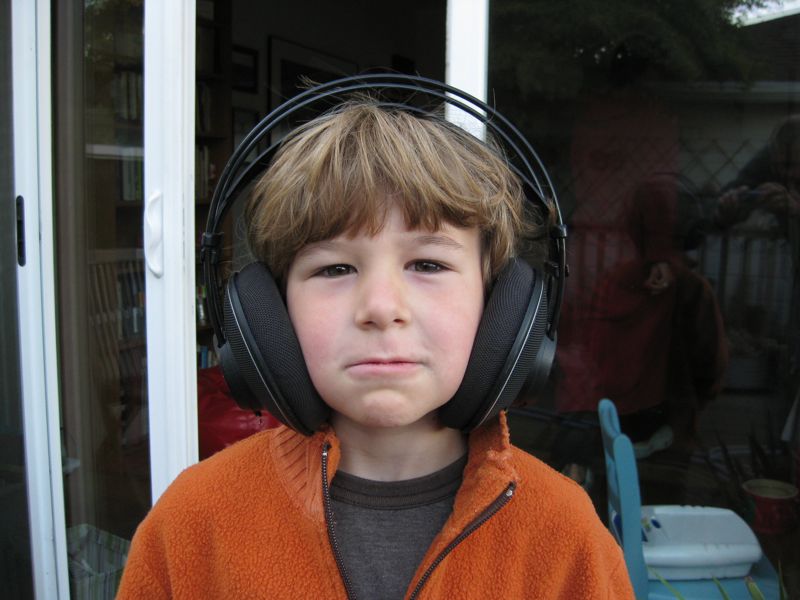
Miles-Headphones If you’ve been following my geocaching rants for a while, you’ll know that my son Miles (6) has been my constant caching companion for the past couple of years. Since he was 4 1/2, I’ve been able to blurt out “Let’s go grab a cache!” and he’s been ready to hit the trail at the drop of a hat. Rain or shine, urban or deep woods, he’s been game to go. When he got old enough to realize that most geocache prizes were more like geo-crap than actual hidden treasure, it didn’t matter – he knew it would still be an opportunity to climb trees, get muddy, play with sticks, find bugs, vault fences and run scrambling down a dirt track, getting his ya-yas out.

A few months ago, all of that started to change. Somewhere along the way, he began to realize that every hour out hiking was an hour not building Legos or making stories at home. And while he was good for five-milers from a very early age, at some point he figured out he could claim to be “tired” after the first 200 yards, and even that passive resistance (laying down in the middle of the trail) was an effective way of brining an excellent afternoon outing to a grinding halt. I’m not positive, but think he learned this from watching other kids do it on group outings. Big ears, and alla that.

It’s a drag. What for the past couple of years had seemed like the perfect father-son bonding activity had often become a wrestling match when it came to getting out of the house. Of course, he usually had fun once he hit the trail, but his little power plays to resist the very idea of going out have become both more strident and more devious. Along the way we mutually recognized that a certain amount of negotiations would do the trick: “If I go geocaching with you today will you play Lego Star Wars with me tonight?” (an excellent deal for me, since I secretly love playing Lego Star Wars).

But even that tactic may be losing its effectiveness. After Amy informed him that we were going to do a big hike tomorrow, he apparently complained: “The last day of Thanksgiving vacation, ruined by a hike? Why do you guys even think I like it? I’m not even an outdoors kind of guy!”

Ouch. Why don’t you just put me in a resting home right now, little squirt? Our Ultimate Bonding Activity, totally up-ended. OK, so you’re not into geocaching anymore. I can live with that. But “Not an outdoors kind of guy?” Where did you even learn an expression like that? And is that an example of genuine self-knowledge, or just an extension of increasingly sophisticated rhetorical ploys to let you stay home and play? And how can I make hiking feel more like play to you?

Well, Sid the Science Kid recently told you all about the importance of getting a good dose of cardio daily, and you seemed to buy that. But Sid or no Sid, just don’t wound your dear old dad like that, eh? Ouch.

Music: The Fall :: Before the Moon Falls

Why I Don’t Do Facebook

I have a confession to make to people who count me as a “friend” on Facebook: I don’t “do” Facebook. Yes, you do see a lot of status updates from me on FB, but I don’t post them there directly. Truth is, I’m pathetically Twitter-obsessed, and use a pair of Facebook apps to funnel my Twitter posts (“Tweets”) and blog entries directly to FB. So while I do have a Facebook account, I never spend time surfing around on it, which means I may not see your updates unless you’re also on Twitter. Is that rude or uncongenial? It’s not that I’m trying to avoid you, but that I prefer to avoid the high noise-to-signal ratio on FB (I find Twitter much more focused).

In addition – and this may sound funny coming from a tech nerd like me – I find Facebook completely confusing. Am I posting to your wall or my wall? Wall-to-wall? Is that same as posting to your inbox? Is this a private message? I’m never quite clear whether what I’m writing on FB is going to be publicly visible or not. When installing a FB app, I’m never quite clear how much info I’m giving away, how much tracking I’m allowing. I recently replied to a group discussion on FB and ended up with a flood of content-free noise in my email inbox for the next two weeks. Every person replying on the thread generated an email to me, and there was no apparent way to unsubscribe from the thread.

Basically, Facebook seems like one big, nasty, unfocused clusterbomb to me. While Twitter has its own share of noise (depending on whom you follow), I find it much easier to dial in to my own work and conversation patterns, easier to distinguish public from private on, easier to find focused information, and just more pleasant to work with in general. See Guy Kawasaki on the Power of Twitter and Tim O’Reilly’s Why I Love Twitter.

If a bunch of you tell me that it’s rude of me to auto-post to Facebook without actually participating in it, I’ll stop. Just let me know.

Music: Cul De Sac :: Homunculus

Notes on a Django Migration

Powered by Django. Earlier this year, I inherited responsibility for the website of the Knight Digital Media Center at UC Berkeley’s Graduate School of Journalism. The site is built with Django, a web application framework written in Python. The J-School has primarily been a PHP shop, using a mixture of open-source apps — lots of WordPress, Smarty templates and piles of home-brew code. Because it’s grown organically over time with no clear underlying architecture and a constantly changing array of publications to support, the organization sits on top of dozens of unrelated databases.

These are my notes and observations on how the J-School got into this mess, why we’ve fallen in love with Django, and how we plan to dig ourselves out.

Continue reading “Notes on a Django Migration”

I’m a Dirty Liberal

What did liberals do that was so offensive to the Republican Party? I’ll tell you what they did. Liberals got women the right to vote. Liberals got African-Americans the right to vote. Liberals created Social Security and lifted millions of elderly people out of poverty. Liberals ended segregation. Liberals passed the Civil Rights Act, the Voting Rights Act. Liberals created Medicare. Liberals passed the Clean Air Act, the Clean Water Act. What did Conservatives do? They opposed them on every one of those things, every one. So when you try to hurl that label at my feet, ‘Liberal,’ as if it were something to be ashamed of, something dirty, something to run away from, it won’t work, because I will pick up that label and I will wear it as a badge of honor. –The West Wing