Bra / Ket

Follow-up to ~? What ~?. Clever piece by William Safire on naming — and deciphering the meaning of – all the obscure / lesser-used symbols on the standard modern keyboard.

The brackets with the nipple in the middle are called bracelets or curly braces, and here’s the latest renaming of the signs: forget less than and greater than. It’s now left angle bracket and right angle bracket, or bra and ket for short; this locution is in hot competition according to the Hacker’s Dictionary, with read from/write to; suck/blow; crunch/zap, and comes from/gozinta.

@ this . I )

In the above symbolic sentence, I was trying to say, “At this point I close.” However, many hackers will translate that as modern poetry: “Snail this dot I right banana.”

Thanks Abe.

Music: Black Star Liner :: Soft Sitar

Alphabits

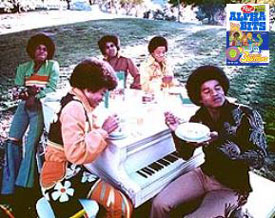
J5_alphabitsA Jackson 5 post from December ’02 is still receiving comments. One cat wrote to let me know he had MP3s of The Jackson 5 doing Alphabits commercials, asked if I wanted copies of them. Well, duh.

Commercial One | Commercial Two

There’s something so… blissed out innocent funky about the Jackson 5. “Tito, stop teasing!”

Amazing to see how many box designs Alphabits have gone through over the years. My mother didn’t allow sugar cereals in the house, so I don’t remember many of these, but a few ring bells.

Music: Jackson 5 :: ABC

Robert Reich Webcast

Currently webcasting: Social Justice & Social Empathy featuring Robert Reich:

What does empathy have to do with inequality? Robert Reich, former United States secretary of labor in the Clinton administration and a distinguished visiting professor at UC Berkeley’s Goldman School of Public Policy.

Pretty amazing spiel, although the drag about these events for me is that as fun as it is to run the webcasts, doing so detracts from ability to pay full attention. Some salient points I took away:

– We are a society of “exit-ers” — we simply leave situations we don’t like rather than sticking around to “give voice” or get involved and try to repair our own communities.

– Our fates are connected, you and I. “Insightful selfishness.” You are wealthy and you are willing to pour money into education. Why? Doing so makes society more productive. Productive citizens will partake of your goods and services, thus increasing your wealth. Rising tides raise all boats. My actions bring society up or down, as do yours.

– (via audience member) We don’t breast feed or sleep with our babies as commonly or for as long as in Canada, Europe, Japan. Is there a correlation between the extended core bonding giving to infants in these places and the greater inclusivity of countries with democratic/socialistic tendencies?

Music: Charles Mingus :: Meditations On Integration (Parts I & II)

Prison Guard Syndrome

Some of the American and British soldiers charged with torturing and humiliated Iraqi prisoners were working under orders to “soften up” prisoners for future interrogation. That’s one of those terms that’s left entirely up to the MP on duty to interpret.

Former Army interrogator Mike Ritz refers to the famous 1971 Stanford Prison Experiment in which regular college students were asked to role play prisoner/guard for an extended period. After five days, the study had to be cut short because the students in the role of guard were becoming sadistic.

The media offers explanations for these MP’s behavior dissmissively (“A few bad eggs”) or suggests a power chain encouraging the behavior. The Stanford study suggests something even more frightening, and in my mind, more probable — that ordinary people put in a position of control will often become sadistic and abusive.

This of course not meant to somehow excuse.

Music: Lead Belly :: Where Did You Sleep Last Night

RSS Is Push?

Remember the famous Wired Magazine feature declaring “Push” the next big thing? (March 1997). Push was going to be so significant it would kill the browser:

“The Web browser itself is about to croak. And good riddance. In its place…”

The feature is famous both for exemplifying Wired’s tendency to make huge, sweeping declarations and for being so painfully wrong (the public ignored push, PointCast died a painful death, and Wired scraped egg from face).

Now, seven years later (Wired 12.05, not online), the magazine has the cojones to run a story “The Return of Push,” asserting that the idea’s time has finally come. Author Gary Wolf makes the case that the rapid rise of RSS has finally proved Wired right. There’s only one problem: RSS is a pull technology. Just sent this letter to rants@wiredmag.com:


Gary Wolf is right about one thing (“The Return of Push,” Wired 12.05): RSS is fulfilling some of the original promise of push. But that doesn’t mean RSS is an example of a push technology. If I leave a plate of cookies on my doorstep and invite you to come take one every hour, would you then say that I brought you cookies?

In order to call something “push,” the publisher has to willfully send it to the user (and, ipso facto, to know something about that user). Thus, an email newsletter is an example of a push technology. In contrast, RSS “feeds” sit on a plain vanilla web server waiting for an anonymous client to come pick them up. This is plain old http and apache we’re talking about – no magic “push” protocol makes RSS delivery different from the rest of the Web. I request a web page; I pull it toward me. RSS works exactly the same way. If RSS is a push technology, then so is Tim-Berner’s Lee’s original web.

RSS probably is the Net’s next big thing. But it sure isn’t push.

Music: The Cramps :: Muleskinner Blues

Lawrence Lessig on China

Today’s portion of the J-School’s China and the Internet conference kicks off with a live webcast of Stanford Law Professor Lawrence Lessig, who has fought valiantly and eloquently against the world’s most overzealous copyright giants. Lessig is the author of “The Future of Ideas: The Fate of the Commons in a Connected World” and helped create the Creative Commons license.

Update: Not sure who linked to the stream, but we suffered the /. effect — suddenly swamped with requests, which took out the streaming server. Back up with the rest of the conference now. Apologies to everyone who tried to connect to the Lessig stream – the archive will be online early next week.

My (incomplete) notes on Lessig’s keynote are posted behind the MORE link.
Continue reading “Lawrence Lessig on China”

Howie’s

With all the clout they carry, it seems surprising at first that more commercial entities (stores, corporations) don’t overtly display their political beliefs. I mean, if you had a lot of money and were buying billboards and magazine ad space, wouldn’t you use the opportunity with the audience to try and make a point?

It means more to most corporations to get hands on max money than to make a point, and that means being politically neutral. “Sure, I hate your politics. I’ll take your money anyway.” That’s why Howie’s clothing is so refreshing – nicely designed*, happily political, and not afraid to sell you something in the middle of the message.

*If you’re not Flash-averse, but that’s a topic for another day.

Music: Orchestra Baobab :: Doomou Baaye

Living with the Genie

Reminder: Tonight we’ll be webcasting Living with the Genie live from Pimental Hall, featuring Ray Kurzweil via videoconference (original plans were to use some sort of state-of-the-art edge tech to bring Kurzweil in as a holographic projection, but doing so proved too expensive). Among other accomplishments, Kurzweil is the author of one of my favorite books, The Age of Spiritual Machines. The “live” panelists – Denise Caruso, Howard Rheingold, Richard Rhodes, and Mark Schapiro are all respected authors and thinkers on the impact and implications of runaway technology.

Update: Kurzweil is shockingly medieval in his take on current copyright issues and his attitude towards cancer treatment and prevention reeks of “blame the victim.” He views regulation in biological research as more of a threat than a necessary safeguard. He was kind of a broken record on several points. Overall, I think some people watched a hero being torn down, the lesser-known panelists eclipsing Kurzweil’s insights. Of course he was at a disadvantage by the fact that he was the only panelist in via teleconference. I don’t mean to tear him down – he had a lot of fascinating things to say; only that some of his viewpoints were… cold and his delivery was kind of redundant.

Music: Stereolab :: Fiery Yellow

~? What ~?

In a conversation the other day with a colleague, I came to the crashing realization that not everyone knows what the ~ (tilde) character is on their keyboards — what it is, how to pronounce it, where to find it, or what it means when used in a shell or URL. I had thought that after ten years of web prominence it had been more or less assimilated into the common consciousness. Now I wonder. Straw poll:

Do you know what the ~ (tilde) character is and does?

View Results

Music: Modest Mouse :: Gravity Rides Everything

Quietly Ovulating

The annual Lyttle Lytton contest challenges writers to come up with the worst possible opening line to a novel — a challenge which generally results in tons of run-on sentences being submitted. This year, the sponsors decided to limit entries to 25 words or less — preferably less. The 2004 winners have been posted. The winner, however:

This is the story of your mom’s life.

Was, in my opinion, not nearly as funny as the example given in the contest rules:

Jennifer stood there, quietly ovulating.

A line which quite literally caused me to spew milk and cereal from the nose this morning.

Music: Ralph Carney :: Out Of The Bag #2