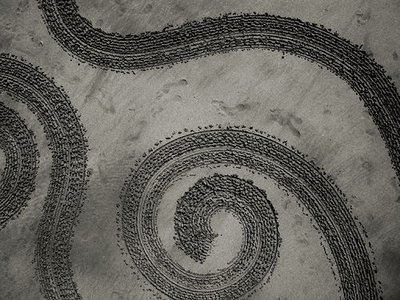
Tyger

Salon on Guilherme Marcondes’s beautiful Tyger:

“Tyger” is a dazzling animation by Guilherme Marcondes, created for an annual festival thrown by the British Council in Brazil. The only requirement was that it reference English culture in some way, so Marcondes chose William Blake’s “The Tiger” for inspiration. Marcondes writes on his Website that he loves the poem because it “gives us a hint of wonder along with a fear of progress.” We love this short, which had us wondering aloud, What immortal hand or eye/Dare frame thy fearful symmetry?

Meganeura

The things you learn from your three-year-old’s books…

Who knew that an orangutan’s favorite food was onions? Now I can’t get the fact out of my head (having been exposed to it about 200 times in the past year).

Now I learn that dragonflies can fly at speeds up to 60mph (no one is quite sure how), and can fly backwards too (probably not at that speed). And that they’ve been around since early dinosaur times. Only there was a variety then called Meganeura that had a wingspan of 30 inches (imagine a swarm of yard-wide insects smacking you in the forehead while trying to picnic down by the tar pits).

I really enjoyed the Golden Books phase — they make me feel warm — but things are getting interesting now that toddler-hood is behind us. Damn that happened fast.

Doomsday Vault

In the Svalbard islands, floating halfway between Greenland and Norway in the Arctic ocean, researchers have begun construction of a vault designed to house seeds of all known varieties of the world’s crops, in the event of global catastrophe — a Noah’s Ark for the plant world.

The vault’s purpose is to ensure survival of crop diversity in the event of plant epidemics, nuclear war, natural disasters or climate change; and to offer the world a chance to restart growth of food crops that may have been wiped out. At temperatures of minus 18C (minus 0.4F), the seeds could last hundreds, even thousands, of years. Even if all cooling systems failed … the temperature in the frozen mountain would never rise above freezing …

The vault is eventually expected to house some three million seeds. And in case any smart-alec seed thieves get bright ideas, the place is crawling with polar bears.

Question: If nobody knows where the Svalbard islands are now, how the heck do we expect the few Mad Max humans who survive to figure out where they are, or how to get there? Oh, wait – Svalbardians will probably be the only survivors anyway, so they’ll be all set.

via antiweb

Music: Francois Bayne :: Rosace 3 from Vibrations Composees

Technorati Tags: ,

Facing the Past

OK, the reason for the Time Forward poll: A physorg.com piece on South America’s indigenous Aymara, who visualize the past in front of them and the future behind, indicating that even some of the most primal and seemingly universal metaphors are still human or linguistic constructs.

New analysis of the language and gesture of South America’s indigenous Aymara people indicates a reverse concept of time. Contrary to what had been thought a cognitive universal among humans – a spatial metaphor for chronology, based partly on our bodies’ orientation and locomotion, that places the future ahead of oneself and the past behind – the Amerindian group locates this imaginary abstraction the other way around: with the past ahead and the future behind.

The article mentions in passing that roughly half of English speakers will answer the question about a meeting being moved forward two days from Wednesday as “Monday,” the other half “Friday.” My small sampling seems to support that.

The other question is how 2000 daily visits to this site can yield only 21 respondents in two days; maybe I need to do another poll on why people don’t take polls.

Music: Mission of Burma :: OK/No Way

via Weblogsksy

spacebarshot

thismorningadiligentvacuumcleaner
knockedacoffeecupintomykeyboard.
wecleanedupasbestwecould.
itookitapartandwipeditoutandlet
itdryupsidedownallday
butbyeveningthespacebarandshiftkeys
stilldidntwork.thissouvenir
blogentryisallthatremainsofthe
illfatedkeyboard,whichwillbeinthe
trashafewminutesfromnow.

Russian Parkour

Posted back in ’04 about “parkour,” the art of using the urban environment as an acrobatic playground, an empty canvas for physical experimentation as graceful as it is death-defying. Since then, parkour’s popularity has increased alongside extreme sports and perhaps as an off-shoot of skateboarding’s outer limits (“Dude, you’re good. Lose the board.”) Check out this young Russian:

My post-40 body would never stand up to this kind of abuse (though I guess the idea is to get so good that it’s not abuse), but if this had been a “thing” 20 years ago, would have been bouncing off walls.

Thanks baald

Music: Daniel Johnston :: Speeding Motorcycle

Technorati Tags:

Klaatu Barada Nikto

Those big flashing yellow text road signs on wheels — the ones towed into place to mark a detour or other warning? Easily programmable by the creative passer-by. And, if you’re lucky, the password to the little hand-held text-entry console will be written on the inside of the control box in big black Sharpie letters. Zug’s Heyoka has some fun.

Music: Mission Of Burma :: Peking Spring

Robot B9

$25k for a hand-crafted life-size replica of the famed “Danger, Will Robinson!” robot from Lost in Space… and the reservation list is full. Perfect in every detail, and featuring (partial list):

  • Acrylic bubble based on the existing original.
  • Laser cut steel brain with polished stainless steel top cover and crown.
  • CNC machined light rod ends brain cup and neck bracket.
  • Accurate acrylic collar & vents, hand formed based on the original jigs used.
  • Fiberglass torso based on the original stone molds.
  • Welded steel torso hooks.

Fully controllable, and with “over 500 voice tracks by Richard Tufeld, the voice of the original Robot” built in.

Thanks David Huff