Cleaning Is No Crime

If graffiti is a crime, what about cleaning? What if you clean selectively, removing only the bits that don’t make art? placeboKatz:

Skull Scrape

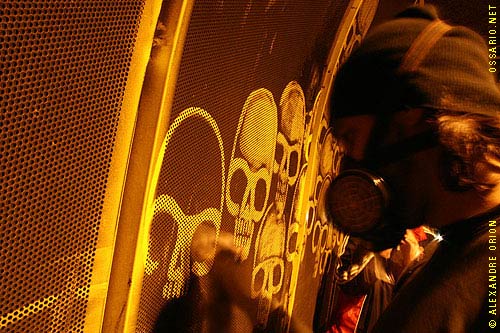
Alexandre Orion is cleaning São Paulo’s tunnels by scraping the deposited vehicle exhaust soot from the walls to make hundreds of sculls. Even so police turned up several times they couldn’t do much as cleaning is no crime. After some time the São Paulo municipal started their own cleaning mission, consequently only cleaning the parts already cleaned by Alexandre. Again the skulls appeared on the remaining soot canvas and this time the city decided to clean all tunnels.

More images, and an interesting bit on our glib acceptance of living amidst our own pollution, at the artists’ site.

Music: Pram :: Meshes In The Afternoon

Like

I wannabe like Paris Hilton! No, wait – I wannabe like Tom Cruise. No, wait… I wannabe a wannabe. A new site called like.com (not linking because I don’t feel like lending them the Google juice) features pictures of celebrities with their shoes, watches, handbags, etc. highlighted. Click the highlighted region and the site instantly shows you where to buy the items your heroes are wearing. So you can be like them. Because that’s all it takes, right? If only I had the right watch, I’d be more like Diddy.

This whole thing just reeks to me. As if the whole culture of celebrity isn’t odious enough all by itself, now we need help from sophisticated image recognition technology to sell it back to us a second time. Ewww.

Music: Moondog :: Nero’s Expedition

The Elephant and the Event Horizon

Saw a pretty stunning piece on Nova recently (Monster of the Milky Way) on the absolute weirdness of black holes (they’re more surreal than you thought). Today found a New Scientist article on what happens to objects sitting at the rim of the event horizon. For 30 years, Stephen Hawking has maintained that all information was destroyed at the event horizon, even though this ran counter to one of the fundamental principles of physics. But now, after studying the work of a young theorist named Juan Maldacena, who essentially posits our universe as the holographic projection of a 5-dimensional counterpart. New Scientist:

Let’s say Alice is watching a black hole from a safe distance, and she sees an elephant foolishly headed straight into gravity’s grip. As she continues to watch, she will see it get closer and closer to the event horizon, slowing down because of the time-stretching effects of gravity in general relativity. However, she will never see it cross the horizon. Instead she sees it stop just short, where sadly Dumbo is thermalised by Hawking radiation and reduced to a pile of ashes streaming back out. From Alice’s point of view, the elephant’s information is contained in those ashes. There is a twist to the story. Little did Alice realise that her friend Bob was riding on the elephant’s back as it plunged toward the black hole. When Bob crosses the event horizon, though, he doesn’t even notice, thanks to relativity. The horizon is not a brick wall in space. It is simply the point beyond which an observer outside the black hole can’t see light escaping. To Bob, who is in free fall, it looks like any other place in the universe; even the pull of gravity won’t be noticeable for perhaps millions of years. Eventually as he nears the singularity, where the curvature of space-time runs amok, gravity will overpower Bob, and he and his elephant will be torn apart. Until then, he too sees information conserved.

Essentially, we end up with a large-scale paradox similar to the light-as-wave/particle paradox: In order to satisfy the laws of physics, objects have to simultaneously be intact inside the black hole and torn to shreds just outside of it. This bakes my noodle.

Thanks Milan

Music: Wire :: I Am The Fly

The Brainman

Excellent documentary on the Science Channel last night about British autistic savant Daniel Tammet, who recently recited the value of Pi to 22,514 decimal places in five hours without a single mistake. After an epileptic seizure as a child, Tammet started seeing mathematics both visually and sensorily, as synesthetic forms and textures with distinctive colors, forms, and sounds.

He can raise large numbers to the power of seven in a few seconds, without calculating a thing. For him, a landscape simply unfolds in his mind. Every number from 1 to 10,000 has a distinctive shape and color, a mood, which he experiences visually. When doing math, he performs no calculations. “The image starts to change and evolve, and a third shape emerges. That’s the answer.” And yet it’s hard to get your hands on a calculator that has enough precision to even check his work.

Unlike most autistic savants, Tammet is fairly normal in most respects, and is able to describe what he sees, how he does what he does, to the rest of us – a fact which makes him fascinating to researchers exploring the outer reaches of the mind.

His savant abilities also extend to languages – he currently speaks seven of them fluently, and can become fluent in new languages in a week. He undertook Icelandic for the documentary – one of the hardest languages to learn – and was interviewed live on Icelandic TV at the end of the week. The day before the TV appearance, his teacher thought it was going to be a disaster. Then, suddenly, he said he had grasped the “form” of the language. He then sucked up the entire Icelandic lexicon “like a vacuum” and performed flawlessly for the interview.

Stories about savants always bring me back to the same thought: If any human brain is capable of these kinds of feats, it points to the existence of mathematical and musical and linguistic structures flowing just beneath the surface of our lives that are just out of reach for the rest of us. If extreme math can be performed by any person without calculation, if savants are able to visualize and breathe musical structures in the way that they do, it’s like proof of the existence of mathematical and musical lattice-works that run through all of existence. They’re there, just waiting to be grasped by our puny minds. Knowing that those structures are there but out of reach for most of us is almost maddening. Though ironically, we’d all probably go mad if we could.

Nice profile on Tammet at The Guardian.

Music: Count Basie and His Orchestra :: It’s Sand, Man

Tweels

Tweels No more flats, air valves, repair kits, or spare tires taking up space and weight in the trunk. Michelin is working on Tweels — airless, rubbber-spoke tire/wheel combos, all intentionally deformable. Seen to the left at speed; more pix here. Law enforcement’s going to love the fact that old school back-up-spikes have no effect on them.

Music: Hatfield and the North :: Shaving Is Boring

Dirty Hippies

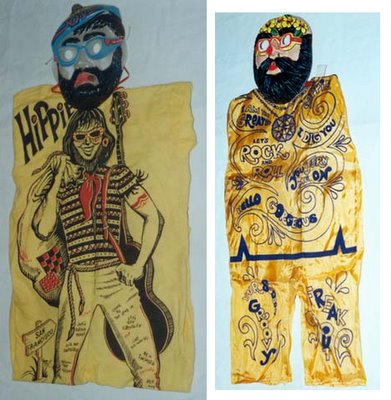
Amazing 1960s halloween costumes. I love costumes that spell out in big letters exactly what the wearer is “supposed to be,” just in case the plastic mask and flame-retardant body suit somehow didn’t get the message across.

Hippies

I’m thinking of Pia Zadora as the beatnik girl in John Waters’ Hairspray: “I play my bongos, I listen to Odetta, I iron my hair.”

via No Smoking in the Skull Cave

Music: Thievery Corporation :: Hong Kong Triad

Giant Swiss

Giant Swiss

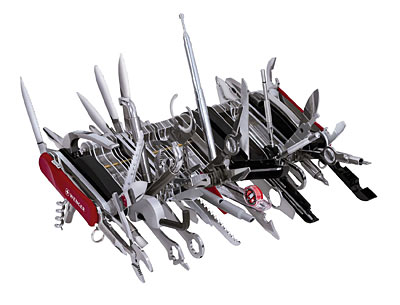
Is the whole greater than the sum of its parts? Not in the case of the Wenger Giant Swiss Army Knife, which includes all 85 tools made by the company in a single knife. Individually, any tool on this knife could be a lifesaver. Assembled in small collections, synergy kicks in and its overall utility expands. But due to its size and extreme awkwardness, I can’t imagine it would be easy to deploy any single tool on this 9″, nearly-3-pound behemoth. Includes such invaluable assets as a golf shoe spike wrench, shortix key, bike spoke adjuster, and a “snap shackle,” whatever that is. Won’t fit in your pocket, you object? No worries – it comes with a keyring so you can attach it unobtrusively to a belt buckle. They’re practically giving this thing away at $800.

Music: Johnny Dyani Sextet :: Magwaza