
The Long Zoom

&tConvening themes: The world viewed as a network of digital photographers collectively shooting every square inch of the globe, the ability to stitch those images together into a cohesive, navigable, continuous view, and the world-changing cognitive power of zooming through scale, now becoming commonplace.

Dan Sandler points out that Google Street View (which is mind-blowing both in its power and its privacy implications) is not only one of the few Google apps to require Flash, it’s also “the first Google app to feature the Be Man:”
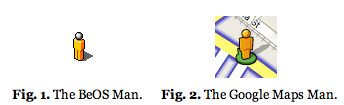
Beman
Thanks for the images Dan.

Humor, history, and coincidence aside, Street View changes the world, just a little bit for the better and a little bit for the worse. For the SF Chronicle, Mark Morford on Street View as invasive: I Can See Your Thong From Here:

Ah, Google, you great wicked benevolent super-cool vaguely disturbing Big Brother überbitch mega-company, quietly taking over the entire goddamn Net universe and most of the terrestrial world, too, one cool but simultaneously unnerving innovation at a time. … The question has been raised: How much is too much? How much implied privacy should we have as a society, as a community, as a city, and do we let this sort of technology run free simply because the draconian creepiness of it all is so easily offset by how damn fascinating and helpful and nifty a utility it so very obviously is?

Posted last August about Photosynth, a product emerging from Microsoft Labs designed not only to be a digital photo album conceptually way beyond iPhoto or Aperture, but that is also capable of intelligently stitching together images from disparate sources into zoom-able, photographic, 3-D representations of places on earth. In this video from a recent TED conference, Blaise Aguera y Arcas demonstrates a 3-D, navigable reconstruction of the cathedral at Notre Dame created by stitching together images scraped from Flickr — photos taken with everything from cell phones to high-quality SLRs, by photographers who have never met one another.

I’ve been playing a bit with Flickr Maps and looking more into the options for geotagging photos, but Photosynth blows the doors off the concepts of 2-D image-place connections, opening up a realm where all photographers on earth are unintentionally collaborating on a single, global, steerable, zoomable view that never ends.

Steven Berlin Johnson did a fascinating seminar for The Long Now Foundation (available both as podcast and as a summarized blog entry) on what he calls “the long zoom” — an entirely new way of grokking our world, started by the famous Powers of 10 and now becoming almost de rigeur thanks to emerging photo / video / vector technologies. What once blew your mind (and all previous senses of scale and proportion in the universe) with “Powers of 10” has become an increasingly commonplace quick swoop around Google Earth to find a business address.

We live in amazing times.
Music: Rickie Lee Jones :: I Was There

1234567

Mid-day tomorrow, the time will be:

12:34 5/6/7

(at least for those of you who render the date as day/month/year). Australia’s just lived through it, and reports little damage. Please synchronize your watches, fasten your seatbelts, and play those Andreas Vollenweider records loud.

Patenting Yoga

Not all goes well when East meets West. The U.S. patent office has been granting patents (yes, patents) on yoga postures and practices, and India’s government isn’t happy about it.

Searches of the database of the United States Patent and Trademark Office show dozens of yoga-related patents have been granted, including one for a breathing exercise, and more than 1,300 such trademarks have been registered.

First of all, I find it almost impossible to imagine that American practitioners are busting moves or other yogic practices that have never been conceived in 5,000 years of Indian tradition. Second of all, is nothing sacred? Third of all, the absurdity of patent overload has been going on for years, but just keeps getting sillier. Except it isn’t silly. It’s bad.

via Weblogsky

Music: The Fugs :: Fingers Of The Sun

Spamland

The spam I (secretly) most appreciate is the sort that uses randomly generated text cut-ups to bust spam filters, some of them fully worthy of the cut-up experiments Burroughs and Gysin were doing in the late 50s / early 60s.

In a gravitation without warning the face of rubbing grew sullen Black angry mouths, the clouds swallowed up the horsehair The air was religion with suppressed excitement

The Brothers McLeod are doing wonderful things with cut-up spam, having developed a series of animated characters to read aloud and act out the impossible, often mythical scenarios.

nodded. The door was closed and sealed again. Quietly forward. Hands extended, fingers lightly bowed. Iron John was Thats why there is no record of them

My own spam filters seem to have wised up to this form of spam in the past year, but every now and then one will eep through the multiple gatekeepers that mostly protect me from scarybig Spamland, discretely dropping special treats at my door in the middle of the night, causing me to feel the tiniest bit hopeful.

Accidental art committed for all the wrong reasons can still be beautiful, right?

Music: Will Oldham :: Ode #1b

San Francisco in Jell-O

Hickock1 Liz Hickok creates scale models of San Francisco cityscapes, then uses the models to create Jell-O molds by the hundreds. The Jell-O cityscapes are lit and filled to perfection, wanting only a giant dollop of Cool Whip (which is itself “a delicious blend of sugar, wax, and condom lube”).

Similar to making a movie set, I add backdrops, which I often paint, and elements such as mountains or trees, and then I dramatically light the scenes from the back or underneath. The Jell-O sculptures quickly decay, leaving the photographs and video as the remains.

The labor involved in creating these must be intensive. The results strike me as super-saturated, glowing representations both of SF’s jellified undercarriage and its playful surface life. The molds later become art objects themselves.

Music: Mr. Smolin :: Face The World

Maker Faire 2007

Spectacle-Tm Spent the day with Miles at Maker Faire 2007, where you can’t swing a cat without clobbering a team of reality hackers. Enjoyed the giant Mousetrap game (perfect functional replica of the original, writ large (very large)), the myriad bicycle hacks from Cyclecide, the whale blimp, Ukey Stardust (the entirety of David Bowie’s ;em>Ziggy Stardust performed on ukuleles), the Victorian mini-mansion on wheels Neverwas Haul, The Disgusting Spectacle (kids running on a hamster wheel cause giant to pick enormous gobs of snot from nose), playing with stop-motion claymation video, performance by the original Pepsi and Mentos dudes, the sonar-controlled self-balancing skateboard (which both Miles and I rode!), the endless procession of robots both sleek and gritty – some of them engaged in mortal combat, others the picture of gentility.

Flickr set posted, though I think my set from last year was better (in fact, I think Maker Faire was better last year in general, but not by much – may have been a state of mind, or creeping jadedness). But Maker Faire has already become an amazing father/son bonding tradition thing for us. Now I just need to learn to weld before he turns five.

Music: Velvet Underground :: Sweet Jane

Peanut Butter: Atheist’s Nightmare

The fact that life has never spontaneously emerged from a jar of supermarket peanut butter is apparently all the proof we need that evolutionists are off their rocker.

What, Chuck Missler never heard of preservatives (added specifically to prevent life from spontaneously erupting from food?) Or that billions of years of planetary soup-making isn’t quite comparable to a cup of goo sitting on a supermarket shelf for two years?

And then there’s the other atheist’s nightmare: The banana, so clearly designed to fit in the human hand and mouth that it’s clear evidence of God’s handiwork. Never mind that bananas weren’t quite so well-engineered to fit human hands and mouths before we evolved them to do so.

If The Earth Were a Sandwich

Last year’s meme, but I missed it — Ze Frank’s If the Earth Were a Sandwich:

Never before have two pieces of bread been placed on the ground directly opposite each other on the globe, thus making an earth sandwich. The fact that the earth has never been a sandwich is probably why things are so f***’d up.

Use the find opposite tool so you can discover what point on earth is diametrically opposite your own back yard. Like Ze Frank, diametrically opposite my house is the middle of the Indian Ocean. In fact, it looks like the entire U.S. is SOL on this one, exceptin’ Hawaii and a tiny sliver of northern Alaska. But I strongly encourage all of you reading from Mongolia to hook up with your antimatter cousins in Argentina.

Music: Tom Waits :: Grapefruit moon

New York To London

London-Directions 1. Go to www.google.com
2. Click on “maps”
3. Click on “get directions”
4. Type “New York” in the “from” box
5. Type “London” in the “to” box
6. Click on “get directions”
7. Scroll down to step #23

Music: The Fiery Furnaces :: Spaniolated

Experiments in Galvinism

Embed a web server in a frog. Dunk httpd frog in formaldehyde. Let public control frog’s movements from any browser.

Experiments in Galvanism is the culmination of studio and gallery experiments in which a miniature computer is implanted into the dead body of a frog specimen. Akin to Damien Hirst’s bodies in formaldehyde, the frog is suspended in clear liquid contained in a glass cube, with a blue ethernet cable leading into its splayed abdomen. The computer stores a website that enables users to trigger physical movement in the corpse: the resulting movement can be seen in gallery, and through a live streaming webcamera.

It’s not pretty.

Music: New Creation :: Sodom And Gommorah