
OpenID: The Missing Link

The OpenID light went on today, after a little setup and testing. I can now go to a blog or CMS or discussion board or other service that supports OpenID and type in “birdhouse.org” – no username, no password. Hit Return, and I’m in. If I’ve never been there before, I get standard user-level permissions. If I’ve been there before and an admin has escalated my privs, I’m in as admin. Securely. How is this possible?

Created an ID for myself at MyOpenID (though you could use any OpenID provider). Doing so gave me an identity URL through that provider. But here’s the dirty little OpenID secret that shouldn’t be a secret: The protocol supports “delegation” — by adding a couple of meta lines to the header of any URL you control (the birdhouse.org homepage, in my case), that URL can stand in as your identity URL. So when I typed “birdhouse.org” into a blog that supported OpenID earlier today, it fetched that URI and read its delegation headers. It then knew my “real” identity URL at the provider. The provider was able to determine that I was already logged into their service and pass “true” back to the blog I was trying to access. If I hadn’t been logged into MyOpenID at the time, I would have been prompted to log in there first, as a middle step in a seamless process.

Once authenticated to the blog, which had the WordPress OpenID plugin installed, a user-level account in that blog was created automatically for me. The admin could then escalate my privileges to admin or whatever, and I’d still only need to type “birdhouse.org” to log in there as admin. And you can’t. So there.

Distributed single sign-on works. Totally elegant.

A while back, Six Apart launched TypeKey, a single sign-on mechanism first made available for Movable Type blogs. TK never really took off, for a couple of reasons. First, most blog owners had already discovered that requiring any kind of sign-on had a chilling effect on blog conversation — any barrier to commenting was too high, and tended to stop casual “stopper-by” conversation dead. Second, a lot of people didn’t want to put all their identity eggs in the Six Apart basket, didn’t feel comfortable having a corporation behind the critical task of identity maintenance. That assumption was bogus – TypeKey was always an open API – but a lot of people didn’t feel comfortable with it. TypeKey isn’t dead, but there aren’t many sites using it.

Lots of identity conversation at SXSW this year, with OpenID emerging as the “final” solution to the distributed identity problem. Ended up not attending that panel, but did get to eat sushi with Kaliya “identity is a commons that no one can own” Hamlin, who (by some accounts) is single-handedly responsible for wrangling the monolithic corporate gargoyles (who all wanted to sell the world on their own proprietary silo identity systems and end up falling into the same hole that swallowed TypeKey), tying them up in a room and making them take mushrooms and hug until they agreed to adopt OpenID. Now even AOL is an OpenID provider.

Free love works!

Thanks Milan
Music: Linton Kwesi Johnson :: Brain Smashing Dub

Writing in the Free World

Jonathan Letham, author of the amazing Fortress of Solitude (one of very few novels I’ve read in the past decade), has come up with an interesting mechanism for handling the film rights to his latest book. Rights will go to the filmmaker who presents the best proposal. That person will pay Lethem two percent of the film’s budget, and will allow the rights to the novel to return to the public domain after five years.

It’s an arrangement that strikes a balance between guaranteeing some income for the content creator while simultaneously steering clear of the usual Disney-fied 75-year copyright stranglehold. The work becomes at once a vehicle for profit and a brick in the public conversation. “It’s based on the recognition that all works of art are, in a sense, a collaboration between artists and the culture at large.”

What Lethem is recognizing here is that the copyright debate doesn’t have to be all-or-nothing, that there’s a huge middle ground that can satisfy everyone.

It becomes one of those issues like, “If you don’t favor wiretapping in the U.S., you must be for the terrorists.” What I’m seeking to explore is that incredibly fertile middle ground where people control some rights and gain meaningful benefits from those controls, and yet contribute to a healthy public domain and systematically relinquish, or have relinquished for them, meaningless controls on culture that impoverish the public domain.

Some good riffing on how Led Zeppelin takes an uncopyrighted foundation (the blues), adds to it, and slaps copyright on it. Same for Brian Eno / David Byrne with their audio montage stuff. Taking it farther, if the blues was a patented form, Zep could never have existed. Loved these quotes:

“…participating in culture by making stuff is inherently a gift transaction and a commodity transaction.”

“If you make stuff, it is not yours to command its destiny in the world.”

Licensing models like Lethem’s don’t help for the 99% of artists who never see the light of day. But I like to hope that creative approaches to licensing like this one will become more common as artists acknowledge that what they do both borrows from and adds to the public dialog, and that all media needs to be quotable / reusable.

Music: Maline :: Lay Down

Spring New Media Lecture Series

Gearing up for another big week at the J-School, as we compress our semester-long multimedia training program into a single week for mid-career journalists from around the country. As always, lunches and evenings are filled with great speakers, which we’ll be webcasting live. If you’re in the Berkeley area, the conversations are open to the public – come on by!

Featured speakers are Joe Howry, Anthony Plascencia, Colleen Cason, Tom Kisken, Ventura County Star; Lisa Stone, Blog Her; Kevin Sites, Yahoo!; Sean Connelley and Katy Newton, Oakland Tribune; Rob Curley, Washingtonpost. Newsweek Interactive; Matt McAlister, Yahoo!

The Kevin Sites presentation last year was riveting, and Curley is a must-see for anyone interested in pushing old-school media properties in new directions.

Music: Jonathon Edwards :: Sunshine

Combinatorial Media as Self-Expression

Loose notes from SXSW 2007 panel: Combinatorial Media as Self-Expression

Sean Uberoi Kelly, eTonal
Lili Cheng, Microsoft Research
Alice Marwick, New York University
Rick Webb, Archenemy

Discussion about the zillion ways multiple media are being mashed up and re-presented, or being presented in formats that make it super-easy for consumers to remix. Implications for creativity, copyright, fun.

Continue reading “Combinatorial Media as Self-Expression”

The Future of the Book: Dead or Alive?

Loose notes from SXSW 2007 panel The Future of the Book: Dead or Alive?

Brewster Kahle, Internet Archive
Terri Ducay, Cheskin
Eileen Gittins, Blurb
Peter Merholz, Adaptive Path

What is happening to the traditional publishing industry? How long before there’s no room in the economy for paper books? And what happened to the push for e-book readers in the 90s – why haven’t they taken off? Just in time publishing is taking off, and there’s still room for blockbuster books, but what about all of the barely profitable middle ground books?

Technorati Tags:


Continue reading “The Future of the Book: Dead or Alive?”

Anna Nicole Smith

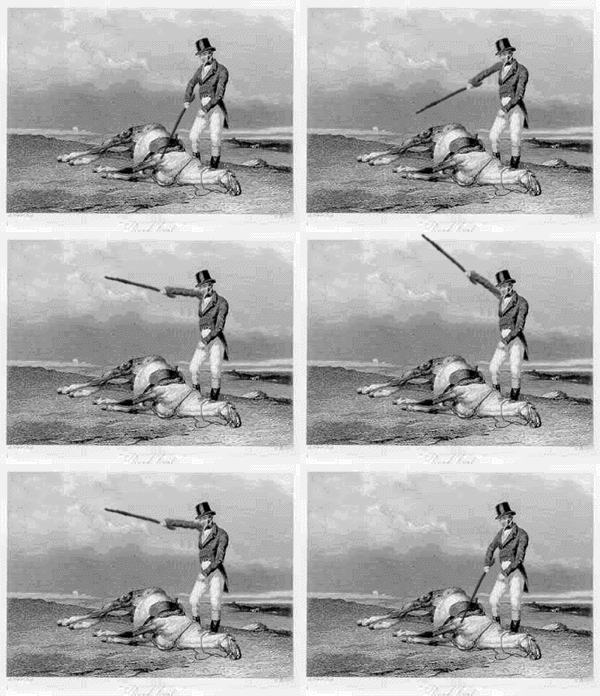
Beatdeadhorse

Literalbarrage on Anna Nicole and the media choking on its own vomit.

It’s unseemly, it’s barbaric and it borders on a near stalker/sexual obsession with a dead woman. Thus, I feel that current words to express the depths to which the media have sunk are insufficient, yet I struggle to find the right word or combination of words to best describe the flogging of a dead woman’s corpse. The closest I’ve come has been “necromediaphilia“, although I think it’s a bit too long and slightly misses the point.

Now, I will confess to being one of those people who had not heard the name Anna Nicole Smith before she died. In fact, I still haven’t seen any actual coverage of her life or death, even though this frenzy is apparently going on under my nose. But I have seen plenty of coverage about how much coverage her death has received. Which, in a way, seems like par for the course for me — I always seem to get more of the meta-story than of the story itself. But it does make me wonder: Would she be getting this much over-play if people hadn’t been lapping up her life/style all along? Have the people made her important, or has the media? I guess that’s, like, the oldest question in the book, but if the coverage about the coverage is getting tiresome, I can only image what life must be like for mainstream news viewers right about now.

Tip: You can turn it off with your mind.

Music: Iggy Pop :: Five Foot One

Ad-Free WordPress.com

John Lebkowsky takes umbrage at the fact that wordpress.com doesn’t allow advertising on its free blogs, saying “I’m enough of a libertarian to see this as excessive control.” I disagree. First, I’d think the libertarian view would be that wordpress.com is free to run their service however they see fit. Second, it’s a free service, so who can look a gift horse in the mouth? Third, people wanting to run ads are free to install their own blogging software and run all the ads they like. And fourth, without a policy like that, wordpress.com could become the ultimate splog magnet. I totally respect that Mullenweg and crew have stuck to their guns on this one.

Music: Holy Modal Rounders :: Mole in the Ground