Religion, Fear, and TV News

AP: Nearly half of all Americans believe the U.S. government should restrict the civil liberties of Muslim Americans.

The survey conducted by Cornell University also found that Republicans and people who described themselves as highly religious were more apt to support curtailing Muslims’ civil liberties than Democrats or people who are less religious.

The researchers also found a high correlation between people who consider themselves highly religious, people who believe in curtailing rights of Muslim-Americans, and the amount of TV news consumed.

While researchers said they were not surprised by the overall level of support for curtailing civil liberties, they were startled by the correlation with religion and exposure to television news. “We need to explore why these two very important channels of discourse may nurture fear rather than understanding,” Shanahan said.

Music: Herbie Mann :: Memphis Underground

Comment Spam – Up Against the Wall

The weblog comment spam problem has implications beyond crowded inboxes for users. Even with tools such as the incredible MT-Blacklist (which has blocked or moderated tens of thousands of comment spams on birdhouse-hosted blogs in the past few months), each request still requires a CGI process and a database request. When the spambots launch their massive onslaughts, shared hosting environments reel from the resource requirements. The problem has reached a critical threshold, and the muckety mucks at SixApart are coming out of the woods to address it head-on:

Jay Allen (author of MT-Blacklist and Product Manager at Six Apart) and Anil Dash (big cheese at SixApart) have both posted “official” positions on MT comment spam in the past few days.

So it looks like patches will be released in the next few days to address the biggest issues for web hosts. I like the fact that they’re approaching this not just as an MT problem but as an issue that affects all online discussion forums. The key to satisfying frustrated web hosts will be in creating a solution that can somehow block comment spam blitzkriegs without having to make a CGI and/or database call for every incoming request. It’s a hard problem to solve.

Update: Very good read on the many aspects and dimensions of comment spam load issues over at photodude. Throwing more hardware at the problem doesn’t make it go away (drooling over the server described there). Long comment section, also worth reading. One comment on the question of whether dynamic or statically generated sites fare better under this kind of load:

Also, last month, my husband and I shut down WordPress on the colo server we share with 3 other people, because … hits from comment spammers were making everything so slow. So we installed prerendering, which, if I’m reading this correctly, takes away the advantage of WP being dynamic(?) [right – this would make a dynamic site behave like a static site; you can’t win. -SFH].

Music: Mildred Bailey :: Squeeze Me

The One Resignation That Matters

From The Left Coaster:

In all the breathless coverage over cabinet resignations and the retirement of overrated network television news readers, it is more than a little disappointing that so few journalists are taking note of the upcoming retirement of one of the very best of their own. While the media whoops and hollers over knaves like Tom Ridge, discarded facades like Colin Powell, pusillanimous media moguls such as Tom Brokaw, mediocrities on the order of Ron Paige, and outright despots like John Ashcroft, the retirement of Bill Moyers from the Public Broadcasting Corporation stands out as the only resignation event of the season that will clearly diminish America and leave it poorer for his going.

Music: Ronu Majumdar, Ry Cooder :: Vaisnava Bhajan

60 Minutes Meets South Park

Over Thanksgiving, had the chance to watch a few episodes of a Showtime program I didn’t know existed: Penn & Teller’s Bull—-.

No magic, just the two of them doing a sort of commentary/documentary on subjects like drinking water, alternative medicines, alien abductions, parents who go overboard trying to perfect their children, the dangers of second-hand smoke, etc. A quick intro, then they launch full-gale into debunking the hell out of the day’s topic. They’re both hard-core rationalists, and they miss no opportunity to make the most gullible consumers and believers look like absolute fools.
Continue reading “60 Minutes Meets South Park”

Epic 2014

Interesting eight-minute b/w Flash movie (EPIC 2014) on the recent history and future of media consolidation, the broadening alliances of Google, Tivo, news providers, and P2P networks projected out a decade into a future where ubiquitous smart servers (“the Google Grid”) and the consuming public cut up and co-create their own news, ultimately pushing the NY Times out of business. “News is now shallow, trivial… but it is what we wanted…”

Not sure who’s behind this, but noticed an embedded reference to montagist Winston Smith (though this doesn’t really feel like his work).

Music: Jorge Ben :: Os Alquimistas Estão Chegando Os Alquimistas

Eyetrack III

eyemovement

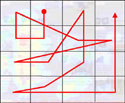
This is a map of how you read a web page. Not you you, but the aggregate “you.” Eyetrack originally started as an attempt to scientifically determine how people read newspapers, and worked by attaching a motion-sensitive device to people’s heads. Updated versions of the study track people’s eye movements as they read web sites by focusing lasers on their eyeballs.

The test equipment is able to draw visual paths showing actual eye movement, and there are some interesting surprises. People don’t scan up and down, or left to right. They start in the upper left corner and hover there for a while, looking for the most important information, then sort of zig-zag up and down, back and forth over the page, finishing in the upper right.
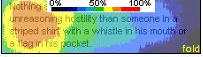
blurbthirdOf interest to both editors and designers: As people zig-zag, they don’t take in complete sentences, or even complete headlines; generally only the first few words of a headline are read before moving on. This heatmap is an aggregate view of how multiple test subjects focused on a blurb, the eye hovering primarily at the left side.

More potential surprises: Smaller type is more likely than large type to draw people into stories. If a headline is much larger than the blurb it accompanies, the blurb won’t get read — the headline is interpreted as self-sufficient. Underlined links and horizontal rules serve as barriers that discourage people from taking in the content directly below them. People do read “below the fold,” but scan content lower on the page very quickly, giving even less time to headlines and blurbs.

The power of images? People actually focus on text before images when both are present (although other studies contradict this). People often try to click on images, even when they’re not clickable. Bold-faced paragraphs leading into article bodies do get read.

No surprise: People ignore ads, and if they do see them, ads get about 0.5-1.5 seconds of attention per. Big ads are “seen” more than small ads.

Music: King Smiley :: Tipatone

Marumushi Newsmap

Google News aggregates vast numbers of news sites, and collects detailed stats on them in the process. Marumushi’s newsmap takes that data and displays it in a Flash-based, database-backed, Mondrian-inspired visual aggregator. The size of blocks on the map represents the number of publications out there covering the topic in some way, relative to other topics. The color of each block represents the broad category to which it belongs (business, technology, nation, etc.), and the shade of that color represents time delta (I don’t really understand this aspect — time since last scan? time the story has been on the map?). Roll over any block for a summary of the number of publications converging on that topic. Kind of a visual, interactive snapshot of the news Zeitgeist at any given moment.

Not sure I’d want to use this as a primary news portal, but it does offer a quick way to tap the mindset of the world’s collective publication editors.

Music: Brian Wilson :: Our Prayer/Gee

Media Tracker

Who owns your local media? Well Connected’s Media Tracker lets you enter your zip code and see at a glance (with drill-down detail) just how many of your local TV, radio, and print outlets are concentrated into the hands of media conglomerates.

In my zip code, the top 6 mega-media fuzzballs own a total of 25/35 radio outlets. And it’s worse in other parts of the country.

Music: Tim Buckley :: Sweet Surrender

They’re Your Eyeballs

For Wired News, J-School student Steven Bodzin writes Inventor Rejoices as TVs Go Dark, on the invention of a small keychain device called TV-B-Gone, which sends out more than 200 infrared codes in quick succession to turn off virtually any television within range. The device is intended primarily for use in public spaces – bars and restaurants, stores, laundromats…

Rude? Totally. But isn’t it also rude to force others to watch or listen to TV when they don’t want to?

Responding to the accusation that it sounded like unaccountable power, Burke said, “You’ve heard about the battle for eyeballs. They’re your eyeballs [emphasis mine -sh]. You should not have your consciousness constantly invaded.

I’m actually less offended by television in public places than I am by noises that invade my home — car subwoofers, car alarms…

Altman said people who hear about TV-B-Gone start thinking about other nuisances. Friends have asked for ways to jam cell phones, shut down vehicle subwoofers and kill car alarms.

“What I really want,” Altman said, “Is Life-B-Here.”

Music: The Fiery Furnaces :: Spaniolated

How’s Your News?

Been down with flu for the past 48 hours, abdominal tectonics. Just edging out of the hole now. Spent a lot of time sleeping, but did have the chance to watch a couple of interesting movies.

How’s Your News is a project by Matt Stone and Trey Parker, but you’d never guess it — a documentary wherein the two take five mentally retarded or disabled individuals around the country in a hand-painted RV, interviewing ordinary Americans on the street, at ball games, cattle auctions, etc. Two of the participants are so disabled they can’t even speak — one just waves a microphone frantically at passers-by, a sign on his wheelchair reading “Free interviews – my name is Larry.”

Given the nature of the project, and considering who’s producing it, you’d expect the primary M.O. would be to mock the attempts of these disabled people to model the newscasters they’ve seen on TV all their lives. And yes, there are some very funny moments, where you’re not sure whether you’re laughing with or laughing at. But somehow Stone and Parker have managed to make the project respectful – they’re giving these people the chance to do something they’d never be able to do otherwise. There is no mocking here, no inside joke between the directors and the viewer. The enthusiasm and joy of the participants is genuine.

The potential for misunderstanding the point of the project is high enough that they include a printed note in the DVD case explaining that “It’s okay to laugh.”

We believe that confusion, awkward moments, and humor are important parts of living with a disability. People who live with disabilities, and those who are close to them, know that if you don’t have a sense of humor, it would be hard to get through the day.

Also rented Peripheral Produce – a compilation of entries in a Portland experimental film and video contest. My favorite piece on the disc was Matt McCormick’s The Subconscious Art of Graffiti Removal — encouraging the viewer to look at municipal efforts to remove graffiti — usually by covering tags in large dun-toned blocks — as themselves being unintentionally artististic. The subconscious creation of Rauschenberg and Rothko-like rectangular swatches playing off the angles of the urban environment. Sounds self-serious, and it is, a bit, but also playful and partly self-mocking. Even if the idea sounds like a joke, McCormick does a good job of showing that there is real beauty left over by the removal efforts. Very enjoyable.

Music: Stereolab :: Tone Burst