Bluster == Journalism

Salon.com:

According to an Annenberg poll conducted this spring, about 40 percent of Americans consider Fox News talk show host Bill O’Reilly a “journalist” — while only 30 percent of the people surveyed said they considered famed Washington Post reporter Bob Woodward to be one. … Meanwhile, more than a quarter surveyed said that another champion of judicious reportage, radio talk show host Rush Limbaugh, was a journalist.

So when you see reports about the sinking credibility ratings of journalists, keep in mind who the “journalists” being rated really are.

Massive Organic Peer Review

Great evening event tonight with Amgine — one of a handful of volunteer administrators at WikiNews. Probably safe to say he blew the minds of a roomful of journalists, discussing grassroots journalism and the growth of open-source information repositories. The discussion, of course, centers around the credibility of the source when you replace the traditionally trained information gatekeeper with a collaborative, volunteer-driven process that can only be described as massive organic peer review. Lots of discussion throughout this conference about citizen journalism, but most of the attempts at enabling it pale, I think, in comparison to the success (both in numbers and in growing credibility) of WikiNews and WikiPedia.

At home, started browsing WikiPedia’s public stats pages. Freaky facts (synthesized from that page and tonight’s talk): WikiPedia currently contains more than half a million articles (6x larger than Encylopedia Brittanica), and is growing at a rate of around 1,000 articles per day — the largest single, unified body of information on the planet. The WikiPedia database now weighs around 67GB, most of it plain text (and only 20% of that text is in English). Dishing up around 1200 hits per second. The changelist, when viewed through the administrator’s IRC-like interface, sometimes scrolls by too quickly to read. Average time needed for the hive mind to correct a vandalized article: 4.5 minutes.

And it all runs as a non-profit entity, on top of donated servers and bandwidth. The only religion of the admins and hardcore participants is total, obsessive commitment to neutrality.

It’s difficult to gauge or imagine what the ultimate effect of open source knowledge bases will be on traditional journalism, but it’s clearly adapt-or-die time. It’s going to be fascinating to watch traditional media struggling to cope with this phenomenon over the next decade.

If you missed tonight’s live webcast, I’ll try and get the archives up by late next week.

Update 2012: Amazing infographic on Wikipedia and education:

Wikipedia
Via: Open-Site.org

Via OpenSite

Killing Michael Moore

From Media Matters:

Clear Channel radio host Glenn Beck said he was “thinking about killing [filmmaker] Michael Moore” and pondered whether “I could kill him myself, or if I would need to hire somebody to do it,” before concluding: “No, I think I could. I think he could be looking me in the eye, you know, and I could just be choking the life out — is this wrong?”

Political Puzzle wonders how it would have gone down if Michael Moore said something similar about a right-wing commentator…

Music: Yes :: Your Move-All Good People

SpamLookup

Just installed Brad Choate’s SpamLookup for John Battelle‘s MT installation, ditching MT-Blacklist for the time being. Looks simple on the surface, but dig into the options and you start to realize this is the next generation comment/trackback-fighting tool. Actually, it’s a whole toolbelt, including realtime distributed blacklists (which probably accomplish 95% of the dirty work alone), moderation levels and exceptions for various types of commenters, bannable wordlists, and a built-in “Passphrase” feature you can use as a human detector. This last being similar in concept to a captcha, but text-based rather than graphical. The commenter is required to answer a dirt-simple question such as “What is John’s name?,” which a bot would be hard-pressed to do. If I wasn’t having such great success with MT-Keystrokes on birdhouse, I’d install it here as well…

Music: Roland Kirk ::Bag’s Groove

IT Conversations

Michael Alderete recommended IT Conversations over lunch a few weeks ago, and I’ve finally started digging in. The site hosts hundreds of archived speeches in MP3 format by thinkers and players in the computer industry, all free. It’s not what you might think – these aren’t boring whiteboard transcripts of talks on XML or rising disk capacity – this is big-picture stuff, history and sociology and commentary on the whole IT sphere.

Have only listened to two so far: George Dyson on Von Neumann’s Universe, about the fabrication and evolution of the first tube-based computers at Princeton in the middle of the last century, and Clay Shirky’s Ontology is Overrated, with a deep look at the power of “folksonomies” and the rise of organic cataloguing systems. Both were provocative start to finish, totally stimulating.

It’s like those too-rare times when you stumble on some great radio program on the way home and get so involved that you sit in the car in the driveway until it’s over so you don’t miss a word… but time-shifted, so you don’t have to sit in the car in the driveway.

Podcasting downside: No easy way to copy/paste excerpts, which makes it harder for me to convey why I find these talks so compelling.

Music: The Fall :: Fit And Working Again

World Wide Panorama

A few days ago I was standing in the courtyard at work when a guy walked in and started to set up a tripod. This reminded me that I had been meaning to shoot a panorama of the courtyard stitch it together into a QTVR movie. Started talking about this with my boss, and the tripod guy piped up. Turns out it was Don Bain, one of the world’s premiere QTVR experts, and that he was there to do just that. “It’s a strange and beautiful world.”

Spent a couple of hours this morning with Bain in his labs at the Geography dept, where he is director of the Geography Computing Facility. Could not have asked for a more thorough or careful introduction to the technology than one-on-one with the man himself. He’s been doing these for many years, and had mountains of QTVRs to show (full-screen on an immense Apple monitor, no less). Also got a very detailed introduction to QTVR Authoring Studio, which, strangely enough, Apple has never ported to OS X (but which works fine in Classic). The difference between watching a master at work and an ordinary Joe is that Joe will pump something like this out in 15 minutes, while the master will spend days doing and re-doing until it’s exactly right.

Bain is also the progenitor of the World Wide Panorama, in which participants from around the world all shoot a similar object (like a local bridge) in their region on the same day, and upload finished QTVRs to the site. You can waste hours surfing the panoramas at the site, for which he won a “Best Find” award from Yahoo UK last year.

Heh – just clicking around his Virtual Guidebooks site and was surprised to see a panorama of Morro Bay on the Help page. I spent many hours paddling across, diving under, rowing over, and daydreaming in that bay. Funny to have it pop out of nowhere at me like this.

Music: Baby Calloway :: Scared Knees

Make 001

O’Reilly was kind enough to send me a copy of the premiere issue of Make — a magazine more about atoms than bits (though there’s software stuff there too), written by and for extreme makers — people compelled to hack anything and everything they can get their hands on.

First issue: Great article on Kite Aerial Photography (which I’ve posted about here before), building a miniature linear accelerator in your basement, fabbing a functional video camera stabilizer on the cheap from galvanized pipe and barbell weights (crude, but effective – apparently performs almost as well as rigs costing thousands)… tons of fascinating stuff. A version of Popular Mechanics not destined for the barber shop, but for the workshop benches and nightstands of modern geeks. And almost no ads (though I’m sure that won’t be true by the second issue).

Includes a wonderful piece by Tim Anderson on Heirloom Technology — how inventors and researchers can work smarter and faster by spending more time in the library researching historical and organic solutions than in the lab reinventing the wheel. Beautifully written. Back when I lived in Boston, used to go to Tim’s MIT inventor/storyteller parties, and never left without jaw on floor. It was in Tim’s lab that I saw my first 3-D photocopier in action.

O’Reilly has hit one out of the park with this one. Will also check out the Make podcast tomorrow.

Music: Cubanismo :: Canto Al Monte

Getting the Podcast Bug

For the most part, I’ve taken a pretty laissez-faire attitude toward all the recent podcasting fervor. Spewing opinions over the internet is nothing new, and neither is the concept of an internet radio station. But as has been the case with weblogs compared to traditional web sites, half of what makes podcasting a powerful meme is the fact that publishing and distribution mechanisms are simplified and streamlined, standardized into easily consumable information streams.

If 99% of everything is crap, the same is true of weblogs and podcasts. Unfortunately, because you can’t time-condense podcasts the way you can skim an online publication via RSS, podcasting presents more of a temporal demand than does blog skimming, not to mention the technical hurdle of teaching non-geeks to subscribe to them, sync to audio players, etc. Still, if you can find a bit of time to listen, and are able to sift out the good feeds…

I don’t see the radio industry shaking in their boots exactly, but this is day one for the technology, after all. The newspaper industry didn’t think much of blogging at first, either. I’ll be working with J-School radio classes next semester to set up their first podcast distribution system.

After Jamie Wilkinson pointed out that NetNewsWire 2.0 has really slick RSS/MP3 enclosure handling abilities (it’ll even transfer downloads right into an iTunes playlist of your choice, ready for sync’ing), I decided to try listening to Slashdot Review and IT Conversations on my run today, rather than to The Slits and Plastic Bertrand. Made me feel old and dusty at first — continued erosion of my dwindling opportunites to rock out, but really enjoyed it and finished the run feeling like I had gained something.

Podcast Alley is teeming with options. Help me winnow the field here — any personal fave casts you’d like to recommend?

Update: Check out Darren Barefoot’s Why I’m Not Smoking the Podcasting Dope.

Music: Tipsy :: Nude on the Moon

NetNewsWire 2.0

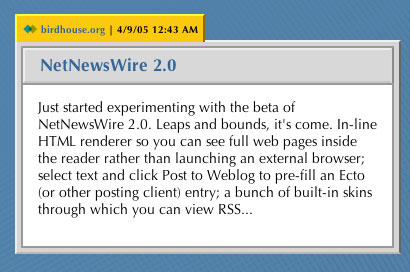
Just started experimenting with the beta of NetNewsWire 2.0. Leaps and bounds, it’s come. In-line HTML renderer so you can see full web pages inside the reader rather than launching an external browser; select text and click Post to Weblog to pre-fill an Ecto (or other posting client) entry; a bunch of built-in skins through which you can view RSS entries (I’m reading through the BeBox skin now… memories!), subscriptions to de.liciou.us and Flickr tags, tabbed views, etc. Every now and then you find a piece of software that just sparkles with excellence. NNW’s got that sparkle.

Nnw2-1

Update: I just pulled down “Show Sites Drawer” in NNW2 and was surprised to see that birdhouse.org is among the list of blogs built into the application itself. Way to go, me!

Music: Erik Truffaz :: No Choice

Thomas the Marketing Machine

Salty Trainloop
Trainpile Emily

It’s time to talk about Thomas the Tank Engine.

If you don’t have a young child, quick introduction: Thomas is based on a series of children’s books started in 1942 by the Rev. W. Awdry to entertain a sick young boy. Today, Thomas is a multi-million-dollar empire of books, wooden trains, and TV shows / videos. The Thomas universe consists of a group of engines and coaches living together on “The Island of Sodor” where they get into trouble, help one another, take pride in being “Really Useful,” learn important lessons about cooperation, bravery, friendship, and self esteem. What makes the Thomas railroad different from a “typical” children’s railroad is the fact that all of the engines and coaches have faces, personalities, strengths and weaknesses, modes of interaction that mimic (the better aspects of) society at large.
Continue reading “Thomas the Marketing Machine”