
NYT Goes Wide

The New York Times has finally launched their redesign, and it looks like the envelope has just been pushed in terms of screen width — the design is 975px wide. Which means it won’t fit horizontally onto 800×600 displays. Which means they’ve decided to shut out (or inconvenience) 20% of their audience (although one can imagine that NY Times readers are wealthier than average and that they thus have a lower-than-average percentage of readers at 800×600).

Update: Jack Shafer says the new NY Times design is so good that he’s canceling his print subscription. P.S.: Just realized that washingtonpost.com is also 975 px wide. When did that happen?

Music: Mekons :: (Sometimes I Feel Like) Fletcher Christian
Open Source DRM

We’re not accustomed to hearing the words “DRM” and “open source” in the same breath, but get used to it. Eliot Van Buskirk, for Wired:

… open-source DRM is exactly what Sun Microsystems has proposed, with its DReaM initiative. Its goal is to promulgate an open-source architecture for digital rights management that would cut across devices, regardless of the manufacturer, and assign rights to individuals rather than gadgets.

Strange bedfellows yes, but the initiative is backed by no less than Larry Lessig, and will be fully Creative Commons-compatible. The big question is whether major players will adopt it. With France putting the skids to Apple’s DRM silo and Denmark threatening to follow suit, the world is waking up to the albatross of data lock-in. Traction for DReaM has the potential to finally break its back — at least as far as MP3 players go — and open things up. But some think DReaM doesn’t include enough guarantees that existing rights won’t still be abused:

Sun’s DReaM “Usage Scenarios” document says that its fair-use mechanism is purely optional for rights holders.

Fair use is optional? Even under open-source DRM? And this has Lessig’s backing? Strange world. Still, open source DRM is better than the alternative.

Music: Mighty Sparrow :: Russian Satellite

Technorati Tags:

WPBlogMail Released

My surgical reconstitution of MTBlogMail as WPBlogMail (bottom-up rewrite to take advantage of WP APIs and to run leaner, cleaner) has been humming along happily for a couple of weeks now, so I’m calling it stable. Just added the script to the WordPress Plugin Database.

If you don’t know what I’m talking about, try subscribing to this site via the field in yon sidebar. :)

Microsoft Feels Your Pain

Well, at least we know we’re not alone. Extracted from CSS files living on microsoft.com web servers:

/* fix for the IE 1px-off margin error */
* html .StupidIEMarginHack 
{
  margin-right: 1px; 
}

* html .StupidIEWidthHack
{
  width: 100%;
}

But as we heard from several sources at SXSW, IE7 (due out soon) will improve CSS compatibility by leaps and bounds. Question then is, what happens to all of the legions of IE-specific CSS hacks in place out there? Will the fix break existing sites badly, or will MS provide some kind of mechanism to detect and ignore the mine-field of a million workarounds?

Thanks mneptok

Music: Billy Bragg & Wilco :: The Unwelcome Guest

Xyle Scope

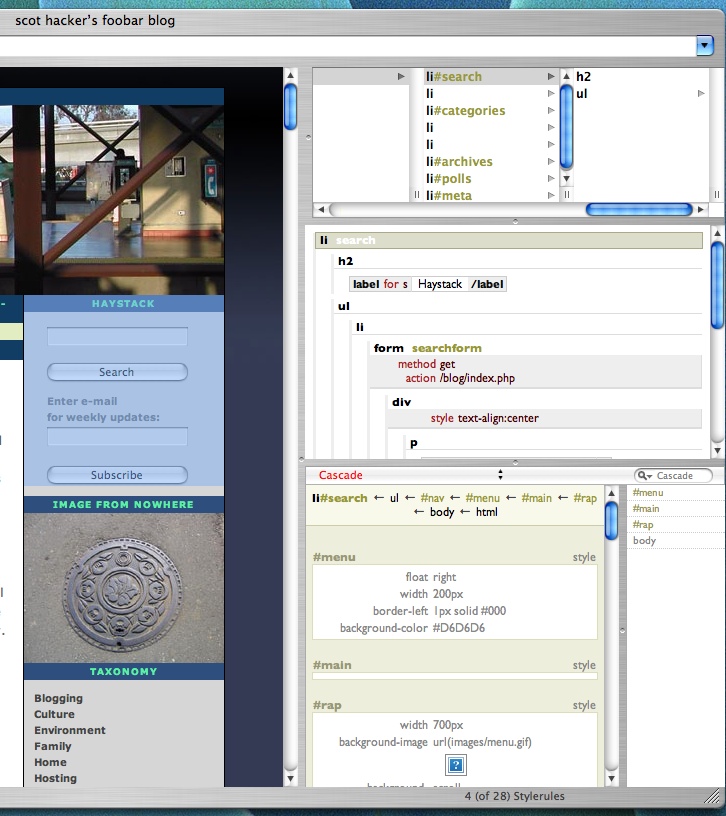
Xylescope A tip from one of the panelists at SXSW, in the CSS Problem Solving session: “If you’re working with CSS and need a good analysis/debugging tool, it doesn’t get any better than Xyle Scope. Mac only, but if you don’t own a Mac, Xyle Scope is a good reason to get one.”

Many CSS designs hide browser discrepancies by allowing white space to overlap, etc. The thing about the current Birdhouse design is that the divs are packed very tightly together, allowing no room for that kind of masking. Tearing out serious hair recently trying to get this style working in all browsers (don’t get me started on MSIE and CSS), with no div overlaps and no fugly gaps. Xyle Scope didn’t magically solve the problem, but it did give me a window onto the primary culprit last night, which I couldn’t have gotten any other way.

Continue reading “Xyle Scope”

Help Test WPBlogMail

What started as a quick-n-dirty port of MTBlogMail to a WordPress-compatible version turned into a major ground-up re-write, to take advantage of native WordPress APIs and simplify configuration. WPBlogMail digests new WordPress posts at regular intervals and sends them to a subscribers mailing list. Not quite a plugin, but a script that runs parallel to a WordPress installation. Wanted to get a bit of feedback from others before uploading this to the WordPress plugins directories, so if this is useful to you, please give it a shot and let me know how it’s working out.

Use the subscribe field in the sidebar to the right to receive Birdhouse updates via email — now powered by wpblogmail.

Music: The Minutemen :: Times

Wiki Tending

The magic of Wikipedia works for just one reason: Care. Gobs and gobs of care. Hundreds of volunteers working tirelessly to fine-tune content and keep the garbage out. As long as there are more good guys than bad guys tending the garden, the system works. But the majority case, I’m finding, is that most wikis are not exactly self-healing. Most of the time, the original fear about wikis plays itself out, and a few bad apples spoil the bunch.

There are multiple wikis installed in Birdhouse customer accounts, and several others on the J-School server. As the admin of these two boxes, I’m the one who gets to hear about it when things go sour. And, sadly, over the past six months I’ve been asked to password-protect every single open wiki running on these two machines. The sad truth, as the LA Times discovered, is that once the spammers find you, it’s open season — a daily admin chore to weed out the crap. Only wikis with groups of good folks actively monitoring ultimately succeed. Wiki owners who think they can “set it and forget it” quickly learn otherwise.

It’s not a total wash though — much of the time, wiki owners care more about having a collaborative platform for a known group, rather than for the general public. And in those cases, password-protection or user registration is a fine solution.

Music: Marc Bolan and T.Rex :: Beltane Walk

SXSW 2006: Loose Notes

For the archives: A complete list of all of my “loose notes” on SXSW 2006 []

And misc SXSW-related posts:

Technorati Tags:

Macs at SXSW

Although there was nothing remotely Mac-related about the SXSW sessions, amazing to see that 70-80% of all laptops in the crowd were PowerBooks or iBooks. Traditionally, this would probably be explained by pointing to “the creative types,” but the crowd breakdown was weighted more to developers than to creatives. As Tim O’Reilly started noting a couple of years ago, the “alpha geeks” have been adopting the Mac at a rate much, much higher than the general computing population. And SXSW was alpha-geek-central. Other than not having to feel like a leper, some nice side-benefits of being at Mac-heavy conference:

– Being able to use Bonjour/iChat for the back-channel.

– The SXSW organizers built a really cool scheduling system: Once logged into their site, add sessions to your online calendar. The SXSW database kept track of how many people had logged interest in the session. Then subscribe via iCal to your own SXSW preferences and get an ideal iCal interface mapping out your week. Click an event and see not only the room number, but also how many attendees were expected to show up. Now overlay a second calendar for parties and a third for personal meetings, and you have a very slick organizational tool for conferences.