Six Flags Hell

Don’t get me wrong – Miles and I had a great day at Six Flags Discovery Kingdom today. Father and son time, gorgeous day, a blast on the rides and quality time spent with elephants, sting rays, and walruses. But I’d be lying if I said it wasn’t a mixed bag. Running through the experience is an undercurrent – or is it a main current? – of being either completely ripped off or force-fed Velveeta. Kind of like coming down from a Sex Pistols concert:

Lydon closed the final Sid Vicious-era Sex Pistols concert in San Francisco’s Winterland in January 1978 with a rhetorical question to the audience: “Ever get the feeling you’ve been cheated?”

Sorry if this sounds like cynical sour grapes, but couldn’t help but make mental notes of every sheister angle on the experience:

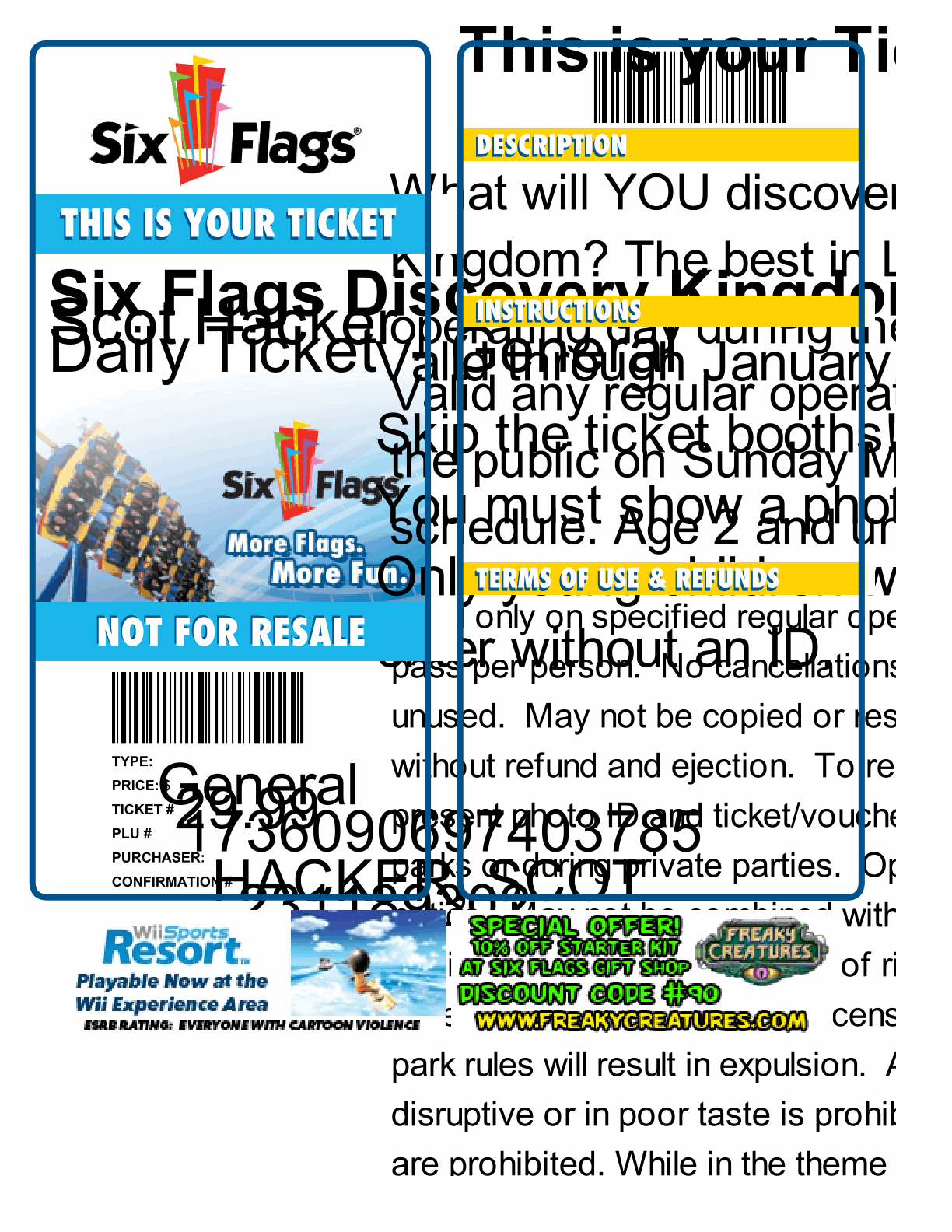
  • Start with last night’s ticket ordering process. The Six Flags web site is clearly a multi-million dollar extravaganza… but one that’s both ill-executed and simultaneously designed to start digging spare change from the depths of your pockets right from the get-go. $5 “processing fee” to have tickets mailed to you I can understand. But if you choose to print the tickets at home yourself? You pay the exact same $5 “processing fee.” Zero cost to them, no choice for the consumer. A fin for the privilege of using your own printer and saving them the postage. And check out the quality of the tickets their site generates (click image at left)hacker Same when generated via all modern browsers I tested. So lame I had to call tech support because I wasn’t sure they’d actually accept it at the gate. Tech support said they’d never heard of this problem, though ticket takers later said they see it all the time.
  • How long should it take to discover something as simple as hours of operation on a web site for a theme park of this caliber? Give yourself a test and try to dig up this info from their site. How long did it take you? Lame.
  • $15 for parking. Multiplied by, what, 5,000 cars? Day in, day out? Unadulterated extraction.
  • Sign at entrance: “NO outside food or drinks allowed.” You’ll find out why in a minute. That means NO you cannot bring your own PBJs for the kids. NO you may not bring water from home.
  • Yes, I know that resorts, airports, and recreation areas of all kinds charge exorbitant amounts for food. But check this out: $4 for water. $6 for small scoop of ice cream. $8 for a hot dog. And so on. What I don’t understand about this kind of pricing is that I thought that’s what anti-competitive / monopoly regulations were all about – ensuring that a free market can do its job. When there is NO possibility of competition in an area and when that area PREVENTS you from bringing your own food, WHY is this legal?
  • Watching the killer whale show, a Jumbotron is used to give people in the crappy seats a better view. Nice, but abused. MC talks up the show, gives you a tease, then says, no lie, “We’ll start Celebrating Shouka after this brief message.” The message? A 60-second ad for the Six Flags credit card. Captive audience already payed $50 a head for the privilege of attending and they’re going to use the opportunity to upsell us on other products and services. Obscene. To add insult to injury, they followed that up with a smarmy “tribute” to the “men and women of our armed services who protect our freedoms.” How is that relevant to a whale show, or to Six Flags in any way? The whole thing felt cheeseball and insincere.
  • Standing in line for rides, a nice opportunity to talk with your family. But no, Six Flags assumes we’d rather be watching TV during that time, so they hang LCD displays in the lines, on which they broadcast Jonas Brothers videos (please just kill me) and, yes, more ads for their products and services. Gag factor: 10.
  • Remember those expensive beverages? It gets worse. Most concession stands offer a $12.99 (not a typo) soft drink cup — in hideous day-glo orange — that can be refilled with 5 cents worth of corn syrup and sugar at any other concession stand throughout the day for 99 cents. For $13 they better be refilling it free for a year! What really blew my mind was seeing how many people took them up on the preposterous offer. One giant goblet of sugar isn’t enough for one day – we’re going to need this thing full all day! Not sure what bothers me more – that Six Flags has the gall to make an offer like this, or that the math works out to a “good deal” in so many people’s minds. Ugh.

All that said, it was still a great outing. But they make it so bittersweet, shoving just enough rip-off culture down your throat to keep the whole experience teetering on the brink of “completely not worth it, no matter how fun the rides are.”

Sometimes capitalism – and the culture that laps it up – makes me want to cry.

Maker Faire 2009

There were stickers scattered randomly around this year’s Maker Faire: “Last year was better.” The weird thing was that whoever made them would had to have printed them up before the fair began. How could they know in advance? What would have happened if this year had been better than ever? Unfortunately, the stickers were right.

We’ve attended all four years of Maker Faire now, so Miles has been there at ages 3, 4, 5 and 6 (does that qualify as a tradition?) I still think it’s one of the Bay Area’s most amazing explosions of talent and creativity — there’s nothing else like it. But this year there were noticeably fewer amazing giant steel sculptures, a much smaller presence from the incredible Cyclecide, more guard rails and safety precautions, more people (again), and more attendance from professional organizations. Year by year, the fair is starting to feel a bit less like a family-friendly version of Burning Man, a bit more like an opportunity for professional Lego collectors to network.

I don’t want to make too much of that though – Maker Faire most definitely has NOT started to suck. It’s still dazzling, inspiring, amazing. Just that it’s started to feel a bit… safer than it once did.

That said, Miles and I had an amazing day watching the Giant Mouse Trap, building inventions with computer scrap parts, learning about the SCA, “driving” the amazing snail car, watching the human llama wobble around, riding the wooden bikes (my fave part of every MF), digging on a thousand kinds of robots, taking on challenges at the Instructables booth, spending way too much time at the various Legos exhibits, eating great good food on a perfect spring day. And the R2D2 Miles wanted so badly to see last year finally showed up – the little Padouin was beaming with happiness.

This year’s photo gallery (63 images and 10 videos):

Click icon at lower right after starting to view full-screen.
View the whole set at Flickr (includes captions you don’t get with the slideshow).

See also: my photos from Maker Faires 2008, 2007 and 2006.

Fidelity

This week’s California Supreme Court Ruling to uphold the voters’ recent decision to bake discrimination into the Constitution was tragic, though it was made for reasons that have little to do with the Supremes’ actual position on gay marriage.

That’s OK. Now we’ve got two years to ramp up a properly prepared campaign for the 2010 elections, in which we can upend this topsy turvy, nonsensical situation and restore reason and compassion to our state.

Courage Campaign has launched a pledge campaign to overturn Prop 8 by 2010. It may take all we can muster to turn this around, but it’s the duty of every person who considers themselves a fair, honest human being with a basic, non-negotiable conviction in basic equal rights. Please join us.

This excellent Fidelity video is already starting to air on TV across the state:

Who Owns Your RSS?

In a case with far-reaching implications for the widespread practice of automated aggregation of headlines and ledes via RSS, GateHouse Media has, for the most part, won its case against the New York Times, who owns Boston.com, who in turn run a handful of community web sites. Those community sites were providing added value to their readers in the form of linked headlines, pointing to resources at community publications run by GateHouse. The practice of linked headline exchange is healthy for the web, useful for readers, and helpful for resource-starved community publications. However, for reasons that are still not clear (to me), GateHouse felt that the practice amounted to theft, even though the Boston.com sites were publishing the RSS feeds to begin with.

Trouble is, RSS feeds don’t come with Terms of Use. Is a publicly available feed meant purely for consumption by an individual, and not by other sites? After all, the web site you’re reading now is publicly available, but that doesn’t mean you’re free to reproduce it elsewhere. The common assumption is that a site wouldn’t publish an RSS feed if it didn’t want that feed to be re-used elsewhere. And that’s the assumption GateHouse is challenging.

Let’s be clear – this is not a scraping case (scraping is the process of writing tools to grab content from web pages automatically when an RSS feed is not available). Boston.com was simply utilizing the content GateHouse provided as a feed. I would agree that scraping is “theft-like” in a way that RSS is not, but that’s not relevant here.

In a weird footnote to all of this, GateHouse initially claimed that Boston.com was trying to work around technical measures they had put in place to prevent copying of their material. Those “technical measures” amounted to JavaScript in its web pages, but boston.com was of course not scraping the site — they were merely taking advantage of the RSS feeds freely provided by GateHouse. In other words, they were putting their “technical measures” in their web pages, not in their feed distribution mechanism, missing the point entirely.

GateHouse seems primarily concerned with the distinction between automated insertion of headlines and ledes (e.g. via RSS embeds) vs. the “human effort” required to quote a few grafs in a story body. Personally, I don’t see how the two are materially different, or how one method would affect GateHouse publications more negatively or positively than the other. If anything, now that GateHouse has gotten its way, they’re sure to receive less traffic.

The result is that Boston.com has been forced to stop using GateHouse RSS feeds to automatically populate community sites with local content. If cases like this hold sway, there will soon be a burden on every site interested in embedding external RSS feeds to find out whether it’s OK with each publisher first.

PlagiarismToday sums up the case:

It was a compromise settlement, as most are, but one can not help but feel that GateHouse just managed to bully one of the largest and most prestigious new organizations in the world.

Also:

The frustrating thing about settlements, such as this one, is that they do not become case law and have no bearing on future cases. If and when this kind of dispute arises again, we will be starting over from square one.

I’m trying to figure out who benefits from this decision… and I honestly can’t. GateHouse loses. Boston.com loses. Community web sites with limited resources lose. And readers lose. Something’s rotten in the state of Denmark.

Religion a Product of Evolution?

New Scientist: Evolutionary anthropologist James Dow has written a program – called Evogod – that simulates the evolution of religion, attempting to determine whether the impulse to pass on unverifiable information might have evolutionary benefits. When run, the software concludes that, yes, the impulse does sustain itself, but only if non-believers help believers out.

Other attempts to explain the origins of religion contend either that A) Religion is an artefact of other brain functions (cf Julian Jaynes’ The Origin of Consciousness in the Breakdown of the Bicameral Mind), or that B) Religion is an adaptation in its own right (my take on #B: when non-believers are persecuted, of course belief becomes a survival benefit).

The article explains the idea that religion only flourishes if non-believers help out believers by suggesting that belief could be an impressive trait to non-believers. I think it could also correlate with the history of non-believers being forced to help build pyramids/cathedrals, or to otherwise participate in believer culture. Religion generally has an imperialistic (evangelistic) trajectory, a tendency to overcome non-believers in the local culture, so that non-believers come under control of believers (even today non-belief carries stigma, which is itself a cultural force that confers evolutionary advantage to believers).

Not addressed in the article is any kind of scrutiny of Evogod’s actual code or algorithms. If the principles in the source code aren’t sound, neither is the theory.

Music: Johnny Cash :: The Man Who Couldn’t Cry

Maker Faire 2008

Awesome day, as always, with Miles at Maker Faire yesterday. Arrived early and glad we did – heard that by early afternoon the traffic and lines were so bad that people were turning around on the highway and returning home. This was our third year at the show, and somehow things didn’t click as well as they have in the past – didn’t manage to catch any of the scheduled events (giant mousetrap, Eepybird’s Diet Coke and Mentos display, floating R/C battleship war…) And starting to realize there’s a lot of carry-over from year to year, so didn’t get the delight of surprise from a lot of stuff. Crowds larger than ever, and the presence of Disney at a DIY fair kind of gave me the willies (though Miles loved their toy Wall-E bot).

Bicycle Guitar

Still, Maker Faire is one of the most inspirational things going – a wonderland of unpackaged, under-funded, can-do creativity. Cyclecide had their full range of human/bike-powered rides and attractions, the giant mousetrap was fully operational. A glass-blowing artist displayed his Prozac-eating chicken, an electronic calliope and a chariot pulled by an Arnold Schwarzenegger bot wandered the grounds, blending in with the Extra Action marching band as Total Annihalation jammed on stage near a 40-ft goddess made of welded steel cable, spewing great balls of flame from her heart chakra. Battlebots battled and hovercraft hummed and dudes roasted pickles near a giant Tesla coil. Steampunk ruled the day, its centerpiece Neverwas Haul alive and well (and until you’ve heard a steam gizmo concerto, your ears ain’t lived). People ground bags of flour from raw wheat with a bicycle, affixed Legos to a Jeep, 4′ cupcakes drove around, kids blasted model rockets 200 yards into the air, a man knitted and drummed at the same time (with the same sticks).

Steampunk Concerto II

In other words, Maker Faire is Burning Man Lite — and that’s OK. If you can’t take off a week to hang out in the desert, or don’t want to usher your kids into a psychedelic love den, Maker Faire brings much of the same creative juice, with a more scientific bent and none of the drugs. It’s one of those things that makes you feel blessed to live in the Bay Area.

Total Annihalation I

Dylan Tweney: Maker Faire and DIY culture

Wired.com: From Welding to Weddings

Here’s my Flickr Set from the day, which also includes five short videos – using Flickr’s new video upload capability for the first time, with 30fps videos taken with my new PowerShot SD1100s – amazing to see how far the video quality has come in consumer still cams.

Other public Flickr shots tagged makerfaire2008.

Music: Stereolab :: People Do It All The Time