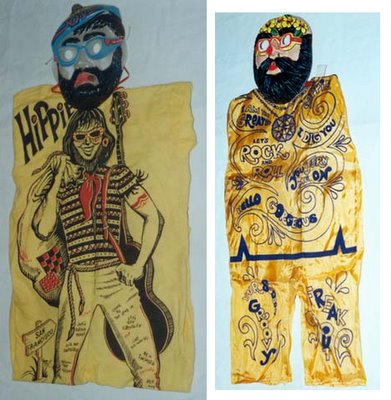
Dirty Hippies

Amazing 1960s halloween costumes. I love costumes that spell out in big letters exactly what the wearer is “supposed to be,” just in case the plastic mask and flame-retardant body suit somehow didn’t get the message across.

Hippies

I’m thinking of Pia Zadora as the beatnik girl in John Waters’ Hairspray: “I play my bongos, I listen to Odetta, I iron my hair.”

via No Smoking in the Skull Cave

Music: Thievery Corporation :: Hong Kong Triad

Flying Spaghetti Monster

My post on Sam Harris a month ago raised some interesting discussion on the subject of whether it’s even logically consistent for an atheist to call themselves that. Many people immediately assumes that atheism means one core thing: The positive declaration that there is no god. But there are several strains of atheism, and many of the most prominent atheists do not subscribe to “strong” atheism. Good interview in Salon with “Darwin’s rottweiler,” Richard Dawkins. Asked “Why do you call yourself an atheist? Why not an agnostic?”

Well, technically, you cannot be any more than an agnostic. But I am as agnostic about God as I am about fairies and the Flying Spaghetti Monster. You cannot actually disprove the existence of God. Therefore, to be a positive atheist is not technically possible. But you can be as atheist about God as you can be atheist about Thor or Apollo. Everybody nowadays is an atheist about Thor and Apollo. Some of us just go one god further.

n.b.: The Church of the Flying Spaghetti Monster came about originally as as a response to the Kansas School Board.

Music: The Mountain Goats :: Dinu Lipatti’s Bones

Diplomatic Immunity

Diplomats from other countries living in the U.S. enjoy a certain level of immunity from local laws, e.g. they can park wherever they want, damn the tickets. Whether diplomats choose to use the privilege seems to have a direct correlation to corruption levels in their home countries. The Economist on parking tickets issued to U.N. diplomats living in New York:

For instance, between 1997 and 2002 diplomats from Chad averaged 124 unpaid parking violations; diplomats from Canada and the United Kingdom had none. The results from 146 countries were strikingly similar to the Transparency International corruption index, which rates countries by their level of perceived sleaze. In the case of parking violations, diplomats from countries with low levels of corruption behaved well, even when they could get away with breaking the rules. The culture of their home country was imported to New York, and they acted accordingly.

But the sword of immunity cuts both ways – American diplomats in London have apparently stopped paying the congestion charge for bringing a car into central London, racking up unpaid charges of $.75 million as of August. If the “corruption levels of home country” theory/pattern holds, what does that say?

Music: Otis Redding :: Pounds And Hundreds

Irrational Respect

What are fundamentalists protecting when they protest stem cell research? A three-day-old human embryo is a cluster of 150 cells, with no brain or nervous system, while the brain of a housefly consists of approximately 100,000 cells. More suffering is visited upon this world when you swat a housefly than when a three-day-old embryo is destroyed. And for this, we prevent a person with 3rd-degree burns covering her body from having new skin grown for her, or a leukemia patient, or paralyzed person from having a second chance. All for the sake of a blastocyst. What is the role of religion in this madness?

300,000 people across Africa die of AIDS every year. Most of those lives could be saved through the widespread use of condoms. And yet Catholic priests across Africa preach to their congregations that condom use is morally wrong. The priests therefore take at least some responsibility for preventable deaths. In the words of author Sam Harris, this is “genocidally stupid” behavior. What is the role of religion here? Is it helping or hindering humanity?

Harris has been on my mind all week. First a Newsweek article covering him and other influential atheists, The New Naysayers turned my head. Then I caught a 30-minute talk he gave to Pop-Tech 2005, The Future of Ideas (podcast). Found that so fascinating I also listened to a much more detailed, 90-minute version (MP3) of the talk I found via the Long Now Foundation.

What is it about religion that prompts us to “respect” others’ beliefs? How is it that a priest can become so convinced he can walk on water that he drowns trying, and still we consider religious beliefs beyond criticism in ways we don’t in any other field of human endeavor? Paraphrasing Harris: “If I stood in front of you and claimed that the Holocaust never happened, you would be under no obligation to respect my beliefs just because they’re my beliefs. You would demand proof. And, if I did a good enough job of proving my case, you would be expected to agree with me. But with religion, it’s different. People can make virtually any metaphysical claim they like, no matter how preposterous, and their beliefs will be ‘respected.’ Why? And more importantly, what kinds of harm does this intellectual double standard — this strange and irrational social acceptance of religion — inflict on societies? Why do even secularists and moderates respect religion, and where is this blind spot taking us?” (Harris speaks about this danger in all religions – he’s not on an anti-Christian jag).

I differ with Harris on this point of respect. Or maybe I just feel conflicted about it. There are religious people in my life for whom I hold tremendous respect, even though I can’t begin to understand their position, how they arrived at the point of religion. Because I know they’re rational, kind people, their religious beliefs don’t “diminish” them in my eyes in the slightest. I understand Harris’ point, but I also don’t feel tempted to stop respecting their beliefs.

Harris’ voice is calm and rational, yet he pulls no punches. He is compelling in ways many will not be prepared for. Those whose religious sensibilities are offended by intellectual challenge should steer clear, even though they undoubtedly would find clearings in the meadows Harris paints that they never expected to find.

I’ve been grappling with the question of whether I’m an atheist or agnostic for a decade, and with questions of faith on and off for a decade before that. Though some of Harris’ stuff is old ground, he covers so much territory, and covers it so well, that I find myself wondering whether it’s time to come to terms with the question once and for all.

What does it take to declare yourself an atheist? What kind of bravery does it require to put yourself so far outside the mainstream? How many people declare themselves agnostic rather than atheist because it’s less “offensive” to family and friends? Why is it that it’s almost impossible to imagine even the most warm, compassionate, ethical, intelligent atheist being elected to a public office? (“Even an openly homosexual candidate has a better chance of being elected to public office than an admitted atheist.”) Would an enlightened society be truly respecting of everyone else’s religious beliefs, or would it not have any?

Music: Wayne Shorter :: House Of Jade

Technorati Tags: ,

Flat Daddies

Flat Daddy Families with loved ones serving in Iraq or Afghanistan and who miss their deployed Mommies and Daddies — and who aren’t of a mind to protest the whole stinking mess — can just order up a 2-D Daddy. Healthy therapy for families? Or has America completely lost its mind?

you hardly know a day goes by
in the cardboard cutout sundown
— Beefheart

Thanks Hamrah

Music: Caravan :: Love To Love You (And Tonight Pigs Will Fly)

No

In the early 80s, some friends and I became obsessed with cartoon character Nancy and her pal Sluggo. Or, more specifically, obsessed with the zen simplicity (or was it idiocy? no, it was definitely sublime genius) of artist Ernie Bushmiller. Buddhism and psychedelia have always bubbled as background interests. These days I’m into ukulele.

Glyph Jockey created this video based on what Mark Frauenfelder calls the the greatest Nancy panel ever drawn (the posting of which inspired one feller to get a tatoo of the same panel).

Gabby Pahinui soundtrack, words by Alan Watts. This one is for you, rinchen.

Infiltration

A subculture about which I knew nothing until today: Infiltration, aka Urban Exploration — a hobby/practice all about getting into places where people aren’t supposed to go (without getting caught). There are beautiful spaces all around us that we never get to see, because we’ve been successfully trained to obey the language of fences and signs. Urban Explorers even have their own ‘zine (though most of the scene has moved online). Abandoned buildings, ferry boat engine rooms, old factories… Some places are totally unguarded, others heavily so (which is half the fun). Urban Explorers take care not to litter, get hurt, or absorb toxins. It’s all about the hunt (and the photosthese are lovely).

Music: Cibelle :: Esplendor

Did Humans Evolve?

New York Times:

In surveys conducted in 2005, people in the United States and 32 European countries were asked to respond … to this statement: “Human beings, as we know them, developed from earlier species of animals.” The United States had the second-highest percentage of adults who said the statement was false and the second-lowest percentage who said the statement was true, researchers reported in the current issue of Science. Only adults in Turkey expressed more doubts on evolution. In Iceland, 85 percent agreed with the statement. (Graph)

via Slashdot, Science Magazine is pointed about the reasons:

The acceptance of evolution is lower in the United States than in Japan or Europe, largely because of widespread fundamentalism and the politicization of science in the United States.

Music: Baguette Quartette :: Reproche

Extreme Telemarketing

Never thought I’d feel sympathy for a telemarketer, but get an earful of this. My heart goes out to the poor guy. Kind of. Despite the caller’s general craziness, she does raise a point with him that I’ve tried before in conversations with telemarketers: The practice violates the categorical imperative, from which all moral action derives (according to Kant, and I agree):

Act only according to that maxim by which you can at the same time will that it would become a universal law.

In other words, don’t do anything that you don’t think all other people should also be allowed to do in the same situation. In context, one should engage in telemarketing only if one believes that all marketers should be allowed to call people in their homes. Consider the massive amount of advertising around us at all times, and imagine that every advertiser pushed their product by calling people at home. Universalizing the practice of telemarketing to all practitioners would make the telephone utterly useless, since it would never stop ringing, much as e-mail spam has diminished the viability of e-mail (which is only rescued through the application of great piles of technology).

When faced with the categorical imperative (though of course the caller does not call it that :), the telemarketer starts to lie to cover his position, saying that marketers do call his home phone all day every day, and that he doesn’t mind a bit.

Unfortunately, the caller’s philosophically sound position is completely blown out of the water by absolutely insane levels of hysteria.

Music: Sylford Walker :: Deuteronomy

Mean People Suck

Once upon a time, the nom-de-plume was a rarely used device. Today, it’s practically the norm. Back in February, I posted On Anonymity, clarifying some stuff about my general dislike of handles and nicks, and the general trend toward people writing as other than themselves, not standing personally behind their own words.

Anonymity has its advantages. In some respects, it’s one of the net’s strengths. Anonymity enables people in politically oppressive environments to speak freely. And a 14-year-old girl would probably be foolish to use her real name online. But what about everyone else?

Seems like there’s a lot of talk recently about the declining quality of online conversation. Reasonable people with provocative things to say talk about how every time they try to post something thoughtful, they get torn a new one by readers. I certainly post a lot less controversial stuff here than I used to; finally got tired of the sh*tstorms (though few people comment anonymously here).

And then there’s the GIFT Theory (not safe for work).

Listening to the Gillmor Gang tonight on the way home from work, was struck by something unusual: These guys usually disagree on everything. But for a rare change they were unified — all of them just sick to the gills with a zoo of buffoons out there who can’t express opinions civilly, or whose first priority is to knock a thoughtful writer down. They even talked about wanting to set up systems not just to register commenters, but to enforce verification of real names for anyone who wants to comment.

Later in the evening, a similar thread came up on the O’Reilly Mac Blogger’s internal mailing list – writers fed up with endless snarking and small-minded mean-ness from readers lacking the grapes even to use their real names.

There are several things going on here: The decline of politeness in general, an increasingly fragmented and direct public, and fallout from widespread anonymity. I think anonymity is a bigger factor than is given credit for. Compare: How do you express anger to a stranger when you’re driving your car? Would you express yourself the same way to a stranger standing next to you in the checkout line at the grocery store? If not, why not? The distance, the anonymity, does something to people. And it isn’t a pleasant something.

Music: Agustín Lara :: Piensa en mi