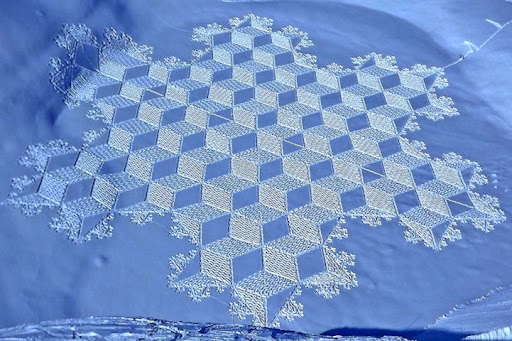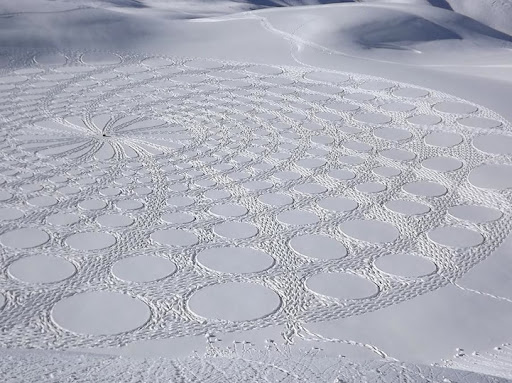
Man Walks For Hours to Create Spectacular Snow Patterns

Reshared post from +Morgan ABBOU

Man Walks For Hours to Create Spectacular Snow Patterns

Artist Simon Beck must really love the cold weather! Along the frozen lakes of Savoie, France, he spends days plodding through the snow in raquettes (snowshoes), creating these sensational patterns of snow art. Working for 5-9 hours a day, each final piece is typically the size of three soccer fields! The geometric forms range in mathematical patterns and shapes that create stunning, sometimes 3D, designs when viewed from higher levels.

How long these magnificent geometric forms survive is completely dependent on the weather. Beck designs and redesigns the patterns as new snow falls, sometimes unable to finish a piece due to significant overnight accumulations. Interestingly enough, he said, The main reason for making them was because I can no longer run properly due to problems with my feet, so plodding about on level snow is the least painful way of getting exercise. Gradually, the reason has become photographing them, and I am considering buying a better camera.

Spectacular art for the sake of exercise!

source: inHabitat ~ goo.gl/3NSYz

In album Spectacular Snow Patterns (5 photos)

Spectacular Snow Patterns

The Smart Idiot Effect

Salon on the “smart idiot” effect – why more education amongst conservatives leads to more firmly believing the opposite of the facts. Interestingly, the “smart idiot” effect does not seem to hold amongst liberals, for whom learning more may actually get them to change their views.

Embedded Link

The ugly delusions of the educated conservative
Better-educated Republicans are more likely to doubt global warming and believe Obama’s a Muslim. Here’s why

Cracked Rib

Spent the weekend in Pioneer, near Tahoe CA – just me and the boy at my parent’s house. On Sunday, M took a snowboard lesson and I took off into the hills. Three rides in, coming off a lift at the top of Cornice, a skiier turned left across my board, knocking me down. A not-uncommon thing, but I landed just … wrong and heard a rib crack. Feeling woozy, but had to traverse hard left across the mountain to meet M at the end of his lesson. Realized I could still ride if I stayed upright, didn’t jolt too much, and didn’t bend over, so went for it.

Unfortunately, the long traverse took me into some deep forest. Low snow cover meant lots of exposed logs and rocks, plus it was mogul territory and the afternoon ice didn’t make things any easier. Turned into a 15-minute trip of pain. By the time I got to the bottom it was aching like a mother.

24 hours later it’s starting to feel a bit better, but still can’t bend over to do anything (like tie shoes) and sitting down is horrible (the temporary strain of muscles pulling at the ribs). Decided not to see a doctor – they can’t do anything for cracked ribs but tell you to take it easy and maybe prescribe meds. Will have to tough this one out.

Still, a great weekend, and I’m jazzed that M enjoyed his snowboard lesson – said he liked it way better than skis! We’re destined to ride together.

The Fireplace Delusion

The Fireplace Delusion – Fascinating as a piece of science, and also as a metaphor for considering what we grapple with when contemplating religion.

Reshared post from +John Poteet

Normally I think Sam Harris is an asshole; except sometime he nails it.

Embedded Link

The Fireplace Delusion :
Sam Harris

Sam Harris, neuroscientist and author of the New York Times bestsellers, The End of Faith, Letter to a Christian Nation, and The Moral Landscape.

Building LED Flashlights in Altoids Tins

I spent a couple of hours with my son’s fourth/fifth grade classroom today, teaching them to build LED flashlights in Altoids tins. This project was both simpler and more complicated than last year’s Bristlebots project – fewer parts to manage, but we went deeper into electrical and electronics concepts. The students learned about voltage, insulators, conductors, circuit load, diodes, polarity, and various types of switches. And had a great time! Every single kid finished with a working flashlight. Some even enjoyed the process so much they stayed after school to build a second one.

I started with this recipe from Instructables.com, but modified it a bit (we used a single LED and battery to reduce wiring and to eliminate the need for resistors, though we did talk about resistance).

One of the biggest challenges for me was figuring out how to drill clean holes in aluminum – every attempt with a punch or standard drill bit resulted in sharp, ragged, non-round holes. Finally figured out that what I needed was a “graduated” drill bit. Happily, I found one from the 1940s in a toolchest that I had inherited from my grandfather. So not only was the bit we used ~70 years old, but I later learned that my grandfather made all his own bits! He would have been proud to see us using his tools this way.

Sorry I didn’t get more photos of the process – no shots here of drilling or soldering, or of the kids playing with their finished flashlights in a dimmed room,  but was bit busy…

View the Flickr set with captions, or check the slideshow version below.

Roger Oh Double Oh Forty Oh

Just rediscovered this after a decade, thought I’d post so there’s a record of it before it’s lost to history. This was before I switched to ukulele. And when I had more hair. Roger’s 50th just rolled around, and a different group of guys got together to do a different song for his half-century. Unfortunately, we had a few technical difficulties, and don’t have good video to show for that effort. So let’s just relive the past.

Sadly, Matthew Sperry (shown here on bass and singing with gleeful abandon) died tragically in a car-on-bike accident a couple of years later. He is memorialized at matthewsperry.org.

http://www.youtube.com/watch?v=tgkkjNGdBjY&list=UUO3IR9VRRYVdnIvYDTztZow&index=1&feature=plcp

Continue reading “Roger Oh Double Oh Forty Oh”

FreeDive – Searchable Web DBs for Journalists

Problem: Journalists often don’t have access to programmers who can help them build searchable web databases, and are often stuck behind inflexible CMSs.

Solution: +Len De Groot and I built FreeDive, a CMS-independent web-based tool that lets journalists transform Google Spreadsheets into sortable, searchable modules that can be dropped into any web page.

FreeDive was the last big project I worked on at KDMC before moving on – incredibly proud to see its official launch today!

http://multimedia.journalism.berkeley.edu/tools/freedive/


Mr. Daisey and the Apple Factory – It’s About Us

This American Life is pretty much always great, but this podcast – covering one man’s journey into the Chinese factories that make our tech products – affected me deeply.

Mr. Daisey and the Apple Factory

Heartbreaking and fascinating, seriously worth 45 minutes of your life. Stories of extraordinarily long hours, child labor, and repetitive stress injuries that make our own seem like hangnails in comparison. Stories of people assembling parts as small as human hairs by hand for 16 hours at a stretch, stories of people working with their hands until their bones simply crumble (and they’re out of work for life). Stories of experiments with neurotoxins like hexane being done on unwitting human workers. It goes on and on.

But listen through to the last ten minutes, where the emotional impact, and the anger the story generates,  is sort of qualified by observations of economic realities in China: “Hundreds of thousands of Chinese choose the grimness of factory life over the grimness of the rice paddies.”

I remember when the suicide nets went up around the Foxconn factory, and the simplistic reactions people had to their existence. But some perspective helps – the truth is, China as a whole has one of the highest suicide rates in the world, while those rates are actually lower in factory cities like Chengdu than they are in the rest of the country. And Foxconn is doing the right thing by trying to prevent them – that’s a good thing, not an example of Foxconn simply accepting suicide as a cost of doing business.

But while Apple is  a sexy centerpoint for the story, it’s important to remember that this isn’t really a story about Apple – virtually every single technology product we buy, from DVD players to smartphones to game consoles to blenders, is made under similar conditions.

Actually, this isn’t even a story about the human cost of our enjoyment of technology. Virtually everything on the shelves at Walmart and Target is made in China. The clothes on your back, that car you drive… chances are high those things were made in conditions that are similar or worse than those at Foxconn. It’s not about Apple – it’s about us (ZDNet’s Larry Dignan does a good job widening the scope of the story in this post).

The popularity of this story is an opportunity for the west to reflect on the implications of its addiction to cheap products in general. We’ve grown into  a dangerous symbiotic relationship with China – we can’t shake the allure of cheap products, and they can’t shake the allure of jobs for their citizens. Your cheap jeans create jobs for peasants. And if we were somehow to bring those jobs back to the U.S., we would be throwing those peasants back into the poverty they’ve partially escaped in the past decade. Reality is messy.

Coupled with a recent NY Times piece covering the same topic, it’s been a hard week for Apple, who are scrambling to do spin control. But whether this is an Apple problem or a larger problem of our addiction to cheap goods, Apple could be stepping up as a leader in making a difference here. With the company’s insane bankroll, they could and should be doing more to affect manufacturing conditions.

What about you? Would you be willing to pay 50% more for an iPhone or an HP laptop if it meant you knew it was made in the U.S., under different conditions?

See also: Apple CEO Steve Cook Responds to Allegations