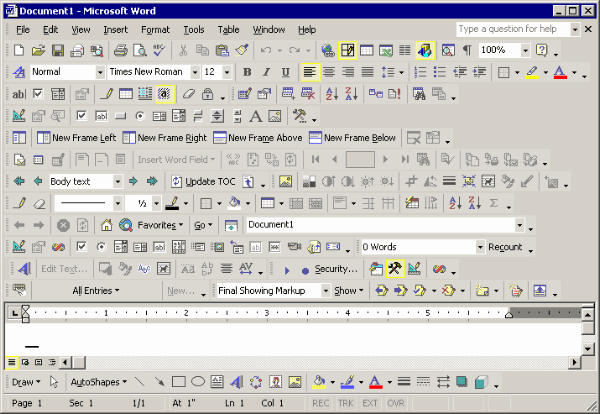
“Simplicity” has been a popular buzzword this year. Everyone complains about bloatware, and points to the success of the iPod and web applications from 37signals as evidence of a backlash toward a “less is more” development style. The usual argument is that the 80/20 rule pertains — 80% of users only use 20% of the features. Trouble is, people don’t use the same 20%, which means that everyone still wants something different out of the same piece of software. Which is why feature sets look like this. Dylan Tweney has been searching for the perfect, slimmed down mailing list system for his Daily Haiku, and is face-to-face with the dilemma. Joel on Software says simplicity is a false idol, and that in the end, what people really want are the features they personally will use. And giving most users what they want means successful software includes a lot of features most users will never use. I think the real challenge for successful software is not to be simple, but to appear simple.
More Plastic Than Plankton
There’s more plastic than plankton in the ocean — about 6x more. Every piece of plastic ever made basically still exists; pieces break down but never decompose entirely. The impact of 100+ years of plastics production on our oceans is tragic, and seemingly unfixable. Heartbreaking (but tiny) video: Our Synthetic Sea.
Long list of resources on the topic of our plastinated oceans. The biggest problem are nurdles – the raw material used to make everything from CDs to plastic pipe. America alone produces 100 billion pounds of nurdles each year. In the ocean, they function as attractants for extremely high ratios of PCBs and other toxins. Since they look to fish and birds just like fish eggs, they are consumed by sea life in quantity. But while plastic in the oceans is a mixture of pre-consumer and post-consumer, “The American Plastics Council says the problem is not with the people who manufacture the material, but rather the people who use it.” In other words, litter.
Humans have a hubris that we can fix any problem we create. But it’s our belief that this is one problem we can’t fix. All we can do is stop polluting and hope the ocean will clean itself up in a few hundred years.
Send a message to your governor asking for support reducing the amount of garbage being legally dumped into oceans.
SimplePie
Yay SimplePie! Super-simple RSS class and mash-up tools for web services and integration. Just used it with the multifeeds package to create a mash of antiweb feeds.
Also impressed by KickRSS, a free multi-feed aggregator that requires no setup (since it runs as an external service), but the ads peppered in the middle of its feeds bummed me out.
Wikipedia Entry
Whoa! Birdhouse reader Jamie Wilkinson just emailed to let me know he had been doing some BeOS research at Wikipedia, not found an entry for my name, and had decided to create one! I made some small tweaks and added a couple of scripts to the list, but Jamie did a great job of summarizing things accurately. Not sure whether this means I’ve arrived or been put out to pasture…
Thanks Jamie – Mighty kind.
Winter New Media Lecture Series
Another big week of multimedia training and speakers/panels coming up at the J-School, starting this Sunday. Once again, we’ll be webcasting all speakers — tune in here (or, if you see this post in the future, visit that page for archived versions).
Featured speakers are Howard Rheingold, “Smart Mobs” author; Travis Fox, Washington Post; Robert Hood, msnbc.com; Al Bonner, Lawrence.com; Seth Gittner, Roanoke Times; Seth Familian, UC Berkeley Haas School of Business; Joe Howry, Bruce McLean, Colleen Casem and Tom Kiska, Ventura County Star.
Should be some fascinating conversations.
Cargo Kite
c|net has a small slideshow demonstrating coming technology to pull large cargo ships along with giant kites, reducing fuel consumption. Not quite a return to the days of great sailing ships, but a nod. Since it’s not quite sailing, it will only work when traveling roughly in the direction of the wind, but it still makes me happy to see big industry harnessing nature and taking enviro steps with zero-impact methods.
Fairyland
Spent Saturday with Miles at Oakland’s Fairyland, a 1950s outdoor park where children’s literature is “brought to life” through fiberglass and concrete exhibits, animals, and talking story books. Sounds wonderful – and it is – but the place is also 55 years old. While it’s been relatively well maintained, many of the exhibits are falling apart at the seams, and the talking books are barely audible, scratchy old inventions.
It’s not as if no one looks after the place – there are signs of renovation all over. But it’s not particularly well-funded, and there are a lot of custom-made moving parts to keep track of and a whole lot of concrete to keep painted. Through the cruftiness, a warm magic shines, and kids don’t notice the disrepair like grownups do. My experience there is always something like one half nostalgia, one half campy bliss, one half sadness to see a fading glory struggling to keep on a good face. But we always have a good time.
Have been itching to give SoundSlides a go – the fastest path to a Flash-based slideshow with synchronized audio I’ve seen. An amazing tool (even more amazing if you’ve struggled to build similar output in Flash before). Just used music for the backing here, so didn’t have reason to try the synchronization features, and didn’t do any image captioning, but the elegance of the tool is impressive.
SuperDuper!
All of my old rsync scripts still work fine, but have thinking lately about altering our home backup strategy. Backing up just user data is well and good, but restoring a fresh system and applications in the event of a total failure would take half a day.
Hearing good things about SuperDuper! for a while now — a system that puts OS X’s native disk imaging capabilities to full use. When backup starts, a “sparseimage” (a grow-able disk image) is mounted, and any changes to the filesystem since last backup are written into it. Make it a bootable sparseimage and you can move it anywhere and boot from it. A complete restore to any volume can be made from it with Apple’s Disk Utility. Or you can mount the image normally and drag files out of it to restore individual bits.
Creating the initial image took most of the day (which is fine – I was busy grouting and caulking and refinishing a door), but subsequent updates should be relatively quick. The biggest downside I can see is that I’ll lose my rolling 30-day incremental rotation system. But that’s also an upside in disguise, since tracking incrementals consumes gobs of space when a family member uses Entourage, which stores everything in one giant database. Receive a single new message in a week and rsync wants to create another copy of the whole gob. SuperDuper will put an end to that nonsense.
I’m liking this, but not 100% sold on the imaging approach just yet. What are your fave OS X backup solutions?
Children of a Greater God?
Weird misappropriation. A well-intentioned man with a big heart, but who is also a pretty radical Christian opposed to single-sex marriage, “borrowed” one of Amy’s images from Flickr (Miles hugging his cousin Scarlett) and posted it to his own site, with some vague message about how we can’t enter the kingdom of god without having the innocence and love of a child. Unlike most image borrowers, the guy actually wrote Amy to let her know he was using the image, and he gave her credit on his blog.
So one hand it’s cool that he gave credit. On the other hand, his approach of borrowing first and asking later isn’t cool in Amy’s book, and we’re both angered by the fact that Miles’ image is now associated with a site that stands in staunch defiance of basic human rights.
Obviously, I’ve got a more open attitude toward sharing and re-mixing of content on the open net, but I also get chills thinking about Miles’ image being associated with hateful views. Amy’s going to be asking him to take it down. Will be interesting to see how he responds.
Sample Trolls
Great piece at Slate on the damage being done to the music industry by sample trolls – companies that obtain rights (often under dubious circumstances) to an artists’ catalog and then go trolling for samples of that work embedded in other artists’ work. When they find samples – no matter how brief or how recognizable – they sue the hell out of ’em. The lawsuits are often won because of a decision once reached by the 6th Circuit court:
There’s only one appellate court, the 6th Circuit, that takes the ridiculous position that any sample, no matter how minimal, needs a license. Most copyright scholars think the decision is both activist and bogus.
A sample troll called Bridgeport is a one-man company with no holdings other than music rights, who basically stole the rights to the George Clinton catalog and then launched an assault to find every example of sampled Clinton music, however trivial. That’s kind of like suing everyone who’s ever quoted Shakespeare — and Bridgeport has made millions doing it. If trolls like Bridgeport had been around when Public Enemy was making It Takes a Nation of Millions to Hold Us Back (which includes thousands of samples in a single album), it would have cost millions of dollars to secure all the necessary rights.
What, if anything, can be done? In the big picture, copyright must continually work to ensure that the basic building blocks of creativity are available to artists and creators, especially as new forms of art emerge. We already know what this means for novelists: freedom to use facts, borrow stock characters (like Falstaff) and standard plots (the murder mystery). For filmmakers, it means the freedom to copy standard shots (like The Magnificent Seven’s “establishment shot”). For rap music, it means the freedom to sample. Rap’s constant reinvention and remixing of old sounds makes it what it is; now is the time for the copyright system to get that. Vibrant cultures borrow, remix and recast. Static cultures die.
Even sadder than the fact that parasites like Bridgeport are allowed to hide behind the law is the fact that Congress could put an end to the practice with the enactment of a single law declaring some small threshold of legal sampling length – say, 7 seconds. “With a single line of code, Congress can make this problem go away.”