Six Reasons To Use Apple Music Rather Than Spotify

This is a radically shortened version of my Medium piece Spotify vs. Apple Music (Why I Can’t Switch)

I see Apple Music as having six major advantages over Spotify:

  • Better audio quality (but not by a landslide). This is not just my subjective impression – Google it for verification.
  • 100,000 track max library size, compared to 10,000 at Spotify (that’s a deal breaker for me – I could not even fit my “favorite tracks” into a Spotify library).
  • Full-screen album covers instead of being forced to view tiny thumbnails (sorry, but cover art is really important to me, maybe I’m just old school). Though in the switch from iTunes to Music, cover art is now limited to 600px square, unfortunately.
  • Freaking amazing query-based playlists (Smart Playlists). Spotify has nothing comparable.
  • Ability to switch any view between Songs view, Albums view, Playlist view. IOTW you can view a Playlist as a collection of the albums they come from, etc.
  • Vastly superior/easy to use integration of all of your out of print or manually digitized audio content into your cloud space. Spotify makes this difficult if not impossible. This is a deal breaker for people who spent years digitizing their LP and CD collections.

For me, it’s just no contest. I tried Spotify for a month and found it pretty lame in comparison, given that the pricing is pretty much identical. AM gives you a lot more for your money.
Beyond vs. Impossible — Fake Meat Taste Test

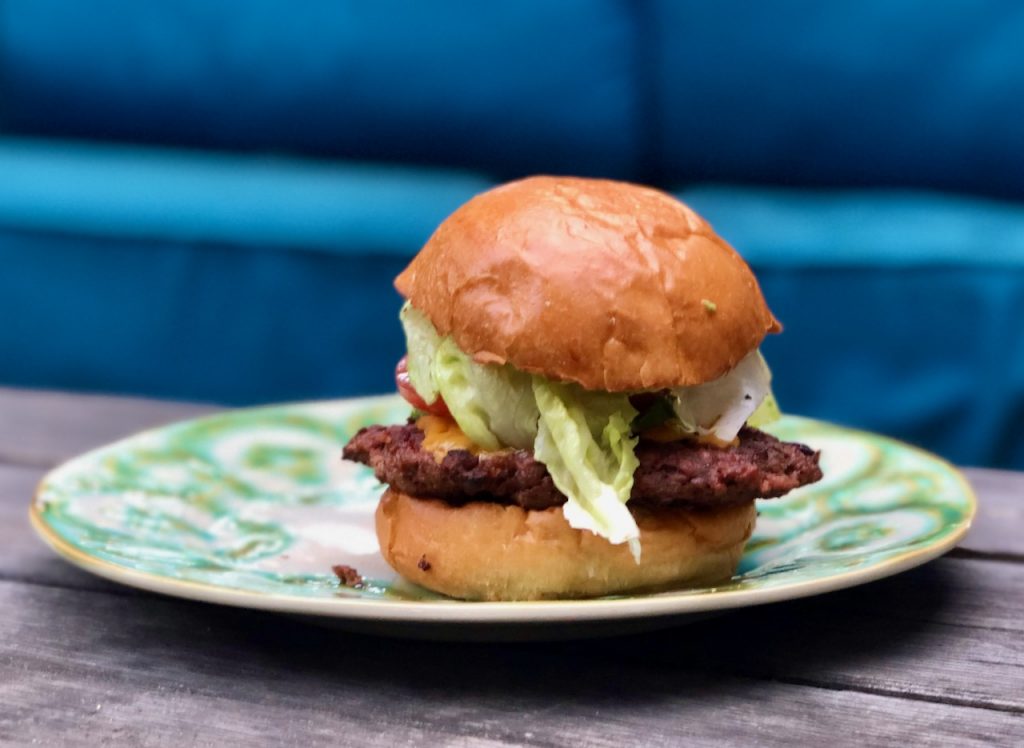
Used to be that Beyond meats were available in the grocery store, but you had to go to a restaurant to try Impossible Burgers. But recently I found Beyond and Impossible side-by-side in the grocery store, and bought one of each. Last night I set up a little taste comparison test for family.

These modern fake meats are so delicious, it’s hard to find a reason to justify the eco- and health costs of buying real hamburger anymore.

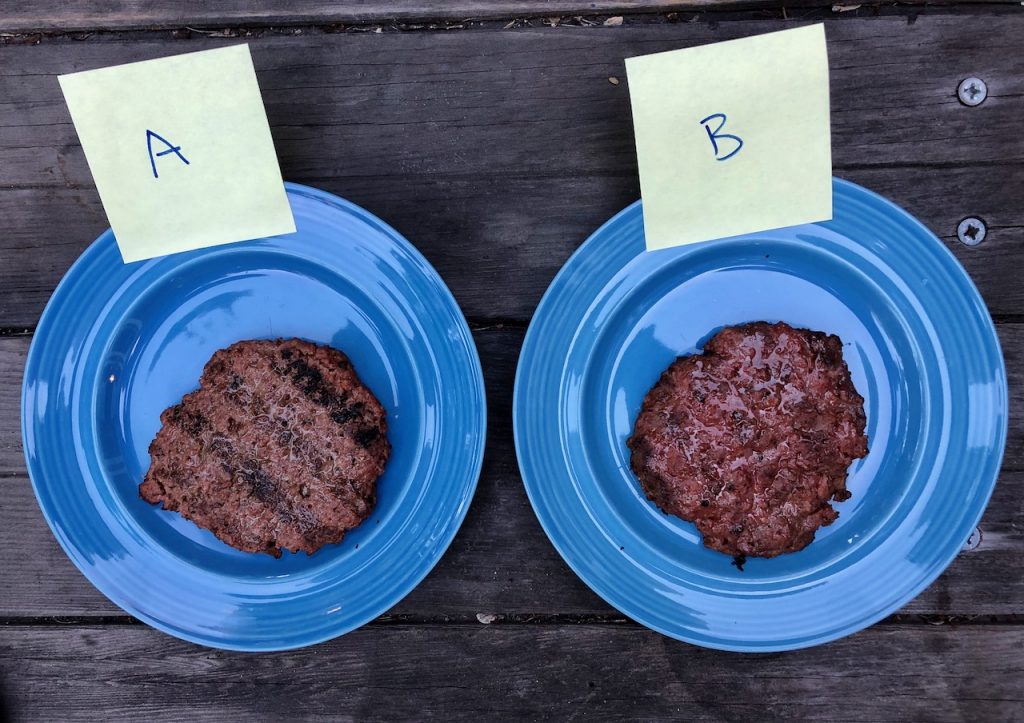
Setup: Two patties the same size. Added the same amount of salt and pepper to each, grilled them at same temperature for the same length of time (3 mins/side). We tasted them as-is: No condiments or extras to get in the way of taste.

Impossible on the left, Beyond on the right.

My wife and son didn’t know which patty was which. To make things fair for my own opinion, I left the room and asked them to flip a coin to decide whether to switch the labels on the plates or not.

Conclusion: We all thought Impossible was slightly sweeter, and sure enough, the label shows that it contains a bit of sugar. We all though Beyond was slightly more chewy, and sure enough, it turns out to contain a bit more fat. Impossible had a bit more native seasoning – a flavor that’s hard to put your finger on, but good. Impossible was also more reddish in color (beet juice, right?) but Beyond had a slightly more realistic taste, if that’s what you’re going for.

At the end of the sampling, we all agreed that if a store had both and they cost roughly the same, we would choose Beyond over Impossible (consensus!). We thought Beyond was more delicious by a shade, despite the fact that Impossible has more seasoning built in. But both are delicious, and it’s gotten really hard to justify the eco- and health-costs of buying hamburger meat when products like these are available.

Honest Photography

Almost no one posts images straight out of the camera (SOOC) — there’s always work to do, improvements to be made. But how far can you go before crossing an ethical line?

As our photo editing tools grow artificial intelligence, and tricks that used to be difficult become progressively easier to pull off, photography forums continue to erupt in debates over what kinds of edits cross the line from acceptable and unacceptable? How far can you before an image becomes untrue? I just posted this in the /photography subreddit, on a topic titled “No It’s Not Cheating“:

There is only one question that matters as far as I’m concerned (but several ways to ask it): Is this an honest photograph? And by that I mean “Is the viewer being intentionally deceived?

If you convert to b/w, the viewer is not deceived. If you add a frame the viewer is not deceived. If you focus stack, the viewer is not deceived. If you modify saturation or contrast, the viewer is not deceived.

On the other hand, If you remove a blemish from a human face the viewer IS deceived. If you replace out the sky, the viewer IS deceived. If you change skin tone in such a way as to misrepresent, or “heal” out a passing airplane, the viewer IS deceived.

The difference between acceptable and unacceptable editing is easy when looked at this way. Does this photograph still tell the truth, or does it now tell a lie? Am I attempting to deceive or not? For me, this makes it easy to tell the difference.

I’m shacker on Flickr and Instagram if you want to follow along.