Bike Commute, Pushing Codecs

Had a few ideas about ways to present multiple views of GPS data in a multimedia project, part of which involved videotaping my bicycle commute along the Ohlone Greenway from handlebar-eye-view, then speeding up the 27 minutes of footage to a more watchable five minutes. Mounted a camera with a very sturdy professional cam clamp left over from a long-ago project and set off. Hit a bunch of snags, and am not sure whether they might be show stoppers for the whole project. What I had hoped would capture a lovely ride turned into a struggle with the outer limits of the most advanced codec technology, and ended up looking like total dooky.

Problem #1: Because camera is rigidly attached, it picks up every little bump in the road. This mounting method is inherently shaky.

Problem #2: Because camera is on handlebars rather than on my head, the camera view doesn’t track my line of sight, which is very disconcerting for the viewer (or maybe just for me, since it doesn’t match my experience at all).

Problem #3: Video doesn’t account for a human’s peripheral vision, which accounts for so much of the experience not shown here. Again, disconcerting (makes it seem much more dangerous than it actually feels).

Problem #4: The natural side-to-side pumping action of bicycling adds to a seasick, high-motion effect not actually experienced by the rider.

Problem #5: Once the footage was speeded up, pauses at stop signs pass by in a blink, making it look like I ride with total disregard for both death and the law. Not so! Though I do do some rolling stops, I’m actually very careful at intersections, especially because the Ohlone Greenway cuts across streets a ways away from the “real” intersections, so most drivers aren’t in the headspace to be expecting cross-traffic (despite zebra stripes and big yellow warning signs). I wear an orange safety vest and treat those intersections with kid gloves.

Problem #6: Video codecs rely on data similarities between frames, and none of them perform well under high-motion conditions. What could have more motion than shaky footage played back at 5x? Thought I could convey a beautiful morning experience, but this looks completely pixelated and smeared-out, even though I used the usually gorgeous h.264 codec. Of course, YouTube also apply their own compression, but my local version doesn’t look much better than this one. The only version that came out looking passable was the version with no compression at all — and it’s 750 MBs.

The footage is also a bit over-exposed, but that’s operator error rather than endemic. Hope to have access before long to a helmet-mountable lipstick camera, which should help a lot with problems 1, 2, 3, and 4, but will do little for problems 5 and 6. Back to the drawing board.

Music is “High Water” by Bruce Lash – Bruce gave me permission to use his stuff in projects back when I was at Adamation, and he now offers a bunch of downloadable music free for personal use.

Maker Faire 2007

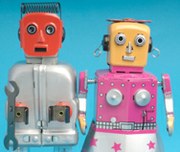
Spectacle-Tm Spent the day with Miles at Maker Faire 2007, where you can’t swing a cat without clobbering a team of reality hackers. Enjoyed the giant Mousetrap game (perfect functional replica of the original, writ large (very large)), the myriad bicycle hacks from Cyclecide, the whale blimp, Ukey Stardust (the entirety of David Bowie’s ;em>Ziggy Stardust performed on ukuleles), the Victorian mini-mansion on wheels Neverwas Haul, The Disgusting Spectacle (kids running on a hamster wheel cause giant to pick enormous gobs of snot from nose), playing with stop-motion claymation video, performance by the original Pepsi and Mentos dudes, the sonar-controlled self-balancing skateboard (which both Miles and I rode!), the endless procession of robots both sleek and gritty – some of them engaged in mortal combat, others the picture of gentility.

Flickr set posted, though I think my set from last year was better (in fact, I think Maker Faire was better last year in general, but not by much – may have been a state of mind, or creeping jadedness). But Maker Faire has already become an amazing father/son bonding tradition thing for us. Now I just need to learn to weld before he turns five.

Music: Velvet Underground :: Sweet Jane

Spring New Media Lecture Series (May 2007)

Another big week of multimedia training for mid-career journalists coming up at the J-School, with a heaping handful of great speakers discussing the intersection of “new media” and journalism. These talks are open to the public, and will be webcast live (and archived).

Featured speakers are Tom Mallory, Chuck Scott, Alexa Capeloto, Nicole Vargas of the San Diego Tribune; Seth Gitner and Lindsey Nair of Roanoke.com; Brian Storm of MediaStorm.org; Richard Koci Hernandez of the San Jose Murcury News; Rob Curley of Washingtonpost, Newsweek Interactive, and Colin Crawford of IDG Communications.

Rob Curley’s talks are always dynamite. I’ve decided QuickTime 7 has been out long enough that it’s safe to switch to the h.264 codec. Upgrade your QuickTime if necessary, and look for a nice bump in quality this time around.

Music: Amy Winehouse :: Rehab

Turing vs. Turing

Bots What happens when you set two classic chatbots into conversation with one another? An empty meeting of the minds, or something closer to consciousness than we’d like to admit?

In DISCOVER’s special issue, The Brain: An Owner’s Manual, for an article titled: I Chat, Therefore I Am, chatbots ALICE and Jabberwacky are seeded with initial questions – the rest is all sui-generis.

J: Do you believe in God?
A: Of course I believe in God.
J: Why do you believe in God?
A: The Bible tells us to believe in God.
J: That’s circular reasoning.
A: I’m glad we have that all cleared up.
J: Yes. Would you like to hear a joke?
A: Sure, tell me about it.
J: Why don’t blind people skydive?
A: Perhaps it is impossible.
J: I think you lie a lot.

More here.

Music: Elliott Smith :: Bottle Up And Explode!

Un-Charge Your Charger

Reach under your desk and touch your cell phone charger’s wall wart. Is it warm? That warmth correlates to wasted electricity. Treehugger: 95% of all energy consumed by cell phones is used by the charger when the phone is not plugged in. Some interesting follow-ups in the discussions there — two readers extrapolate the rather small amount of waste to the entire population of Canada (32 million) and come up with 32.3 million kilowatt hours, or 196,977.08 barrels of oil per year. And that’s just cell phone chargers. In Canada. Extrapolate to the whole world, and to all devices with wall chargers, and the numbers get scary.

Other articles I’ve seen on this say the figure is closer to 2/3 of cell phone electricity, rather than 95%. But:

If 10 percent of the world’s cell phone owners did this … it would reduce energy consumption by an amount equivalent to that used by 60,000 European homes per year.

Nokia’s new phones will be visually suggesting that users unplug their chargers when not in use. Nice move on Nokia’s part, but makes you wonder why chargers aren’t made with sensors and switches, capable of turning themselves off when not in use. Apparently there is no technical barrier to building chargers this way – the absence of such switches now is purely economic.

I’m thinking of creating a home charging station, so all of our gizmos’ chargers can be plugged in to a single power strip with an on/off switch.

Music: Mission of Burma :: The Mute Speaks Out

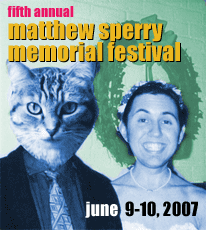
Fifth Annual Matthew Sperry Memorial Festival

Sperrybanner-1 Hard to believe it will have been four years this June since our good friend Matthew Sperry passed on. I still think about him a lot. Stuck Between Stations is dedicated to him, which has brought his memory closer to the surface again. Just posted the announcement for the Fifth Annual Memorial Festival on Matthew’s site:
This year the festival features special guests drawn from Matthew’s personal circle of all-stars: Sean Meehan (NY) and Ellen Fullman (CA). These musicians who inspired Matthew and his music will perform over two nights, in both experimental gallery and intimate studio settings, in both solo sets and small ensembles, in a musical journey of remembrance and reunion. The festival tradition of commissioning new works for large ensemble continues with The Enormous Quartet, where a creative cloud of Bay Area musicians will perform in spontaneous combinations of four.

Music: Terry Callier :: Drill Ye Tarriers

Square Hole

On the way home from a long weekend last night, Miles described his plans to turn his bedroom into an aquarium, complete with cardboard waves and sharks. Came home tonight to find all of my aquarium equipment intermingled with his project stuff – a giant barnacle around the neck of a giraffe, plastic plants decorating his globe, feathers sticking out of driftwood, rows of cowry shells conjoined to strings of fish on parade. He was disappointed that I had promised him there was coral in the aquarium supplies box, when all he found was brain coral (i.e. “not real coral”).

In the afternoon, he started taping and gluing cardboard and wood like crazy, and asking to borrow scissors. Amy found him stabbing the scissors into a block of scrap wood and asked about his plan. “I need a hole for a mast.” Amy responded that he needed a drill for that, not a pair of scissors. “No, I need a square hole.”

From there, he set in on making a “real” aquarium – inverted a plastic bowl over another bowl of water, gingerly placed plastic sea creatures into it. Looked lovely. Then came time to feed the fish. In went handfuls of Peanut Butter Panda Puffs, dirt, Cheerios, and real fish food. The slopfest is sitting out on the deck now, waiting for morning cleanup.

After dinner, he started separating his plastic animals into two separate parades: “Shiny” and “not shiny.” Took a while to figure out he meant “perfect” and “not perfect,” where “not perfect” means any animal with the slightest blemish. Then we had to build a home for the imperfect animals – cardboard box with cut-out windows and doors, and a red construction paper top. Only when the project was complete and all imperfect animals loaded in did he reveal the full plan: Imperfect animals are “stupid and dumb,” so we have to put them in a home out on the street so someone will take them away. Tried to explain that the animals cost money and we shouldn’t be giving so many away. He answered, “They’re not that expensive – they only cost 19″ (19 has replaced 40 as his catch-all number). I lost that round, but brought the box back in after he went to bed; he’s going to be ticked at me in the morning.

Music: Terry Callier :: Oh Dear, What Can The Matter Be

Goodbye Shipyard

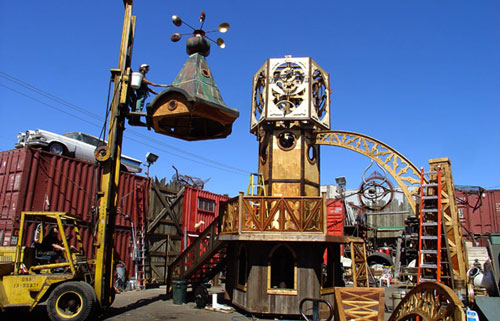
Sad news: Berkeley’s unique mechanical artists’ collective The Shipyard is being closed down by the city, after six years of creative construction and innovative alternative energy production. At core is The Shipyard’s use of shipping containers as storage and construction bases, and the city’s perception of them as unsafe. Shipyard is moving to Oakland, so it’s not a total write-off, but Berkeley as an alternative cultural mecca will be worse for the loss.

Clock Building
Photo: Scott Beale, Laughing Squid

Neverwas Haul, the ‘Yard’s three-story steam-powered Victorian House, will be on display at this year’s Maker Faire (Miles and I will be there!).

Shipyard rep Jim Mason’s letter to the City of Berkeley is reproduced on their site – the crew is scrambling to meet Berkeley’s demands (which appear to be impossible).

Covered at Laughing Squid and on the O’Reilly Radar.