My boss titled the subject line of the email he sent this to me in: “Why I never want to be in live TV news.”
Just painful to watch.
Tilting at windmills for a better tomorrow.
My boss titled the subject line of the email he sent this to me in: “Why I never want to be in live TV news.”
Just painful to watch.
When base jumping isn’t enough… there’s always the wingsuit:
(Higher-quality version here. Lots more on YouTube).
What strikes me about the wingsuit, once I pry my heart out of my stomach, is its simplicity. With humans trying for millenia to fly like the birds, with the airplane having been with us for more than a century, it seems odd that the wingsuit is so simple, so elemental, and yet took so long to develop. “You need webs, like a bat!” Why wasn’t this invented a thousand years ago? Almost seems like it could have been made with deerskin and twine.
OK, I take it back. Wikipedia:
According to wingsuit lore, between 1930 and 1961, 72 of the 75 original birdmen died trying their wingsuits. Some of these so-called ‘birdmen’, most notably Clem Sohn and Leo Valentin, claimed to have glided for miles and inspired dozens of imitators.
In case you’re wondering, a wingsuit costs around a grand. Great photo gallery.
Part of the fun of exploring the brave new world of HDTV and Series 3 TiVo is figuring out how to get Tivo-recorded shows onto the Mac and preserved on DVD, and to go the other way around, from the Mac to the TiVo (i.e. watching BitTorrent movies in the living room). None of this is built in, exactly, or well-documented. But it’s do-able.
For the First Case, I’ve used TiVo Desktop, which only comes bundled with Toast Titanium 8 (grrr — if you’re going to bundle a network connection on a device, then software to make it work should be included free), then burned to DVD with the awesome VisualHub.
I haven’t yet mastered the art of the Second Case, going from the Mac to the TiVo. Michael Alderete, who was a communications ace at Be back in the day, has written an excellent guide covering the process soup-to-nuts. We hooked up on the topic through a post in the VisualHub forums, and I wound up throwing in a few edits to his doc.
This document describes set-up and processes for downloading videos from the Internet using BitTorrent or other mechanisms, and then transferring them to a TiVo Series 3 high-definition (HD) recorder, for playback on a high-definition TV (HDTV).
Ironically, I haven’t yet gotten the Mac –> TiVo connection working yet myself; TiVo says my “brain” (that’s this Mac’s hostname) is empty. I suspect a firewall issue. Alderete’s directions assume Tiger, not Leopard. The problem is that in Leopard you need to manually poke a firewall hole for the apps you want to be able to communicate with the rest of the world — but Tivo Transfer is a preference pane, not an app, so there’s no clear way to add it (adding the preference pane module to the list of apps hasn’t unblocked the pipes).
Will get this licked eventually. And keep burning DVDs when necessary until then.
Miles is just beginning to read in earnest. Had a classic first reading experience with him last night, working our way through the first few pages of Green Eggs and Ham (couldn’t ask for a more textbook test harness). Interesting to be reminded of how deeply we’ve internalized the arbitrariness of our language, and how profoundly the unintuitive bits strike someone just learning our non-rule rules for the first time.
Capitalizing on the words and spelling patterns he’s learned so far, M wanted to know why “do” isn’t spelled “doo,” why “edge” isn’t spelled “ej” and was pretty peeved about the seemingly random presence of silent “e” (not to mention the silent “l” in “would”).
Numbers always make sense, but languages only make sense when they feel like it.
But why???
How can you explain such a thing to a 5-year-old who barely knows what history means, let alone the migration of cultures and evolution of languages? Those are even harder to explain than the fact that the “b” in “lamb” is slightly less subtle than the “b” in “subtle.”
I do not like them in a boat, I do not like them with a goat. I do not like them, Sam I am.
So we’re ditching English around the house and doing immersion Esperanto instead. And we’re switching our keyboards to Dvorak. OK, that’s a joke, but this is serious: Miles’ school teaches only the metric system, from kindergarten on. Admirable, or not so much?
Using Leopard for a couple of weeks now – a few more scattered impressions here. Haven’t had time to explore all the nooks and crannies. I spend 95% of my time in Mail.app, TextMate, and FireFox/Safari. Haven’t even launched Time Machine – need to clear a partition on the NAS, and even then, not sure TM is the way to go – we’re pretty happy with SuperDuper for backup, and its images are bootable/restorable, which is something I wouldn’t be eager to give up.
No accident that the Ars review spends the first few pages on UI annoyances. Nice finally to have the look and feel consistent across all apps, but the semi-transparent menu bar is a UI disaster if you use a background with mottled textures, like “stones.” Knew it wouldn’t be long before some kind of hack came out to restore the opacity. Leo ColorBar to the rescue – not only gets rid of transparency, but also lets you tint the menu any color, which I’m liking:

Ditto for the Dock: I never asked for a mirror. And replacing black “running app” triangles with little glow lights? Cute, but I was tired of them in a couple of days. All gratuitous eye candy. TigerDock lets you return the Dock to something closely resembling… the Tiger Dock. Dock Delight gets your triangles back.
The one thing I thought I missed the most from BeOS days was having multiple workspaces – I used to keep email and browser on one virtual desktop, photo and video apps in another, etc. Spaces was the single Leopard feature I was looking forward to the most. Somehow, in BeOS, the workspaces concept just worked. The first thing I noticed about Leopard’s Spaces was that, unlike in BeOS, there’s no way to assign different wallpaper or background colors to different desktops – they all look the same. Important visual cue, missing. And BeOS also let you run workspaces at different resolutions, which was a great way to test web designs. Not in Leopard.
But I soon realized that somehow, in the intervening years, the perceived need for multiple workspaces had gone away. Between Expose’, the Dock, Cmd-Tab, utils like QuickSilver, and showing/hiding apps, the Mac offers so many ways to switch apps effectively while keeping the desktop clean that the need was effectively gone. After using them for a few days, I realized that all Spaces was getting me was an additional animation when switching apps. I turned Spaces off.
Guess I’m giving the impression of not liking Leopard – but that’s not true. Just getting the annoyances out of the way. Lots to say (mostly good) about changes to Mail.app, iCal, and other features… will save those for another day.
Interesting video produced by the Introduction to Cultural Anthropology class (Spring 2007) at Kansas State:
Speaks for itself. More at mediatedcultures.net.
See also: 60 Minutes‘ report on the Millenial generation – an eye opener.
 Veteran’s day… us gubmint employees got the day off. Felt more poignant than usual since Amy and I have been working our way through The War… slowly. Painful and fascinating to watch, learning so much.
Hung a 70-lb. TV on a 50-lb. wall-bracket today, finally eliminating the hideous shiny plastic stand it came on and getting it 12″ farther back from the couch. For a weight like this, hitting the studs was of paramount importance, couldn’t risk missing. Unfortunately, thick lathe walls and multiple repair jobs over time* resulted in getting lots of false readings from the electronic stud finder. For a while there it seemed like chaos, and I was beggining to consider fishing for it, though I didn’t relish the thought of having to patch it up later.
Each time I got a reading for the edge of a stud, I made a mark on the wall. After a while, I had about 40 tiny Xs dotting the LR wall, and noticed a pattern starting to emerge. While no single mark was reliable, in the aggregate I was starting to see implied vertical lines on either side of a 2″ space.
This got me thinking… when placing a geocache, it’s really important to publish accurate coordinates. But marking a single waypoint is inaccurate by definition, since the satellites and the earth are constantly shifting in relation to one another. The first cache we placed, I did the “bee” dance, walking out 30′ and returning repeatedly, marking the spot again and again, then finally plunking down a waypoint in the middle of the cluster to represent the average reading. That worked OK, but later discovered there was an “average waypoint” feature built into the GPSr – set it down in one spot and let the earth move while it takes a reading every few seconds. Let it do that for 200 or so readings, hit Stop, and you get a dynamite average. Conclusion: The world needs an electronic stud finder that does automatic averaging. Just drag the finder randomly around on the wall for a few minutes and let it report well-averaged stud edges.
Aside: Got my stitches out today – hand’s doing well, but will probably have a nice Frankenstein jag in it for life. At least it’s fully mobile again.
* Have I mentioned that when doing wall repair recently (earthquake cracks), I discovered that the living room had once been painted top to bottom with gold glitter paint? I love trying to imagine what the rest of the room must have looked like at whatever point in history that might have been.
Talking with a friend tonight, and with another friend the night before, about how life has become a blur of commitments, kids’ birthdays, workload, sleeplessness. Then, almost like a perfect case-in-point, our babysitter showed up while we were in the middle of serving dinner to guests – we had arranged for a date night to get out and relax, then completely spaced it. Both of us. (The babysitter joined us for dessert and it was all good, but sheesh). We’re all ridiculously over-extended, over-committed, over-saturated, brains turning to … not quite mush, but something closely resembling it.
I sometimes feel like I can make things better, keep shreds of meaning afloat, by browsing RSS feeds in the margins, scanning a few sites for news of the weird and wonderful, blogging a bit. But ultimately, all those little tidbits amount to nothing, and life is no less blurry. In fact, it’s all just more noise, more crazy multitasking, and the extra information just contributes to the blur. We try to use software and organization techniques to bring order to the chaos, but in the end we’re just trying to tame the noise rather than making it go away.
Lately I’ve had the feeling that what I need is to just make a lot of my inputs go away, and to spend some time reading books, having conversations that last more than a minute. More than that, I find myself wanting to be gathering chicken eggs from a henhouse, shoveling goat shit… When I was a boy, we lived for a couple of years on a very small farm, and my brother and I drank nothing but goat milk – sometimes directly from the goats’ teats, warm and hairy. We raised a pig, then slaughtered and butchered it ourselves. I’ve never taken meat for granted from that point on. My parents were trying to create a real environment for us, and to some extent I think the message got through. And yet I’ve allowed my life to become disconnected from dirt. Something in me wants to make sure that Miles can suckle from goat teats too.
The more noise that gets through, the more drowned I feel, the more I find myself wanting to reconnect to something elemental and permanent and meaningful. And yet I’m so embroiled in this digital world that I can’t see my way clear to enjoying a simple Sunday without tending to everyone else’s needs… how many years has it been since I’ve read the Sunday paper, or been able to read more than one or two books a year? Looking in this particular mirror makes me feel like something is desperately wrong.
Right now I’m longing to hear the clang of goat bells outside my bedroom window, to know I’ll be heading out to gather breakfast from the chicken coop in a few hours. But I can’t see how to get there from here. How do you re-organize a life that dramatically?
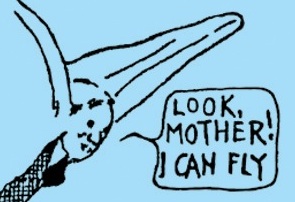
Boston Globe’s Joshua Glenn:
The Complete Dream of The Rarebit Fiend is a gorgeous, exhaustive, self-published collection of Winsor McCay’s sophisticated, literally fantastic newspaper comic strip (1904-11). It’s edited by independent scholar Ulrich Merkl, available only from Merkl’s website.
Glenn’s audio slideshow for the Globe “demonstrates the influence of McCay’s imagination and sense of humor on five films in particular: the 1930 surrealist classic “L’Age d’Or,” “King Kong,” “Dumbo,” “Mary Poppins,” and “Charlie and the Chocolate Factory.” ”
This is the same Winsor McCay who was the author of Little Nemo in Slumberland – the incredible early-century comic that ran in the Sunday papers when our grandparents were young. I bought a large-format reprint of those comics for Amy a couple of years ago, and it continues to inspire (though its ridiculous size defies its being filed in any bookshelf known to man).
Remember why you’re here. Unknown surfer on monster wave in unknown location, about as close to the immensity and awe of naked existence as one can physically be.
Also awesome: “In the Brazilian state of Amapa, on the full moon closest to the March equinox,” a set of waves form twice a day that ripple up through the Amazon jungle, providing surfers the opportunity to experience the longest rides of their lives – up to half an hour long.
Aside: Photography and film used to signal to us “truth,” while obvious animation signaled fiction. But while watching surf clips on YouTube with Miles this evening, he kept asking “Daddy, is that real?” Already, he’s so accustomed to photo-realistic special effects and the blending of live film with rendered characters that he’s utterly unsure what’s real and what’s not. Trying to explain the truthiness of a show like Prehistoric Park, which is scientifically accurate in every way and yet totally fictional, I never feel sure whether he’s making the distinctions clearly in his mind or not.