When Good Mail Goes Bad

Great way to wrap up a holiday: Agreed to take on a new Birdhouse client – a mid-size company who’s had a horrible email experience with their previous “top tier” provider. They had a dozen or so addresses; could we take them on? No problem. The old host had been storing a couple weeks worth of their mail, but there was no way to get it through to the mail exchanger for delivery. The old host agreed to relay it all to Birdhouse for processing.

That’s when things turned ugly.

Turns out the previous host didn’t have the basic common sense to discard mail to unknown addresses on the domain (it hasn’t been feasible to accept mail for unknown names, like balloon345@domain.com) for years. But they were not only accepting it all; they relayed it ALL to Birdhouse.

300,000 messages worth, 95% of which was theoretically discardable.

Unfortunately, discarding crap mail isn’t trivial when parsing a queue that large. Needless to say, things came to a grinding halt. Complicating matters was the fact that Birdhouse actually utilizes two mail queues: One for MailScanner, which pre-processes spam, and another for Exim, which is the actual mail transfer agent. The MailScanner queue was so large we couldn’t even get things out into the Exim queue. Exim documentation assumes a single queue, and MailScanner doesn’t offer the same range of queue management options that Exim does.

Which meant I got to script a solution, examining each messages on the pre-que to determine whether it was destined for a valid or invalid address, and dropping it if invalid.

The script is running now, but will take a while. All spectacularly unpleasant. Once again, wanting to skewer a spammer or two and painfully aware of how much of my time is consumed by fighting bad guys.

Progress updates on the Birdhouse System Status page.

Music: Andy Bey :: I Let a Sing Fo Out of My Heart

Hang On Sloopy

When I was a boy, one of the things I loved about driving through the Bay Area was looking for the amazing sculptures people created and planted in the mud flats and low tidal areas around area highways and bridges. There are far fewer of those around these days than there once were, but there are still a few, if you know where to look. Yesterday Miles and I found a few good ones while geocaching around the Emeryville Marina, including this excellent biplane just beyond arm’s reach from the end of a pier at the base of the marina peninsula.

Img 8523

Img 8522

Img 8521

The GPSr pointed to a spot somewhere just beyond the plane’s cockpit, which explained why the cache was rated a 4.5 on the terrain scale – one of the more difficult ones I’ve attempted (yay adrenaline!).

Geonewyears2007

Absolutely gorgeous caching day, and booty everywhere. At the end of the day, sun going down and the sky turned absolutely electric. One of the most gorgeous sunsets of my life, and the vista was 180 degrees of perfect.

Me: Miles, this is one of the most incredible things I’ve ever seen. No, wait, *you’re* one of the most incredible things I’ve ever seen.

Miles: Yeah, but I’m not a sword swallower. [Then, looking at the sky:] Hey, this must be where God lives!

Music: Devendra Banhart :: Sea Horse

Experiments in Geocoding

For a while now, I’ve been wanting to try my hand at geocoding — attaching latitude and longitude (coordinate) data directly to the EXIF metadata in photographs so they can be precisely positioned on a map.

The easiest way to do this is to use a camera with a built-in GPS. Unfortunately, that’s still a pretty rare feature in cameras, and comes at a hefty premium. Because most people aren’t interested in the feature and never will be, it’s not likely to become commonplace any time soon. Some day we’ll all have high-quality cell phone cameras with native GPS — the Nokia N95 is the current front-runner, and I think it’s a safe bet the coming Google phone will have fully integrated GPS features. I’ve been holding back on taking the iPhone plunge until it has fully realized GPS capabilities (at which point it will also become the ultimate geocaching device).

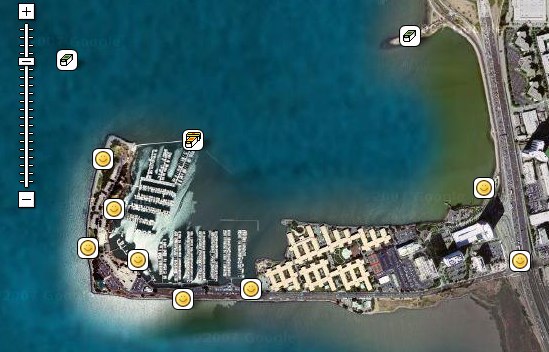
But the cool thing is, you don’t have to wait for a GPS-enabled camera to start geocoding. Here are the results of my first geocoding experiment, created without a GPS-enabled camera. The icons are clickable; the thumbnails in the balloons are too.


View Larger Map

The photos aren’t great, the interface isn’t perfect, and due to several beginner’s mistakes, only some of the coordinates shown here are accurate. This was more a proof of concept than anything – a way to explore available software and techniques. You’d think generating a map like this would be trivial at this point in the game. Well… yes and no. There are a ton of options, but getting things to appear exactly the way you want them to is still a bit of a pain. Click through for the gory details.

I recently picked up an excellent (paper) map detailing 140 of Berkeley’s hidden pathways – concrete or wooden stairs covering the steep stretches between many of the twisting, heavily wooded streets of Berkeley. These were mostly built at the turn of the last century to help citizens without cars get to the local train systems. I recently explored a few dozen of the paths with my family, and started my geocoding experiment there.

Continue reading “Experiments in Geocoding”

Magic Highway USA

So Tomorrowland wasn’t supposed to be a Disneyland-only thing? You have to wonder whether the Imagineers really did think we’d achieve this kind of transportation utopia, or were fully aware that they were projecting a full-on fiction.

The film seems to blur the line between futurism and science fiction (futurism being an honest attempt to predict). Technology that never arrived aside, one of the the most amazing aspects of this is the fact that it takes no account of the population explosion. These cars have the road as much to themselves in the projected future as they did when the film was made in the 1950s.

Thanks Jeremy

Music: The Clash :: Police & Thieves

Spam Poster Art

Nogirls Thumbtack Press hosts a gazillion great pieces of indie art (whatever that means), available as posters. A friend tracked down this excellent collection of art posters made from common spam taglines. Also loved “Realize your dreams with our help for a short time.” How promising! Also: “This secret weapon will give more power to you little soldier.” Little soldier thanks you. See also: Spam Plants and Spamland.

Music: Leaders Of The New School :: Mt. Airy Groove

Real Good for Free

This week at Stuck Between Stations:

Me, on violinist Joshua Bell’s recent experiment playing in a D.C. subway:

Violinist Joshua Bell’s virtuosity is so renowned that Interview magazine once said that his playing “does nothing less than tell human beings why they bother to live.” A few months ago, Bell walked into a D.C. subway station, flipped open his violin case, and played his heart out for spare change — on a $3.5 million 1713 Stradivarius.

… Of course almost no one paid any attention. Context is everything, and we only hear what we’re prepared to hear. More on context, presentation, perception in the piece.

Music: Billy Bragg & Wilco :: The Unwelcome Guest

New Media Webcasts

Another week of interesting webcasts coming up at the J-School, mostly focused on questions surrounding the evolution of newsrooms – the integration and embrace of new and alien techniques and technology in the news gathering process.

The talks represent the public component of another digital media training workshop sponsored by the J-School and the Knight Foundation. We’ve greatly ramped up the number of workshops held each year – this topic is becoming critical to struggling newsrooms around the world.

Tune in live, or check back for archived versions.

Music: Wilco :: At Least That’s What You Said

Does God Exist?

In the car with Miles yesterday, he suddenly chirps up: “Daddy, does God really exist?” As I’m formulating a response, he answers his own question with some flavor of techno-contemporary agnosticism: “I bet not even Google knows the answer to that!”

Indeed.

Of course, the same question WRT Santa is very much on his mind right now. It’s unclear whether he puts Santa and God on the same or different epistemological / mythological levels. I know he knows that not all grown-ups believe in God; I’m not sure he realizes the same about Santa.

I think he thinks that grown-ups do believe Santa is real – interesting that he would question God’s existence before Santa’s (I promise I’ve had no hand in that!), though I guess it’s understandable since he sees Santa all over the place. God, not so much.

Music: Wilco :: Spiders

reCAPTCHA

Fascinating project. The idea is that optical character recognition processes in place at the world’s largest book digitization projects naturally make lots of mistakes, and encounter plenty of computer-unrecognizable words – especially with older books or books printed with messier inks or using less-precise fonts. Rather than having staffers laboriously read every word of every book just to correct the clinkers, reCAPTCHA puts the hive mind to work, every time a member of the public solves a captcha.

About 60 million CAPTCHAs are solved by humans around the world every day. In each case, roughly ten seconds of human time are being spent. Individually, that’s not a lot of time, but in aggregate these little puzzles consume more than 150,000 hours of work each day. What if we could make positive use of this human effort? reCAPTCHA does exactly that by channeling the effort spent solving CAPTCHAs online into “reading” books.

I’m going to replace a few captchas I’ve got in place at the J-School with reCAPTCHAs. I’d been meaning to add audio accessibility to them anyway, and reCAPTCHA has an audio option built in. Being able to contribute to book digitization is delicious gravy.

Update: Adding this video thanks to Jeremy:

Music: Gary Wright :: Our Love Is Alive