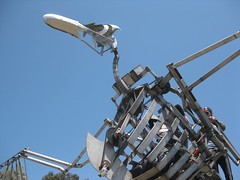
Miles and I have attended Maker Faire in San Mateo every May since it started five years ago. It’s gotten huger with every passing year of course – wall to wall people, and tricky driving/parking if you don’t arrive first thing. A lot of the same themes from year to year, but always something new to feast the eyes and tease the brain. Didn’t stay as long this year, didn’t dig as deep, and didn’t get as many diggable photos as we have in the past, but still glad we went and will keep on keeping on!
Strangely, one of the best moments of the day had nothing to do with welding or LEDs or Adam Savage. It was a magical encounter with a lone man sitting at a small typewriter (yes, typewriter), selling poems. “You name the topic, you name the price.” With a friend’s 50th birthday coming up that night, I asked him to improvise on the topic of “bicycles in the city of your mind.” We carried on a conversation about French surrealist Alfred Jarry and his impact a hundred years later on the punk/new wave movement, and about how Picasso actually bought his gun after he passed, and ended with me spontaneously ejecting the sentence “This moment is a grommet through which the aglet of morning has finally emerged.” We laughed, he handed me the finished poem, and it was absolutely fantastic (sorry, I already gave it away as a gift, so can’t share it here). More at zachhouston.com.
At the Knight Digital Media Center where I work, we depend on interns and assistants to accomplish a lot of what we do. We’ve had a lot of good ones over the years, but one of the best was Hannah Hart, aka Harto. Unfortunately for us, Hannah moved to NYC to become an assistant to one of the actors on 30 Rock… and to turn herself practically overnight into a minor celeb as host of her own YouTube channel, where she’s been working on the net-only cooking show My Drunk Kitchen.
MDK is recorded on a single MacBook webcam from her kitchen apartment while demonstrating cooking techniques for complicated “meals” like grilled cheese sandwiches and cookies – while getting completely and totally crocked on cheap champagne, wine, or whatever happens to be sitting around that day. Sound insane? Just you watch. It’s all about the repartee’.
Each episode starts off innocently enough, but by the time the prep is done, Hannah’s pretty much off her rocker, questioning whether anyone really knows what it means to “cream the butter” (“I’m sure they meant ‘cram’ – I’ll just cram the butter in here…”).
Hannah’s just launched her own web site, featuring all MDK episodes to date.
Never mind black-hat SEO and the mostly closed ecosystem of the second internet (Facebook) – the web is facing a possibly even bigger nemesis in “content farms” like Demand Media, which attempt to game the search + advertising money machine that is Google. I knew that content farms were a big problem (Google even recently released a Chrome plugin that would let end users identify non-useful content on the internet so it could be deprecated in search results). But check out the infographic below. It’s all interesting, but wrap your head around the the raw numbers: “Demand’s goal is to publish 1 million articles/month (30,000 articles per day)” — all crap content written by underpaid writers churning out intentional baloney, all with the intention of skimming pennies and dollars out of AdWords. In the process, they’re wrecking the quality of the search results you rely on every day, and filling the web with bile and nonsense. Staggering.
Over the past year, Miles has been building a city of Legos along one entire wall of his bedroom. It changes every day – tearing things down and rebuilding them, rearranging them… this is how it looks today, but it was different yesterday and will be different tomorrow.
Social networking and online publishing weren’t always about the web. When I got my start at ZiffNet – an umbrella organization for the family of Ziff-Davis computing magazines – “online” meant CompuServe, Prodigy, and AOL. At the time, CompuServe was only accessible in command line mode, through terminal emulation software. Seems impossible by today’s standards, but at the time, it was the state of the art. The Ziff-Davis presence on Prodigy and AOL came a bit later, and were graphical – some of the first to take advantage of the then-new new Windows operating system.
We were lucky to have been in the cat bird’s seat when the web hit in the early ’90s (though we were also blind-sided by it, since our business model was all about charging for connection times). I was lucky to have been there at the birth of the web, and got to help create Ziff’s first web presence, which in turn inspired me to launch Birdhouse (first as an arts collective, then later as a blog, and later as a hosting service).
A lot of water under the bridge since then – incredible to contemplate how the landscape of online publishing has changed since then. To celebrate the 20th anniversary of ZiffNet, ZDNet has published a ZDNet 20th Anniversary Special, with memoirs from myself and others involved at the time. ZiffNet launched my passion for technology and my career. I’ve re-posted my own contribution below, for posterity.
When Bucketlist launched a year ago and I needed a good app to let users create a taxonomy for their life goals, django-tagging was the main contender, and that’s what we went with.
Django-tagging worked pretty well overall, but had one critical bug: Because it only had a tag “name” field but no slug field, users could enter tags with slashes in them. Accessing lists of those tags would then generate a 500 error – a bad user experience, unclean, and I was getting tired of seeing the error reports. Unfortunately, django-tagging hasn’t been been updated in quite a while – starting to look like abandon-ware.
At Djangocon 2010, buzz was that Alex Gaynor’s django-taggit was picking up the slack and becoming the go-to tagging library for Django. Unfortunately, Taggit provides no migration strategy to move your existing tag base over. I held off on migration hoping one would appear, then finally decided this week to try it myself. Thought I’d document the process for others in the same boat. Continue reading “Migrating from Django-Tagging to Taggit”
Update: Apple has now released their iTunes Match service, which also places a ridiculously small limit on the number of allowed songs. As with Amazon, music lovers with larger collections – the very customers most likely to pay for the service – are excluded.
Much hay is being made over Amazon’s new Cloud Drive music storage system, which lets you upload your music collection to the cloud so you can listen to it from almost anywhere without having to carry it with you or worry about backing it up. Most of the articles I’m seeing, including David Pogue’s NY Times piece, are calling the service “Almost Free” or “Very Cheap.”
Huh? After 30 seconds of surfing around their FAQs, I had already determined it was way too expensive. While most articles about Cloud Drive claim it costs $1/GB, the rate chart at the bottom of this page makes it clear that that’s not quite true. It’s a tiered pricing plan, which means that if you own 250GBs of music, you have to pay for the 500GB service plan, which costs $500/year!
Had so much fun playing Mad Libs as a child , diving headlong into surrealism and humor while learning the parts of speech. Thrilled to see Miles getting into Mad Libs now – we’re having a gas learning to tell our adverbs from our plural nouns. Loved the Nixon and other old-school political references in this one he completed today:
Ladies and gentlemen, on this sleepy occasion, it is a privilege to address such a gassy looking group of birds. I can tell from your smilingcars that you will support my sassy program in the coming election. I promise that, if elected, there will be a mirror in every toothpaste and two leaves in every garage. I want to warn you against my stinky opponent Mr. Miles. The man is a coolshoe. He has a boastful character and is working vent in glove with the criminal element. If elected, I promise to eliminate vice. I will keep the sea turtles off the city streets. I will keep crooks from dipping their pencils in the public till. I promise you rainy government, clean taxes, and runny schools.
A year ago, Miles and I made our first Bristlebot – a small robot made from a toothbrush head, hearing aid battery, and the vibrating motor from a cell phone – which skitters around on flat surfaces in chaotic patterns.
The experiment didn’t end well – Miles grabbed a hot soldering iron by the shaft when I wasn’t looking and we had to segue into burn control. When that subsided, we had great fun racing the bot across the floor.
I just volunteered to help his entire second/third grade classroom build their own bristlebots this April. We’ll also try a variant with mint tins and paper clip legs. We plan to build a “sumo” ring they can push each other out of, and may also try our hand at bristlebot painting:
Enjoying my sixth annual pilgrimage to Austin, TX for South by Southwest Interactive, 2011. Once again, I’m renting a bike from Barton Springs Bikes – fantastic way to get around, especially now that the conference is much larger and more spread out. It actually makes it feasible to attend sessions 10 blocks away, given the 30 minute break between sessions. Unfortunately, the excellent mountain bike they gave me was stolen from in front of the hotel on Saturday night – cable lock clipped. They cheerfully delivered a replacement bike to me later the same day. Since my hotel is right on the river, I’ve got the luxury of riding all the way to the convention center along Ladybird Lake (which is actually a reservoir that “flows” through town). Weather was high-70s/low-80s all week – shorts weather in March, so lovely!
As soon as I arrived, rented a kayak and spent a couple of hours boating around on the “lake.” Next day, had a few hours before sessions started and went bicycle geocaching along the water. Frabjous day! You’ll find my photos on Flickr or by following @shacker on Instagram.
Ate lots of great Texas BBQ and TexMex (thanks Chuy’s, Stubbs, and IronWorks). Didn’t do a lot of partying, but did manage to squeeze in a visit to the Museum of the Weird, where I got to see a woman drive a 30-penny nail straight into her nose (a move called “The Blockhead”). And of course my annual pilgrimage to Tears of Joy hot sauce shop – had another box of excellent sauces shipped home. Was treated to an evening of hilarious comedy with John Oliver of the Daily Show (and four others, each more funny than the last). Met tons of cool people, got my brain filled with inspirational and challenging new ideas, and ran myself ragged. Halfway through, gave up trying to stay caught up with email or anything going on back home, though we were very much aware of the earthquake/tsunami disaster going on in Japan – it was very strange to try and stay focused on the conference while that was happening. The enormity of it is still sinking in. There were many disaster-relief fundraising efforts going on during the conference, and SXSW did what it could to pull together and help.
Spent most of the week attending dozens of sessions on interactive media and taking notes, which I’ve posted here as “Loose Notes” and have tagged here at Birdhouse under #sxsw2011 (though that link won’t get you to all of them – pagination is currently broken, sorry). While every session had something useful to offer, some are obviously better than others. If I had to pick a favorite, I’d give the honors to Jeff Jarvis’ amazing talk Let’s Get Naked: Benefits Of Publicness V. Privacy, which crystallized a lot of the thoughts I’ve had on the public vs. the private vs. semi-private web over the past year. The other big one for me was Jane McGonagil’s talk Reality is Broken: Why Games Make Us Better, which challenged a lot of my notions about the effect of gaming on kids’ minds, and its potential benefits to education and to improving the world. Truly inspirational.
As for hands-on sessions, the most inspirational/useful was Creative JavaScript and HTML(5) Visual Effects – a double-long session that gave us a great hands-on intro to doing particle animation, movement, shading, and WebGL in the HTML5 canvas tag. That’s not to detract from any of the other sessions – check the links below for lots of juicy stuff.
If I had one complaint about the conference organization, it would be the fact that it was so spread out. In part, this was necessary, since there were more than 19,000 attendees this year – more than could fit in a single convention center. But the trek to some of the remote hotels was a barrier for many people. In addition, it ghettoized some topics unnecessarily. For example, all of the Future of Journalism sessions were at the Sheraton, 10 blocks away from the Convention Center. If anyone could benefit from being mixed in with all of the geeks, it’s journalists. I get why multiple venues are needed, but would have liked to have seen the topics mixed up across venues, not split up.
A handful of misc images taken from in and around Austin throughout the week:
To view larger, or with full captions, check out the Flickr set.