Epic 2014

Interesting eight-minute b/w Flash movie (EPIC 2014) on the recent history and future of media consolidation, the broadening alliances of Google, Tivo, news providers, and P2P networks projected out a decade into a future where ubiquitous smart servers (“the Google Grid”) and the consuming public cut up and co-create their own news, ultimately pushing the NY Times out of business. “News is now shallow, trivial… but it is what we wanted…”

Not sure who’s behind this, but noticed an embedded reference to montagist Winston Smith (though this doesn’t really feel like his work).

Music: Jorge Ben :: Os Alquimistas Estão Chegando Os Alquimistas

Uncle Meatspace

Buying more music at iTunes Music Store over the past six months; their catalog keeps expanding in ever-widening circles. Increasingly, it seems that when I buy a CD, it only gets touched once. Not because it’s not good, but because it only needs to be ripped once. After that, it’s in iTunes, on the iPod, or pumped to the living room via Airport Express, and the meatspace disc does nothing but take up space. If all I really want is bits, why futz with atoms (especially if I can still support the artist, kinda, by buying it electronically?)

When I told a friend this recently, he remarked (nicely/half-jokingly) that I was “part of the problem.” “What problem is that?,” I wanted to know. “Encouraging the proliferation of lo-fi digital music.” Well, he has a point. On the other end of the spectrum, another friend recently rejected a large-ish collection of music because my 192kbps MP3s were of too-high quality. Even with disc space so cheap today it may as well be free. You can’t win this one. There’s nothing to win.

Can’t help but think that too much discussion about formats, codecs, and bitrates falls prey to the traditional and sometimes true criticism leveled at Hi-Fi freaks: Energy spent thinking about gear is energy stolen from enjoyment or discussion of the music (which is why I love it when an audio tweak puts an old scratchy mono LP on the turntable — I know they have their ears in the right place).

Now excuse me as I return to my regularly scheduled MC5.

Related: Mary Hodder at Napsterization: The Musician’s Era: Do We Still Say ‘Album’?

So will musical development change as more people download by the song and musicians know and work with this new way of interacting with music? Or will both musicians and listeners maintain the convention of the reference to an album, even though we don’t have them for the other reasons mentioned, to describe an associated grouping of music as a complete work?

Music: MC5 :: Kick Out The Jams (Uncensored)

Pansy Bikes

Took out time with baald to test-drive a couple of scooters today: The Aprilia Mojito and the Kymco People — both 50cc, both a bit over my budget, and both totally anemic. Haven’t been on a bike since I cracked up the R1100R, and even though I knew a scooter would be a pale shadow of that magical creature, wasn’t prepared for just how pathetic a commuter scooter would feel. Head up an SF hill, open it up.

“Baby, is that really all you got?”

Sad, but that was the goal after all. Efficient, not fast. Of the two, was surprised to find the Kymco more peppy, and better handling than the Aprilia. Kinda fun, but felt like a pansy. Felt like I should have a cell phone with little baubles and tassles hanging from the handlebar. One of them even had a little hook for hanging your pink plastic grocery bag from. Kind of hoped no one I knew would see me on it. That’s not where I want to be. So, two lessons learned:

1) Can get a 150 or 200cc scooter on the used market for less than a new 50cc.

2) Want something that’s been through the mod wars. Original styling, not retro plastic, and with battle scars. Fixer OK, if it’s a proven work donkey.

Still, time well spent. Had to ride them to know.

Music: Nils Petter Molvær :: Kakonita

Prozak for Lovers II

The best thing I ever accidentally stumbled upon at the once-great MP3.com was the music of Bruce Lash – a Chicago musician with a sparkling thing going on: equal parts George Harrison, Joe Strummer, Donovan, Spacemen 3, and some other influences I haven’t yet put a finger on. But I don’t mean to paint him as a mere collection of influences – he’s all Bruce Lash.

At a certain point, Lash “realized the music business was a business” and, sadly for all of us, took his early self-published CDs off the market (check these clips of 1996’s High Water or 1997’s I Went to Tea With the Elephant Man). Totally off the public radar, Lash’s music would still be in my personal Top 100 lists today, if I kept Top 100 lists (I don’t).

On the side, he started doing easy listening / lounge versions of classic 70s and 80s rock, under the name Prozak for Lovers, covering anthemic tracks such as Love Will Tear Us Apart, Rebel Rebel, London Calling… but with vibraphone, bongos, and soul-soothing vocals. Spellbinding.

Lash and I have corresponded a few times over the past four years, but I hadn’t heard from him for a while. Then, out of the blue last week, received email from him saying that Prozak for Lovers II was almost out. Received a copy yesterday, and have been listening non-stop. Three years since the last one, but flowing in perfect sync with the first. Insanely great new lounge songs for your next dinner party: Mexican Radio, Misty Mountain Hop, Heart of Glass, Psycho Killer, Alabama Song, and Blister in the Sun (samples here).

Music: Bruce Lash :: Medicine Show

Coast to Coast on a Segway

My knees are getting too old to bike to work every day. Driving to work is out of the question — would cost nearly $1000/year to park, and the garage fills up by early morning anyway. If a dude can ride a Segway Human Transporter 4,000 miles coast to coast (pictures), my daily commute should be cake. I’m in an almost ideal situation to ride one to campus, but they’re still not showing up on the used market for less than three grand. Starting to look like an old fixer Vespa might be in the cards (motorcycles park free — a municipal reward for not being part of the problem (or that’s how I look at it anyway)).

Music: Autechre :: Slip

Slavery in Mauritania

Had the privilege last night of viewing an almost-completed documentary by J-School student Jigar Mehta on the problem of endemic slavery in Mauritania, where light-skinned Moors have for centuries been enslaving sub-Saharan blacks. Although the government of Mauritania has decreed slavery illegal three times in the past twenty years, it turn a systemic blind eye, chases out journalists, and has even abolished the word “slave” from the vocabulary.

The problem is made more complex by the fact that Mauritania is so poverty-stricken that many slaves feel they’re economically better off being owned than being on their own — freed slaves have been known to return voluntarily to their masters (some masters are abusive, others relatively “civilized,” apparently). And it’s culturally and religiously embedded: Children born into slavery are taught that their enslavement is part of their duty to God.

Another interesting twist: Although the country was until recently a vocal critic of the United States, the discovery of oil and the recent installation of drilling rigs off the Mauritanian coast (expected to double the country’s GNP) has coincided with them suddenly turning against Saddam Hussein, switching their official state position to pro-Israel, etc.

A Mauritanian slavery watch group, working underground to document details on tens of thousands of slaves (and in some cases freeing them), has produced a report which was recently accepted by the U.N.’s human rights watch group.

Mehta’s documentary, which is exceptionally well-produced, is not yet available for public viewing. Will post again when it is. Here’s a 2001 NPR story on the subject.

TWIRP Day

SF Chronicle: Paleo-con parents out of control. A Texas school had a yearly day set aside when boys could dress in girl’s clothes and vice versa. Some parents (apparently under the influence of the anti-gay mania sweeping the country ever since Kerry promised to force all gays to marry) decided that the “cross-dressing day” promoted homosexuality. The tradition has been swapped out for “Camo Day,” wherein students get to wear black army boots and camouflage to school. Now that’s emotional health!

Music: Jack Johnson :: Sexy Plexi

Money’s Worth

After more than a decade of hard-core devotion, mneptok is starting to question his Mac allegiance. Yep, Linux just keeps getting better as a desktop OS, and yes, you can save money on hardware, but I’m not about to give up iTunes, FinalCut, or Entourage. We pay a premium to use Macs, and IMO, we get much more than our money’s worth.

Music: The Fiery Furnaces :: Blueberry Boat

Eyetrack III

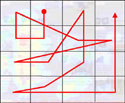
eyemovement

This is a map of how you read a web page. Not you you, but the aggregate “you.” Eyetrack originally started as an attempt to scientifically determine how people read newspapers, and worked by attaching a motion-sensitive device to people’s heads. Updated versions of the study track people’s eye movements as they read web sites by focusing lasers on their eyeballs.

The test equipment is able to draw visual paths showing actual eye movement, and there are some interesting surprises. People don’t scan up and down, or left to right. They start in the upper left corner and hover there for a while, looking for the most important information, then sort of zig-zag up and down, back and forth over the page, finishing in the upper right.
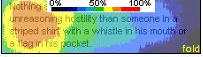
blurbthirdOf interest to both editors and designers: As people zig-zag, they don’t take in complete sentences, or even complete headlines; generally only the first few words of a headline are read before moving on. This heatmap is an aggregate view of how multiple test subjects focused on a blurb, the eye hovering primarily at the left side.

More potential surprises: Smaller type is more likely than large type to draw people into stories. If a headline is much larger than the blurb it accompanies, the blurb won’t get read — the headline is interpreted as self-sufficient. Underlined links and horizontal rules serve as barriers that discourage people from taking in the content directly below them. People do read “below the fold,” but scan content lower on the page very quickly, giving even less time to headlines and blurbs.

The power of images? People actually focus on text before images when both are present (although other studies contradict this). People often try to click on images, even when they’re not clickable. Bold-faced paragraphs leading into article bodies do get read.

No surprise: People ignore ads, and if they do see them, ads get about 0.5-1.5 seconds of attention per. Big ads are “seen” more than small ads.

Music: King Smiley :: Tipatone

Marumushi Newsmap

Google News aggregates vast numbers of news sites, and collects detailed stats on them in the process. Marumushi’s newsmap takes that data and displays it in a Flash-based, database-backed, Mondrian-inspired visual aggregator. The size of blocks on the map represents the number of publications out there covering the topic in some way, relative to other topics. The color of each block represents the broad category to which it belongs (business, technology, nation, etc.), and the shade of that color represents time delta (I don’t really understand this aspect — time since last scan? time the story has been on the map?). Roll over any block for a summary of the number of publications converging on that topic. Kind of a visual, interactive snapshot of the news Zeitgeist at any given moment.

Not sure I’d want to use this as a primary news portal, but it does offer a quick way to tap the mindset of the world’s collective publication editors.

Music: Brian Wilson :: Our Prayer/Gee