The creativity of spammers never ceases to amaze me. Received this overnight, smack in the middle of a dozen spammy comments that made it through Akismet (but not through the moderation layer):
Hello , my name is Richard and I know you get a lot of spammy comments , I can help you with this problem . I know a lot of spammers and I will ask them not to post on your site. It will reduce the volume of spam by 30-50%. In return Id like to ask you to put a link to my site on the index page of your site. The link will be small and your visitors will hardly notice it, its just done for higher rankings in search engines.
I feel so vulnerable, so helpless. I don’t know who to turn to for help. OK Richard, you’ve got a deal!
WP-Cache easily ranks among the top five of my most-used (and most critical!) WordPress plugins (static site performance with dynamic site behavior, and all that jazz). But last week, heard about another kind of WP-Cache — developer Ryan Boren planted a couple of ammo cans full of WordPress t-shirts in the middle of Almaden Quicksilver Park — and didn’t list them on geocaching.com. In other words, a little insider training :)
Don’t generally like to drive much for a geocache (it kind of taints the enviro aspect), but made an exception today – this just sounded like too much fun. A huge and beautiful park, and plenty of traditional caches in the area too. Made the trip with Miles this morning and ended up spending almost the entire day hiking.
Tracked down the shirts mid-day and there’s still a ton of ’em. No extra-smalls, so had to drape him in a small. The find was extra special because this was, coincidentally, our 100th find! Happy birthday to us, or something.
Stopped to eat Bunny Grahams and drink the last of the water (when will I learn?). Splashed each other in a creek. Found an entire deer skeleton (and brought the skull home in the bag my WP shirt came in). Dropped off some of the travel bugs we picked up in Minnesota. Ate peanut butter and honey sandwiches in the middle of the woods. Hiked our butts off (Miles did five full miles today!) Amazing views, very few people, great father-son day. Life is good.
OK, you already know this, but still fascinating to see the numbers spelled out. Your chances of dying in a plane crash are approximately 1 in 20,000; chances of dying in an auto accident roughly 1 in 100. And yet the thought of going down in a burning plane perpetually occupies a special fear-spot in the public imagination.
As our media wrings its hands relentlessly over the 11 victims of Minnesota’s Interstate 35 bridge collapse and the nine missing Utah coal miners, 42,000 people will die of cancer this month. “Meanwhile, 3,000 people, mostly sub-Saharan African children, will die today of malaria with nary an Associated Press story to spread the news.”
We care, but the diseases and the car wrecks that kill thousands of us every day are so common that they’re the opposite of news. They’re also usually too frightening to contemplate. Freak accidents, in contrast, are freakishly comforting.
Posted a while ago about the Moral Compass produced by some of our recently graduated students as part of the News 21 Initiative on the Future of Journalism (News21 is a collaborative effort between four J-Schools). This year’s theme is “Faces of Faith in America,” and the Berkeley piece of that is called “God, Sex, and Family.” Most of the content from all four schools is in now, and the project has shaped up as an extremely well-rounded snapshot of the myriad ways religion plays out in American life.
So much at the site I’m not sure what to point to (and I haven’t begun to read it all). The tent city multi-religion conference inside Second Life was incredibly ambitious (catch a full video snapshot of the event here), and the Data Road Trip provides some fascinating perspectives into everything from Bronx abortions to Arkansas divorce rates. I appreciated this brief interview with atheist Sam Harris, who (to my surprise) says he prefers not to be called an atheist: “atheism is not a good term because it requires defining oneself in opposition to an arbitrary group.” I really appreciated that he made the point that atheism does not imply not having a spiritual life.
Anyway, there’s tons there – dig in. And leave comments if you got ’em – the fellows would love to hear your feedback.
This is becoming (for me) the summer of pushing the envelope with WordPress – bending it to become a full content management system, rather than just a blogging tool. Between work and home, have been converting a couple of sites over the past few weeks – one from an old-school static site, and another from Movable Type to WordPress.
landwater.com represents the environmental and historic preservation law firm Rossmann and Moore – I’ve been working with them since forever. Their old static site (originally designed by baald, who comments here sometimes) has stood up to the years amazingly well, but it was time to move on. Now in WordPress, office assistants there can finally update the site without having to learn Dreamweaver or FTP. I love the way WP pages can become children of other pages. By nesting them, you get a hierarchal URL structure automatically, and can use the workhorse wp_list_pages() function to generate structured HTML lists, which in turn can be styled as CSS fly-out menus. Throw in the My Page Order plugin and non-tech editors can rearrange the hiearchy (and thus the menu system) via drag-and-drop. So elegant.
At work, have been on a mission to get all Movable Type sites converted to WordPress by the end of summer. The first of the two largest projects is pretty much done. North Gate News Online is the publishing arm of J-200, the journalism bootcamp all first-year students endure. The site has been a CPU-sucking Movable Type hog with a hideous design (my fault!) for years; as of today it’s majorly multimedia-enabled WordPress site with its own podcast feed (nothing there yet). This is a soft-launch; all the tech is ready and waiting for the next crop of J-200 students. OK, we’re showing too much roof, but the design is leaps and bounds beyond the old site. Using a ton of plugins to handle Flash, QuickTime movies, embedded audio, image pop-ups, etc. But most impressive is WP-Cache, which gives you the static page performance of MT combined with the dynamic page behavior of WordPress. Poetry.
The biggest WP challenge of the summer starts on Monday – total rebuild of China Digital Times, which has much more sophisticated needs. Looking forward to the challenge.
Google ad sales rep Lauren Turner spoke out against Michael Moore’s “Sicko” on a corporate blog, but didn’t stop there. She went on to tell the healthcare industry that Google was there to help them fight back. The industry could counter “Sicko,” she suggested, by buying Google ads promoting all of their good qualities.
I’m all for corporate blogging — transparency is good. In this case, what’s transparent is the fact that Google (or a Google employee – remember, this was a corporate blog, not a corporate statement) feels that advertising is a fine way for deep-pocketed corporations not just to sell products, but to cloud debate on an issue that affects the whole public sphere.
Machinist: But it wants us to believe that we should resolve public policy disputes through search marketing? Advertising is no longer just for selling soap — it’s for democracy, too. Note, first, the irony: Michael Moore accuses the industry of throwing up a haze of marketing, P.R. and lobbying to hide its practices, and Google tells Big Healthcare to respond by buying up more ads.
Turner later posted an apology for the post, but only for her error in framing Google’s policy on the blog; the idea of pushing AdWords/AdSense as a great way to shape public opinion, rather than just to sell products, stood.
Ignore this post if you’re not a WordPress user :)
There’s an interminable discussion going down on the WP-Hackers mailing list about one of those little semantic issues that snowballs perniciously into a major debate. WordPress’ back-end lets users manage URLs for inclusion in the sidebar. This area is usually used for the site’s blogroll, but many people use WordPress for non-bloggy purposes. The debate is over whether to title the administrative interface for this external URL manager “Links,” “Bookmarks,” or “Blogroll” (though “Blogroll” isn’t really on the table – that’s what it’s called now, and no one likes it).
There are a dozen good arguments on either side, but we’re trying to take the temperature of the WordPress user community. Helping out a bit by posting a poll here. Which term seems more intuitive / palatable / sensible to you?
&tConvening themes: The world viewed as a network of digital photographers collectively shooting every square inch of the globe, the ability to stitch those images together into a cohesive, navigable, continuous view, and the world-changing cognitive power of zooming through scale, now becoming commonplace.
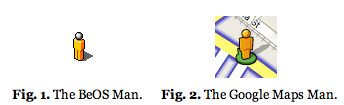
Dan Sandler points out that Google Street View (which is mind-blowing both in its power and its privacy implications) is not only one of the few Google apps to require Flash, it’s also “the first Google app to feature the Be Man:”
Thanks for the images Dan.
Humor, history, and coincidence aside, Street View changes the world, just a little bit for the better and a little bit for the worse. For the SF Chronicle, Mark Morford on Street View as invasive: I Can See Your Thong From Here:
Ah, Google, you great wicked benevolent super-cool vaguely disturbing Big Brother überbitch mega-company, quietly taking over the entire goddamn Net universe and most of the terrestrial world, too, one cool but simultaneously unnerving innovation at a time. … The question has been raised: How much is too much? How much implied privacy should we have as a society, as a community, as a city, and do we let this sort of technology run free simply because the draconian creepiness of it all is so easily offset by how damn fascinating and helpful and nifty a utility it so very obviously is?
Posted last August about Photosynth, a product emerging from Microsoft Labs designed not only to be a digital photo album conceptually way beyond iPhoto or Aperture, but that is also capable of intelligently stitching together images from disparate sources into zoom-able, photographic, 3-D representations of places on earth. In this video from a recent TED conference, Blaise Aguera y Arcas demonstrates a 3-D, navigable reconstruction of the cathedral at Notre Dame created by stitching together images scraped from Flickr — photos taken with everything from cell phones to high-quality SLRs, by photographers who have never met one another.
I’ve been playing a bit with Flickr Maps and looking more into the options for geotagging photos, but Photosynth blows the doors off the concepts of 2-D image-place connections, opening up a realm where all photographers on earth are unintentionally collaborating on a single, global, steerable, zoomable view that never ends.
Steven Berlin Johnson did a fascinating seminar for The Long Now Foundation (available both as podcast and as a summarized blog entry) on what he calls “the long zoom” — an entirely new way of grokking our world, started by the famous Powers of 10 and now becoming almost de rigeur thanks to emerging photo / video / vector technologies. What once blew your mind (and all previous senses of scale and proportion in the universe) with “Powers of 10” has become an increasingly commonplace quick swoop around Google Earth to find a business address.
Ryan Sholin knocks one out of the park: “10 obvious things about the future of newspapers you need to get through your head“. Pretty much mirrors a lot of lunchtime conversation at the J-School over the past few years, with the discussion seeming somewhat more urgent lately (because the writing is on the wall for dead-tree distribution). I liked #7 especially:
Bloggers aren’t an uneducated lynch mob unconcerned by facts. They’re your readers and your neighbors and if you play your cards right, your sources and your community moderators. If you really play it right, bloggers are the leaders of your networked reporting projects. Get over the whole bloggers vs. journalists thing, which has been pretty much settled since long before you stopped calling it a “Web blog†in your stories.
… though all of his points are spot-on. John Battelle has some interesting commentary in a similar vein. On where newspapers are falling down (this was directed at the SF Chronicle, but could be applied to many/most municipal papers):
400 reporters and what is the paper DOING with them? Not much, I’m afraid. The paper should OWN the Valley Tech story. Does it? No. It should OWN the biotech story. Does it? No. It should OWN the real estate/development story. Does it? No. It should OWN the California political story. Does it? No! … I agree that Google and others should be more engaged in helping shore up and – GASP – evolve the fourth estate. But assuming the way to do it is to support more of the same – the approach that gave us a bloated newsroom that puts out a product fewer and fewer people want to read each year – is to ask for tenure over evolution.
Claus Christian Malzahn for Spiegel Online, on how the quickest way for a German politician to win public cred and rise in the polls is to take a swipe at America.
Anti-Americanism is the wonder drug of German politics. If no one believes what you’re saying, take a swing at the Yanks and you’ll be shooting your way back up to the top of the opinion polls in no time. … Not a day passes in Germany when someone isn’t making the wildest claims, hurling the vilest insults or spreading the most outlandish conspiracy theories about the United States … For us Germans, the Americans are either too fat or too obsessed with exercise, too prudish or too pornographic, too religious or too nihilistic. In terms of history and foreign policy, the Americans have either been too isolationist or too imperialistic.
Not sure whether this correlates to Rufus Wainwright having recently moved from New York to Berlin, recording his disgust with the U.S., and rocketing up the European charts (“I’m so tired of America.”) Of course, German politicians may simply be using anti-Americanism as a popularity mechanism, while I don’t think Wainwright is doing that. Either way, the man in the mirror is looking pretty grisly. Those who still doubt that America’s image has been irreparably damaged must be wearing some mighty thick blinders.