My Drunk Kitchen

At the Knight Digital Media Center where I work, we depend on interns and assistants to accomplish a lot of what we do. We’ve had a lot of good ones over the years, but one of the best was Hannah Hart, aka Harto. Unfortunately for us, Hannah moved to NYC to become an assistant to one of the actors on 30 Rock… and to turn herself practically overnight into a minor celeb as host of her own YouTube channel, where she’s been working on the net-only cooking show My Drunk Kitchen.

MDK is recorded on a single MacBook webcam from her kitchen apartment while demonstrating cooking techniques for complicated “meals” like grilled cheese sandwiches and cookies – while getting completely and totally crocked on cheap champagne, wine, or whatever happens to be sitting around that day. Sound insane? Just you watch. It’s all about the repartee’.

Each episode starts off innocently enough, but by the time the prep is done, Hannah’s pretty much off her rocker, questioning whether anyone really knows what it means to “cream the butter” (“I’m sure they meant ‘cram’ – I’ll just cram the butter in here…”).

Hannah’s just launched her own web site, featuring all MDK episodes to date.

Kauai 2010

It’s sometimes said that Kauai is the last remaining vestige of “the old Hawaii” or “the real Hawaii” – the last bastion of island life as it was before much of it was taken over by hotel chains and tourism. Kauai isn’t without its share of commercialism, but it’s true that it’s almost entirely free of high-rise hotels, and that natural wonders abound.

At the same time, some of your old-school stereotypes about Hawaii just aren’t going to come true. Visitors are no longer greeted on the tarmac with a flower lei around the neck, you aren’t going to hear ukulele concerts or witness spontaneous hula dances on every corner, and luaus are no longer organic affairs where people sit around on the beach sipping Mai Tais and picking meat off a pit-grilled pig, scooping three-finger poi with bare hands.

To be fair, your visions of stereotypical Hawaiian nature are still real, while the stereotypes you may hold of Hawaiian culture are probably not.

Kauai is encircled – for the most part – by a single road running through a dozen or so major towns. You can drive around the entire island in a couple of hours (note that “driving through” does not equal “exploring,” and that driving the outer rim will only get you to the beach towns, not to the juicy jungles that comprise Kauai’s interior). I say “for the most part” because the insane terrain of the Napali coast has proven impenetrable to road builders – it’s simply not possible to build a drivable road through the mountains of the northwest coast.

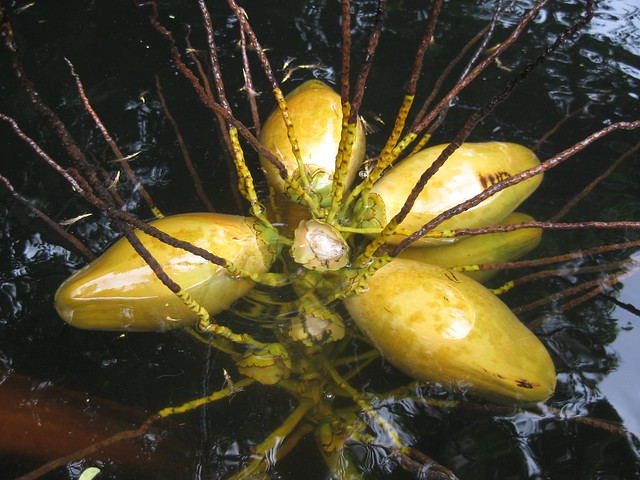
Coconuts in Water

You won’t find the “real” Kauai by hanging around in the downtown areas. But if you make an effort to get even a little off the beaten path, you will find yourself surrounded by nature at its most powerful. Kauai is a volcanic wonderland of dense jungle, incredible ocean life, succulent wild fruit, and loose chickens.

Throw yourself into the environment, and you won’t be able to avoid swimming in impossibly blue/green waters, inhaling the cleanest air your nostrils have ever encountered (remember you’re surrounded on all sides by thousands of miles of wild Pacific). You will find that the Aloha spirit is omnipresent and real. You will find yourself slowing down, being reminded why you’re walking this earth, and what nature at its most raw can do for your soul.

In June/July 2010, we spent two weeks in Kauai, staying in two different houses with two different families, in two very different environments. In the end, I shot more than a thousand photos. Thought I’d turn all my vacation notes and photos into a quick blog entry on return; the process ended up taking a couple of days — which was OK since I needed that time just to transition back to “real” life and get the hang of cold weather and the absence of snorkeling grounds outside my back door. Editing the photos down to a “mere” 470 and filling in the details from my notes turned out to be the perfect obsessive/compulsive transitional gig.

Photos: Here’s the Flickr standard photo set view, but much better is the Flickr lightbox view. I’ve also embedded a slideshow version below, but for best results dim the lights, put some Hawaiian music on the hi-fi, and put your browser in full-screen mode.

Note: I lost my camera on the very last day — turned out I left it under the seat in the rental car — so the set isn’t quite complete. Fortunately I had been backing up the camera’s contents to iPhoto throughout the trip, so had an almost complete set. Super-lucky news is that Budget Rent-a-Car in Lihue found the camera and is returning it to me; I’ll add the final images when it arrives. Thanks Budget!
Continue reading “Kauai 2010”

Maker Faire 2010

Miles and I have a perfect track record so far at Maker Faire, attending every year since its inception in 2006. This year was our fifth time out, though things took a slightly different turn this year. Rather than it being father/son bonding time, my extended family trekked out to the Bay Area for the experience. Corralling nine people meant a bit less explore time, so we saw less of the cornucopia, but what we did see was amazing, as always.

Highlights: RC-controlled neon land sharks chasing kids around in the dark. Tall bikes everywhere, including one with “roots” that could be deployed at the flip of a lever so the rider could stop at lights without toppling over. A grand steampunk calliope with half-sawn tubas, whoopee whistles, cuckoos, and tubes galore honking out a rendition of Yellow Submarine. The giant Tesla coils throwing lightning, but this time generating music at the same time (remember Hot Buttered’s “Popcorn?” Imagine that set to explosive blue electricity). A guy playing drums, didgeridoo and bass at the same time. 6-ft.-wide plates of paella. The life-size mousetrap, as always.

Unfortunately, the Wooden Bikes crowd was nowhere to be seen, and the Cyclecide crew’s human-powered carnival rides were shut down for a break when we arrived. Still, Maker Faire remains “Burning Man for families” – an explosion of creativity and weld joints like no other. Won’t be the last.

Took fewer photos than usual, but managed to put together an OK Flickr set.

Jaron Larnier Presentation

Loose notes from the SXSW 2010 session Untitled by Jaron Larnier.

Wasn’t sure what to expect from this session, which had no title and no description. But a few weeks ago, the photo professor at the J-School handed me a copy of Larnier’s new book You Are Not a Gadget, a sort of backlash manifesto against the digital age. Well, that’s not entirely fair — it’s not so much a backlash as it is a reasoned, thoughtful wander through some of the gotchas and backwaters of the digital age. Larnier talks about dignity, culture, black boxes, the history of our relationship to technology, mean-ness in online communities, and everything in between. His talk was as meandering as the book is, but inspirational and amazing at every turn. Though difficult to encapsulate, Larnier and his thread is something I feel everyone and tech should be listening to.

Continue reading “Jaron Larnier Presentation”

Joi Ito: Untitled (Saving the World)

Fantastic way to end the first full day of SXSW sessions, with a talk by Japanese activist, entrepreneur, and venture capitalist Joi Ito Untitled (Saving the World)

Social software hasn’t solved all the world’s problems, but the long term effects will be bigger than you think.

Key difference between the way the world was messed up in the past and the way it’s messed up now: Nonlinear complexity. It’s not necessarily better for the world in the long run if you make everything more efficient.
Continue reading “Joi Ito: Untitled (Saving the World)”

danah boyd: Privacy and Publicity

Loose notes from SXSW 2010 session by social network researcher danah boyd: Privacy and Publicity

Just because people put info in public places doesn’t mean it was meant to be aggregated. Just because something is public doesn’t mean people expect it to be publicized.

What people mean by privacy is more complicated than what can be summarized in a sound bite. A conversation with a friend could be spread by that friend. *Trust* is what allows us to go forward with the conversation. We don’t always navigate privacy well.

Continue reading “danah boyd: Privacy and Publicity”

Pile of Mulch and the Creative Commons

In September 2004, I posted a brief story about a honkin’ pile of mulch that had recently landed in our driveway, along with a couple of quick snapshots.

Five years later (i.e. last week) I was contacted by a nice woman at a film production company who were making a film for Microsoft about a Boy Scout tracking mulch sales with an Excel spreadsheet. They wanted to use my image in the film and were prepared to pay me $250 for the rights to use the photo. While flattered, I have serious ethical issues with both the Boy Scouts (of today) and Microsoft, so my first inclination was to go ahead and take the money. But I have another ethical issue that outweighs those – the idea that I deserve to be paid for a snapshot I took four years ago.

I am not a professional photographer, and I did not take the photo with artistic or resale value in mind. The photo was only taken to support that brief blog entry. Its small amount of value was used up in that post, and I was paid for my small efforts with the equally small amount of attention it received (yes, we live in an attention economy now).

In my work, I benefit tremendously from the efforts of people who give away their work. My career would simply not be possible without the thousands of hours that have gone into Apache, MySQL, Firefox, PHP, Python, Django, etc. Likewise, I am studious about giving away the source code to the projects I put time into. I benefit from blog posts by people who are solving problems, and I try to repay that debt in some small way. In other spheres, all of this would be considered “intellectual property” with a monetary value. In the open source software world, it’s called “the free exchange of ideas,” and it makes the modern world go ’round.

I believe that we all stand on the shoulders of those who have gone before us, and our peers. Our culture is built on quotations – an endless re-use and re-mix of ideas exchanged between people. While I support an artist’s right to earn a living, I have serious problems with the idea that a 3-second snapshot is somehow worth more than dozens hours of time put into code. I believe an artist has a right to be paid for their initial work, but not to be paid again and again in perpetuity for that work. If an artist wants to keep making money, they should have to keep doing new work, like the rest of us laborers do. The idea that a person can put work into something once and then feel entitled to keep making money from it forever feels unfair. It smacks of a world that values money over ideas. That’s a problem I don’t want to be a part of.

I feel that copyright should exist for a very brief period of time — just long enough for the artist to recoup their efforts before moving on to the next thing — not the 70+ years Disney has pushed it out to. How long should that period be? I don’t know – I suppose just long enough so that consumers don’t say “I’m not going to buy that record – I’ll just wait until it enters the public domain.” So… five years? Maybe. Why are we still battling over the hugely valuable Beatles catalog? The band isn’t even together anymore – that music should have entered the public domain decades ago.

Cc-Attribution To accept money for this snapshot would have felt hypocritical. A couple of friends worked on me last night, trying to convince me that the marketplace, not the creator, should set the value for the work. Their arguments almost worked. And of course the money would be nice. But in the end, I decided to stick to my guns and publish the piece on Flickr with the attached Creative Commons Attribution license, which requires nothing but credit to the artist, even for commercial use.

I’m sorry to learn that the photo is being used by Microsoft and the Boy Scouts, but confident in my decision that to accept money for it would make me part of the larger copyright over-extension problem. If I believe that ideas should be free, and that a photograph is an idea, then I need to back up that belief by NOT accepting money I don’t deserve for for an old snapshot that took close to zero time, effort, or inspiration to create.

At bottom, I don’t feel that Microsoft or the Boy Scouts should have to ask for my permission to use the photo to begin with. They should be able to proceed on a cultural understanding that that photo is nothing but a speck of dust in our cultural landscape, and know that they can use it as freely as we use the English language in our daily speech. The fact that they “have” to ask permission is exactly what’s meant by the term chilling effects.

So, Julie, please use the image in your film however you like. A line of credit is all that’s required. As it should be.

Music: Ornette Coleman :: Sleep Talking

Sow, grow, harvest, cook

I’m very taken by the mission statement of the East Bay School for Boys:

By the time he graduates, each boy will:

Examine and acknowledge his own learning strengths and weaknesses and set personal learning goals; collaborate in a community-oriented, project-based internship experience; conduct a conversation in a foreign language about something that he reads in that language; disassemble, diagram, rebuild, and write instructions for something electrical or mechanical; write a cogent persuasive piece on a matter of personal importance; analyze a meaningful passage of another’s writing and declaim it with passion and from memory; sow, grow, harvest, cook and eat his own vegetable; solve a challenging problem in a team; take a leadership role in a project, event or activity of significance; By performing the appropriate research, determine whether a statement by a public official is true; assess media coverage of an issue or event from various perspectives; hold and care for a newborn baby; demonstrate by something measurable a commitment to creating a more sustainable future; conduct a scientific experiment, collect and record empirical data, and produce a written summary of the results with sound scientific conclusions; participate in a physical team competition; mentor another boy in something in which he feels confident; and produce or perform a work of art.

Imagine what the world would look like if every boy and girl in the United States (or world?) could graduate saying he could do all of these things. How would things be different than they are today?

Cognitive Surplus

There’s an expression I hear a bit too often, in reference to other people’s chosen pastimes. It’s usually used in a negative sense, and more often than not, the pastimes being referred to are things like blogging, or Twittering.

“People have too much time on their hands” … or …  “Where do people find the time?”

Clay Shirky had a similar conversation recently, regarding the thousands of people who spend their free time culling, cultivating, editing, and massaging the vast fount of human knowledge that is Wikipedia.

“Where do people find the time?” A fair question, until you look at it in comparison to the amount of time people spend watching television. As it turns out, Wikipedia represents, collectively, about 100 million hours of thought. Meanwhile, watching television consumes around two hundred billion hours, in the U.S. alone, every year.

So how big is that surplus? So if you take Wikipedia as a kind of unit, all of Wikipedia, the whole project–every page, every edit, every talk page, every line of code, in every language that Wikipedia exists in–that represents something like the cumulation of 100 million hours of human thought. I worked this out with Martin Wattenberg at IBM; it’s a back-of-the-envelope calculation, but it’s the right order of magnitude, about 100 million hours of thought. And television watching? Two hundred billion hours, in the U.S. alone, every year. Put another way, now that we have a unit, that’s 2,000 Wikipedia projects a year spent watching television. Or put still another way, in the U.S., we spend 100 million hours every weekend, just watching the ads. This is a pretty big surplus. People asking, “Where do they find the time?” when they’re looking at things like Wikipedia don’t understand how tiny that entire project is.

Shirky is talking about this in terms of “cognitive surplus” — all the brain power that’s sitting idle in a consumptive state, rather than a productive state. That’s not quite fair – we all need to consume information if we’re going to produce information. And oh yeah – we all owe ourselves a bit of “veg time” every day. But before you ask the question “where do people find the time” in regards to any person’s pastime that doesn’t interest you personally, remember that the average American watches 8+ hours of TV per day.

That in itself is a stunning statistic, and I’m not sure how to digest it – if you subtract time for work, school, eating, etc. I can’t see how a person could even watch two hours per day (I’m guessing that a lot of people simply leave the TV on all the time), but still. That’s a whole lot of cognitive surplus.