
Spent an incredible day Sunday traipsing around Angel Island with family and friends, immersed in the We Players’ interpretation of Homer’s Odyssey. Not so much a retelling of the whole story (which would be impossible) as an impressionistic series of vignettes, acted out in the many strange and wonderful old buildings scattered around the island. The audience hikes between settings (five miles total), with the players acting out bits and pieces of the opus in and amongst the audience – performing soliloquies, celebrations, music and poetry culled from the amazing 1200-year-old story of a hero’s voyage.

Wikipedia and Education
Amazing infographic digging into the size and scope of Wikipedia, especially as it relates to its use in schools. Interesting to see the decline in the number of teachers who prohibit the use of Wikipedia in research.

Via: Open-Site.org
Via OpenSite
Wow, this just stopped me cold
In July 2010 I posted a writeup of my family’s experience in Kauai, which I found physically and spiritually cleansing (linked below). Tonight, I received the following comment, and am just not sure how to respond. It’s a bit racist, and full of obviously gross generalizations. But there’s a part of me that understands where this is coming from – a heart that just wants the old ways back, wants Hawaii back.
“Your race is a pestilence to my people, our culture and OUR way of life. Your stench has been filling our nostrils since the arrival of your kind. Your exploitation, your perversion and your robbery of our history and our land makes me sick. IÊ»m glad you had a nice time galavanting around the land of my fathers and mothers, IÊ»m glad you had fun seeing our wonderful island in all its beauty and thinking you have a right to even look upon it. I shall remember your trip, and your pictures, and when you return, for scourge always does, you will get no respect, no hospitality from me or my ohana, who outnumber all the citizens of KauaÊ»i.”

Kauai 2010 | scot hacker’s foobar blog
It’s sometimes said that Kauai is the last remaining vestige of “the old Hawaii†or “the real Hawaii†– the last bastion of island life as it was before much of it was taken over by hotel chains a…
The Fireplace Delusion
The Fireplace Delusion – Fascinating as a piece of science, and also as a metaphor for considering what we grapple with when contemplating religion.
Reshared post from +John Poteet
Normally I think Sam Harris is an asshole; except sometime he nails it.
Embedded Link

The Fireplace Delusion :
Sam Harris
Sam Harris, neuroscientist and author of the New York Times bestsellers, The End of Faith, Letter to a Christian Nation, and The Moral Landscape.
Mr. Daisey and the Apple Factory – It’s About Us
This American Life is pretty much always great, but this podcast – covering one man’s journey into the Chinese factories that make our tech products – affected me deeply.
Mr. Daisey and the Apple Factory
 Heartbreaking and fascinating, seriously worth 45 minutes of your life. Stories of extraordinarily long hours, child labor, and repetitive stress injuries that make our own seem like hangnails in comparison. Stories of people assembling parts as small as human hairs by hand for 16 hours at a stretch, stories of people working with their hands until their bones simply crumble (and they’re out of work for life). Stories of experiments with neurotoxins like hexane being done on unwitting human workers. It goes on and on.
But listen through to the last ten minutes, where the emotional impact, and the anger the story generates, Â is sort of qualified by observations of economic realities in China: “Hundreds of thousands of Chinese choose the grimness of factory life over the grimness of the rice paddies.”
I remember when the suicide nets went up around the Foxconn factory, and the simplistic reactions people had to their existence. But some perspective helps – the truth is, China as a whole has one of the highest suicide rates in the world, while those rates are actually lower in factory cities like Chengdu than they are in the rest of the country. And Foxconn is doing the right thing by trying to prevent them – that’s a good thing, not an example of Foxconn simply accepting suicide as a cost of doing business.
But while Apple is  a sexy centerpoint for the story, it’s important to remember that this isn’t really a story about Apple – virtually every single technology product we buy, from DVD players to smartphones to game consoles to blenders, is made under similar conditions.
Actually, this isn’t even a story about the human cost of our enjoyment of technology. Virtually everything on the shelves at Walmart and Target is made in China. The clothes on your back, that car you drive… chances are high those things were made in conditions that are similar or worse than those at Foxconn. It’s not about Apple – it’s about us (ZDNet’s Larry Dignan does a good job widening the scope of the story in this post).
The popularity of this story is an opportunity for the west to reflect on the implications of its addiction to cheap products in general. We’ve grown into  a dangerous symbiotic relationship with China – we can’t shake the allure of cheap products, and they can’t shake the allure of jobs for their citizens. Your cheap jeans create jobs for peasants. And if we were somehow to bring those jobs back to the U.S., we would be throwing those peasants back into the poverty they’ve partially escaped in the past decade. Reality is messy.
Coupled with a recent NY Times piece covering the same topic, it’s been a hard week for Apple, who are scrambling to do spin control. But whether this is an Apple problem or a larger problem of our addiction to cheap goods, Apple could be stepping up as a leader in making a difference here. With the company’s insane bankroll, they could and should be doing more to affect manufacturing conditions.
What about you? Would you be willing to pay 50% more for an iPhone or an HP laptop if it meant you knew it was made in the U.S., under different conditions?
R.I.P. Christopher Hitchens
I got to see Hitchens debate former J-School dean Orville Schell during the height of the Iraq war, and found him a puzzle, as one often does when you agree with exactly half of what someone really smart is saying.
Embedded Link

Christopher Hitchens Is Dead at 62 — Obituary
Mr. Hitchens wrote in the tradition of Thomas Paine and George Orwell and trained his sights on targets as various as Henry Kissinger, the British monarchy and Mother Teresa.
1.5 Million Twitter Users on “A Steve Jobs of Religion”
Came across what I thought was an interesting piece in the New York Times, Americans: Undecided About God?, about the rising percentage of Americans who declare their religious/spiritual affiliation as “None” but who still feel a personal need for the connectedness that organized religion brings. In it, the author (Eric Weiner) made the perhaps too-flip remark:
“We need a Steve Jobs of religion. Someone who can invent not a new religion but a new way of being religious.”
The article was about a lot of stuff, and the Steve Jobs reference was just an aside, an analogy. But that’s the bit I quoted in a Tweet …
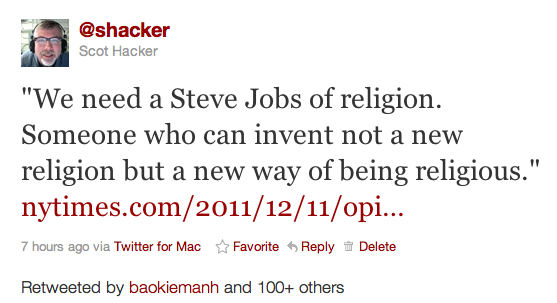
not because I necessarily agreed or disagreed, but because I thought it was an intriguing thought. Nothing more, nothing less. What happened next was an interesting lesson in just how little attention people pay, and how ready people are to unload half-cocked thoughts, work from assumptions, and to have loud opinions without bothering to actually, you know, read. Because a few minutes later, Tim O’Reilly retweeted the quote to his 1.5 million followers, and the switchboard lit up.

I’ve stitched together a bunch of screenshots to show what the stream looked like, which is quite amazing (see below).
Continue reading “1.5 Million Twitter Users on “A Steve Jobs of Religion””
Hallejuah
Stopped to watch a bearded guy playing a fantastic acoustic cover of Leonard Cohen’s “Hallejuah” (via Jeff Buckley). Really getting swept up in it, when a Muslim dude came by, realized it was prayer time, got down on his knees and started praying to the East, praising Allah. Thing was, he was just a few feet in front of a BART ticket machine, so it kind of looked like he was praying to a mechano. All very surreal and beautiful.
Audrey Hepburn with coffee cups
Spotted in a cafe’ last night. Like encountering a real-world collage of a classic image and mundane objects.

90% of people can’t find a word on a web page
90% of people can't find a word on a web page.
Embedded Link

Why Don't We Teach Kids How to Use CTRL+F? – Education – GOOD
Teaching students how to use a book index is great, but what about how to use a computer or do internet research?