Interesting video produced by the Introduction to Cultural Anthropology class (Spring 2007) at Kansas State:
Speaks for itself. More at mediatedcultures.net.
See also: 60 Minutes‘ report on the Millenial generation – an eye opener.

Tilting at windmills for a better tomorrow.
Interesting video produced by the Introduction to Cultural Anthropology class (Spring 2007) at Kansas State:
Speaks for itself. More at mediatedcultures.net.
See also: 60 Minutes‘ report on the Millenial generation – an eye opener.
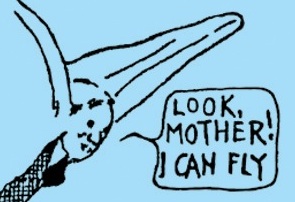
The Complete Dream of The Rarebit Fiend is a gorgeous, exhaustive, self-published collection of Winsor McCay’s sophisticated, literally fantastic newspaper comic strip (1904-11). It’s edited by independent scholar Ulrich Merkl, available only from Merkl’s website.
Glenn’s audio slideshow for the Globe “demonstrates the influence of McCay’s imagination and sense of humor on five films in particular: the 1930 surrealist classic “L’Age d’Or,” “King Kong,” “Dumbo,” “Mary Poppins,” and “Charlie and the Chocolate Factory.” ”
This is the same Winsor McCay who was the author of Little Nemo in Slumberland – the incredible early-century comic that ran in the Sunday papers when our grandparents were young. I bought a large-format reprint of those comics for Amy a couple of years ago, and it continues to inspire (though its ridiculous size defies its being filed in any bookshelf known to man).
For the Boston Globe, Hermenaut‘s Josh Glenn got Boing-Boing‘s Mark Fraunfelder to decode some of the icons that frequently appear on the world’s most popular blog. Hey, any video stream that can display the face of J.R. Bob Dobbs without going to snow is champ in my book. Hmmm… would love to hear Dawkins or Hitchens comment on the Church of the Subgenius sometime.
Former J-School students Anna Sussman and Jonathan Jones are traveling the world as backpack journalists, and shot this image of the Dalai Lama on a sticker on the dashboard of a taxi floating around Darjeeling. Sage advice to keep surfing those cosmic waves.
Jonathan recently wrote a piece for the San Francisco Chronicle on how American Idol’s Indian counterpart Indian Idol has become a platform for rivalry between many of India’s 2,000 ethnic groups.
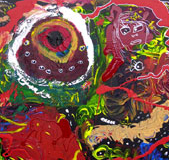
Whoa: 4-year-old painting prodigy Marla Olmstead creates abstracts on canvas that are so expressive, and so visually penetrating, and so comfortable with themselves… her mind is exactly where so many artists want to be – connected directly to her inner life, but completely unburdened by expectations of the art world that’s falling all over itself to buy her work.
Watching her paint, she’s got this rhythm, this ease. All four-year-olds are un-self-conscious in the adult sense, of course, and all are in touch with their “inner child” (whatever that means), but Marla is working on canvases larger than herself, and creating works that stand on their own against paintings done by people who have been painting for decades, trying to achieve something like what she does in pure play. Her paintings have been compared to “legends like Pollock, Miró, Klee and Kandinsky and had sold for first hundreds and then thousands of dollars.”
OK, except Marla is now seven (still painting) and a new documentary film about her gift has just been released. I haven’t seen it. But it gets tricky: Salon’s My Kid Could Paint That looks at the controversies unearthed in the making of the film, which have some people wondering just how “pure” Marla’s paintings really are, how much coaching she might have received, etc.
I have two thoughts:
1) No amount of “coaching” or “direction” given to a 4-year-old is going to affect the kind of artwork they make in any substantial way. In small ways, sure, but the fact that her father apparently sometimes gave her certain kinds of encouragement while painting does nothing to change the fact that her gift is genuine.
2) Whatever the truth behind Marla turns out to be, her amazing creative gifts are being permanently affected – possibly marred – by mass media attention and the self-consciousness that will bring.
I do want to see the film though – sounds like it raises some interesting discussion:
As New York Times art critic Michael Kimmelman discusses in the film, Marla’s story appealed to two contradictory popular prejudices. First of these is the idea of prodigal artistic talent as a lottery prize handed out to random toddlers by God. Second is the notion that modern art (at least in its abstract or nonfigurative guises) is a pseudo-intellectual con game that has no standards and conveys no meaning, so the apparent success of a 4-year-old debunks the whole enterprise.
Interesting that every single painting in her online gallery is marked “sold.” But I try to put myself in her parents’ shoes. If I had a kid who could paint like that, what would I do? Shield him/her from the world? Keep the talent a secret? Is what I think I would do what I would really do?
I am feeling at peace, and sort of speechless after having just watched Ron Fricke’s 1992 film Baraka, a follow-on to his 1983 journey Koyaanisqatsi. No words (but not silent), no script, no actors or plot. Just existential film imagery from seemingly half the countries in the world, depicting humans in all their meditative, strange, indescribably gorgeous religious splendor, juxtaposed with footage of humans in all their violent, herd-like, strange, indescribably gorgeous cultural porridge.
Baraka is, ultimately, an environmental film, but not in the way we’ve come to think of the term – it’s about the environment of our existence, our ways of being in (and with, and without) the world. There is an environmental subtext in a more traditional sense as well, but that’s not Fricke’s primary thought – it’s more about human life and the myriad ways our quest for meaning manifests.
The wisdom of making such a film without words cannot be underestimated. While there are many sequences that leave you dying to know more about what you’re seeing, any speech or text would have diluted the experience by intellectualizing something intensely experiential.
Watching Baraka had me revisiting thoughts on religion I’ve expressed over the past year. Religion is strange and arbitrary, but only because existence is strange and arbitrary. Our world is ineffable, and so therefore are our expressions of it. Religion is no more irrational than being in the world is.
I feel peaceful tonight, in a way I have not for a long time. I’ve been living in stress for months on end, feeling my nerves begin to fray, my mind atrophy as external inputs have all but ceased. Watching Baraka made me want to travel the world, open my eyes, close them, then open them again. It made me want to taste dirt, stare into the sun, kiss every human, sing Ketjak, wander through the desert, taste every food, scale the pyramids, swing from vines, paint my body, read every scripture.
I feel washed.
Artist Norm Magnusson has been creating cast aluminum sculptures in the style of classic historical markers, but focused on contemporary issues.

Taking observations that may once have been chilling but by now have become old news, and casting them in metal as if they were some kind of official state declaration somehow makes them affect one all over again, like this one did me:
ON THIS SITE STOOD RY BRAUER, TYPICAL AMERICAN TEEN. BY THE AGE OF 18, HE HAD WITNESSED OVER 30,000 MURDERS ON TV
Others focus on institutions that “once stood,” rather than on individuals:

OK, you already know this, but still fascinating to see the numbers spelled out. Your chances of dying in a plane crash are approximately 1 in 20,000; chances of dying in an auto accident roughly 1 in 100. And yet the thought of going down in a burning plane perpetually occupies a special fear-spot in the public imagination.
As our media wrings its hands relentlessly over the 11 victims of Minnesota’s Interstate 35 bridge collapse and the nine missing Utah coal miners, 42,000 people will die of cancer this month. “Meanwhile, 3,000 people, mostly sub-Saharan African children, will die today of malaria with nary an Associated Press story to spread the news.”
We care, but the diseases and the car wrecks that kill thousands of us every day are so common that they’re the opposite of news. They’re also usually too frightening to contemplate. Freak accidents, in contrast, are freakishly comforting.
As the neocon backlash continues to swell, the “I told you so” temptation grows. Liberals: Right about the environment, right about the war. On a similar tack, the always astute (though often overly wordy) Mark Morford, for the SF Chronicle:
The hippies had it right all along.
All this hot enthusiasm for healing the planet and eating whole foods and avoiding chemicals and working with nature and developing the self? Came from the hippies. Alternative health? Hippies. Green cotton? Hippies. Reclaimed wood? Recycling? Humane treatment of animals? Medical pot? Alternative energy? Natural childbirth? Non-GMA seeds? It came from the granola types (who, of course, absorbed much of it from ancient cultures), from the alternative worldviews, from the underground and the sidelines and from far off the grid and it’s about time the media, the politicians, the culture as a whole sent out a big, hemp-covered apology.
Here’s a suggestion, from one of my more astute ex-hippie readers: Instead of issuing carbon credits so industrial polluters can clear their collective corporate conscience, maybe, to help offset all the damage they’ve done to the soul of the planet all these years, these commercial cretins should instead buy some karma credits from the former hippies themselves. You know, from those who’ve been working for the health of the planet, quite thanklessly, for 50 years and who have, as a result, built up quite a storehouse of good karma. You think?
via Tim Bishop
Posted a while ago about the Moral Compass produced by some of our recently graduated students as part of the News 21 Initiative on the Future of Journalism (News21 is a collaborative effort between four J-Schools). This year’s theme is “Faces of Faith in America,” and the Berkeley piece of that is called “God, Sex, and Family.” Most of the content from all four schools is in now, and the project has shaped up as an extremely well-rounded snapshot of the myriad ways religion plays out in American life.
So much at the site I’m not sure what to point to (and I haven’t begun to read it all). The tent city multi-religion conference inside Second Life was incredibly ambitious (catch a full video snapshot of the event here), and the Data Road Trip provides some fascinating perspectives into everything from Bronx abortions to Arkansas divorce rates. I appreciated this brief interview with atheist Sam Harris, who (to my surprise) says he prefers not to be called an atheist: “atheism is not a good term because it requires defining oneself in opposition to an arbitrary group.” I really appreciated that he made the point that atheism does not imply not having a spiritual life.
Anyway, there’s tons there – dig in. And leave comments if you got ’em – the fellows would love to hear your feedback.