The untold story of how NASA excluded black Americans… and how the Negro American Space Society of Astronauts got to the moon a full three years before whites took all the credit. The Old Negro Space Program (55 MB, worth it).
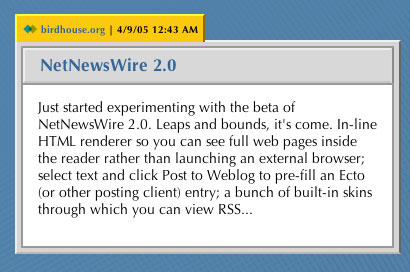
NetNewsWire 2.0
Just started experimenting with the beta of NetNewsWire 2.0. Leaps and bounds, it’s come. In-line HTML renderer so you can see full web pages inside the reader rather than launching an external browser; select text and click Post to Weblog to pre-fill an Ecto (or other posting client) entry; a bunch of built-in skins through which you can view RSS entries (I’m reading through the BeBox skin now… memories!), subscriptions to de.liciou.us and Flickr tags, tabbed views, etc. Every now and then you find a piece of software that just sparkles with excellence. NNW’s got that sparkle.

Update: I just pulled down “Show Sites Drawer” in NNW2 and was surprised to see that birdhouse.org is among the list of blogs built into the application itself. Way to go, me!
Roboscalper
Ticket scalping is legal in California, I learned from an East Bay Express piece. When you think about it, why shouldn’t anyone be able to buy any item from a store and sell it on the open market at a higher price? And why should tickets be regarded differently from any other meatspace item in this regard?
But traditional scalpers are being trumped by digital scalpers, as computer software evolves with the ability to defeat human detection software. If software can crack a captcha image and buy tickets online on behalf of its master, a stadium can be sold out in minutes. That’s exactly what happened when U2 tickets went on sale recently and Ticketmaster servers were hammered with two million hits per second.
Trying to figure out why anyone would go to see U2 on purpose, let alone pay money to do so, is beside the point. The question is, is asking computers to go get a bunch of tickets for you qualitatively different from asking a bunch of friends to go stand in line hours before Ticketmaster’s doors open? It’s kind of like comparing MP3 trading to the old days of taping. The principle is the same, but the difference in quantity is so immense that you effectively have a qualitative difference.
Laws will change.
Thomas the Marketing Machine
It’s time to talk about Thomas the Tank Engine.
If you don’t have a young child, quick introduction: Thomas is based on a series of children’s books started in 1942 by the Rev. W. Awdry to entertain a sick young boy. Today, Thomas is a multi-million-dollar empire of books, wooden trains, and TV shows / videos. The Thomas universe consists of a group of engines and coaches living together on “The Island of Sodor” where they get into trouble, help one another, take pride in being “Really Useful,” learn important lessons about cooperation, bravery, friendship, and self esteem. What makes the Thomas railroad different from a “typical” children’s railroad is the fact that all of the engines and coaches have faces, personalities, strengths and weaknesses, modes of interaction that mimic (the better aspects of) society at large.
Continue reading “Thomas the Marketing Machine”
MT-Keystrokes
Rewinding a bit on the new comment registration required policy, have decided to experiment with MT-Keystrokes, a Movable Type plugin that inserts JavaScript into pages which looks for actual keystroke input into form fields. All the captcha goodness, without the accessibility problems raised by image captchas.
So… the comment form is back in plain view for now. Will run this way for a while; if successful, could end up sticking with it and backing off on the registration policy for customers. Will have to wait and see whether spambots end up at the doorstep.
Thanks Nick
Brokaw Lunch
Had the pleasure of sitting in on an impromptu lunch visit by Tom Brokaw to the J-School, who spoke off-the-cuff on a variety of topics and answered questions posed by students. I knew he was an articulate speaker, but was amazed at his insightfulness — reflective, provocative, even-handed. A few quotes from memory (wish I had taken notes):
On the persistent stonewalling of the press by the Bush Administration: “This is nothing new, and has always happened during Republican administrations. Republicans tend to run their ships like corporations, with an accompanying degree of secrecy. Democratic administrations tend to run themselves more like sophomore dorms.”
On video games that integrate the daily news into combat and other scenarios, letting users “play” the news: “I’ve always been a free-speech absolutist, but technology lets speech come crashing down into society in ways that it never has before…” (he went on to talk about the absence of quality editorial oversight in “information sources” such as video games).
On the slow-but-steady adoption of the internet by mainstream news organizations: “Given the tremendous possibilities for new ways to present information, traditional media have shown an astonishing lack of imagination…”
On the notion that news was of a higher overall caliber 30 years ago. “A great deal of it was totally one-dimensional, e.g. ‘There’s a be-in in Golden Gate Park today, here are all the freaks on public display.’ Much national news was presented through the prism of a bunch of middle-age white guys pulling levers from the East coast.”
On the popularity of commentators such as Bill O’Reilly: “On a big night, O’Reilly pulls three million viewers. I consistently pulled 10 million on a routine night.” (He took care not to sound like he was bragging, just putting the numbers in perspective).
Fascinating afternoon.
Y!Q on SearchBlog
Yahoo! has a new live search function called Y!Q that lets site owners embed marked links into sections of web pages. Users clicking the links get a small popup box with top contextualized results. Because blogs etc. deal with multiple topics per page, Y!Q lets you cordon off sections with DIV classes which interact with a JavaScript library. If you use a publishing system like Movable Type, it’s a simple matter of surrounding the summary insertion code with appropriate Y!Q tags and rebuilding. Pretty nifty, though it does add a bit of weight to pages.
Implemented Y!Q for John Battelle’s SearchBlog today.
Pardon Our Dust
Birdhouse is in the middle of an ongoing transition to a new server. As of tonight, I’ve moved about half of our customer domains over, and all is well. Tonight I moved birdhouse.org (and hosting.birdhouse.org) to the new box (pardon our dust if you stopped by during the transition; had to fix a few paths in the blog).
Multiple reasons for the transition:
One is speed; the new server is beefier, studlier, mas macho. Just moving from a 1.7GHz Celeron to a 2.4GHz P4 doesn’t sound that dramatic, but try commenting — we’ve gained about 5x performance in some operations. Still 1 GB RAM, still redundant 80 GB drives.
Another is ease of use (both for me and for customers). Control panels are becoming the norm for consumer hosting, and we didn’t have one. By moving into a truly massive datacenter (20,000 servers, anyone?), we’re able to piggy back on economies of scale – we’re now using cPanel/WHM for most account management tasks (sadly replacing all of the blood sweat and tears, home-brew shell and PHP scripts I had built to manage the old server). Same goes for Urchin stats to augment awstats, which we provide now (awstats will remain the main stats package). Same goes for the Fantastico über-installer (customers can now set up their own galleries, guest books, and weblogs rather than relying on me…)
Another is email. I’ve grown to truly love CommuniGate Pro. It’s fast, it’s solid, it’s supported, it’s used by some of the biggest ISPs in the industry. But I pay per-seat for the CGP license, and Stalker recently doubled their fees (“focusing on the enterprise, blah blah blah”). If you’ve ever wondered why some hosts offer 30 email addresses where Birdhouse offers 3, now you now. As a small host, I can’t afford to compete without doing everything open source. cPanel will allow me to offer a butt-load more addresses per customer, and provides integrated mail management for customers so I don’t have to provision and customize accounts for them. That’s groovy, but not without a downside — I’m spoiled by the completeness of CGP by now, and have been less-than-impressed at the comparative absence of controls in cPanel that Stalker builds in, and annoyed by certain assumptions cPanel makes. But overall, this move is a big win for Birdhouse mail users — more accounts, more user-level control, better customer interfaces. Sometimes you eat the bear, sometimes the bear eats you.
The cPanel system works so differently than from a vanilla server that it’s been impossible to move everyone over en masse, so I’m transitioning one account at at time. We’ll get there soon, and I’ll be able to breathe again. Famous last words.

WordPress Link Farm
David Weinberger has an interesting post on the discovery that the WordPress web site has been hiding a link farm in their pages, gaming Google for profit and, in the process, weakening the effectiveness of one of our most useful tools.
So, IMO, WordPress made a mistake. The mistake definitely wasn’t making money. It was making money in a way that works against the interests of the Web community.
I Can’t Roll My Eyes Hard Enough
Last week, cleaning up after a catered event at work, noticed that people were throwing away some large, very solid, easily-reusable serving platters. I asked, “Doesn’t the catering company want them back? Shouldn’t we save them?” Response: “Nahhh…” And that was it. I said something about landfills, and the janitor rolled his eyes at me, looking for confirmation from another person in the room that I was, indeed, crazy.
This week, a team of 1,300 scientists has released the most comprehensive analysis ever conducted of how the world’s oceans, dry lands, forests and species interact and depend on one another.
Many of the world’s ecosystems are in danger and might not support future generations unless radical measures are implemented to protect and revive them. The five-year study, commissioned by the United Nations and a number of businesses and independent groups, arrived at a mixed prognosis for planet Earth: Its deteriorating environmental health still is treatable, but only with aggressive and expensive corrective measures. In the 219-page report, scientists looked at 24 different “services” the Earth’s ecosystem provided people and found that 15 of them are in trouble. … “Human actions are depleting Earth’s natural capital, putting such strain on the environment that the ability of the planet’s ecosystems to sustain future generations can no longer be taken for granted,” the authors said.
And still, the merest suggestion of care causes half of America to roll its collective eyeballs.